[pageLogInLogOut]

#Spinning

Spinning corespun yarns with SSM Dual Core
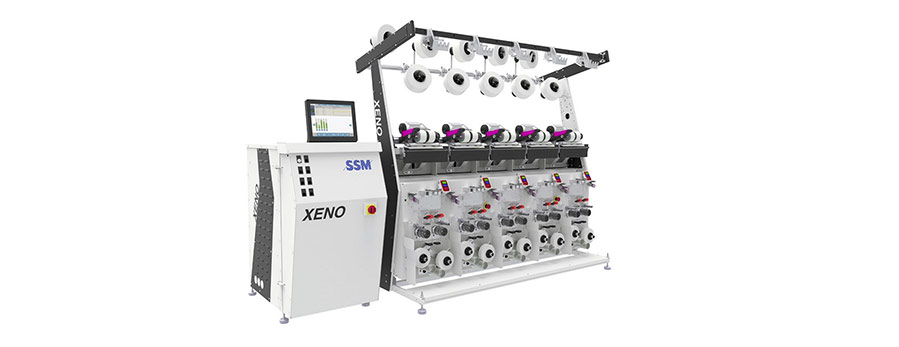
Air covering machine SSM XENO-AC TWIN for producing core yarns with a dual or triple core © 2021 SSM
In the past, items of clothing such as jeans were produced purely from cotton. Some time ago now, elastic woven fabrics became established in the clothing industry thanks to their positive characteristics. To produce these elastic yarns, so-called corespun yarns with a dual core that are spun on a ring spinning machine are used for weft threads and sometimes also warp threads. Due to the increased demand for elastic yarns, traditional ring spinning mills are upgrading their machines to compete in this market.

Corespun yarns that are used to produce woven stretch fabrics consist of an elastic core with a second spinnable fibre wrapped around its entire length. The core can only be made from elastane. Or alternatively, it is made from an elastane yarn and a textured filament yarn. This is known as a “dual-core yarn”. Today, there is even a trend for making the core from two elastane yarns with different drafts and yarn counts together with a textured filament yarn. These “triple-core yarns” further improve the characteristics of these woven stretch fabrics in terms of their stretch and shape-retaining characteristics.

Two Production Possibilities

There are essentially two methods of producing corespun yarns with a dual or triple core. In the first method, the elastane yarn and textured filament yarn are spun directly on a Rieter ring spinning machine with the spinnable fibres that act as sheathing. In the second method, the elastane yarn and textured filament yarn are doubled, air-covered and wound up together on a SSM XENO-AC TWIN machine (Fig. 1) before being processed on the ring spinning machine. In a second step, cotton is spun over the dual- or triple-core yarn located on the “cheese packages” (Fig. 2), for example using a Rieter ring spinning machine (Fig. 3). Both methods require specialized superstructural parts to be fitted on existing ring spinning machines.

For the direct method in which the dual- or triple-core yarn is not pre-wound, these superstructural parts are very tall. In order to reload the ring spinning machine, it must be switched off. This causes a productivity loss of around 13% in comparison to the indirect method. Furthermore, the operating personnel have to climb onto the ring spinning machine in order to place the bobbins with the textured filament. This is not only dangerous but also means that additional personnel are temporarily required who could be utilized for other operational tasks.
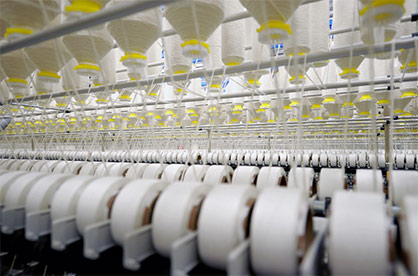
Spinning dual- or triple-core yarn on a ring spinning machine © 2021 SSM


Advantage Indirect Method

As discussed above, producing corespun yarns with a dual or triple core using the indirect method requires an additional work step: preparing the core yarn using the air covering machine SSM XENO-AC TWIN. The bobbin holder on the ring spinning machine needed for this solution is much lower and more user-friendly. A further advantage is that each spinning position can be loaded while all the other positions continue to operate. This means there is no production downtime while the machine is being reloaded. The conversion costs for both methods are around the same, with the SSM XENO-AC TWIN method being slightly cheaper.
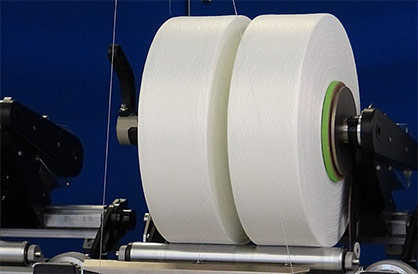
Cheese packages made of air-covered elastane and textured filament yarn © 2021 SSM


Air Covering Machine Ensures Consistent Quality

The main advantage of the indirect method with the air covering machine is that the core yarn is centered better during processing on the ring spinning machine and is very well covered with the spinning staple fibres as a result. This ensures that the core yarn is optimally protected. It is very difficult for the operator to detect a non-centered core yarn in the yarn. This flaw can only be seen once the fabric has been woven and dyed. Since elastane cannot be dyed, poor centering of the core yarn can create flawed spots in the woven fabric that disrupt its overall appearance. The air covering machine ensures consistent quality and consequently reduces complaints.

Excellent Entry Opportunity for Traditional Ring Spinners

Corespun yarns with a dual or triple core where the filament has already been doubled and air-covered on an air covering machine are therefore of a higher quality than corespun yarns produced directly on a ring spinning machine.

The method with the SSM XENO-AC TWIN offers traditional ring spinners an excellent opportunity to enter the elastic corespun yarn market and achieve success. This method is also very user-friendly and safe. No compromises on yarn quality have to be made.

Please do not hesitate to contact us for further information about the SSM applications and possibilities.

SSM Schärer Schweiter Mettler AG


More News from SSM Schärer Schweiter Mettler AG

More News on Spinning

#Spinning

First PA66 spinning plant with EvoQuench successfully commissioned

With the successful commissioning of a multi-digit PA66 spinning line for microfiber yarns, Chinese textile company Shandong Nanshan Fashion Technology Co., Ltd. has added yarn production to its textile value chain.

#Spinning

Saurer Technologies Twisting Solutions at ICFE 2026

Saurer Technologies Twisting Solutions, a global leader in textile machinery innovation, will be present at the International Carpet and Flooring Expo ICFE 2026. Join us January 6–9 at the Istanbul Expo Center, Türkiye, as industry leaders, manufacturers, and innovators gather to explore the latest breakthroughs in carpet and flooring technology. Let’s meet at the new established global Center of the Carpet Sector in hall 3, booth 300!

#Spinning

Details matter: How Trützschler cylinder wires boost efficiency in Pakistan’s spinning sector

Pakistan’s textile industry, especially its spinning sector, is the backbone of the national economy and a vibrant hub of innovation. Today’s spinning mills face growing demands for efficiency, quality, and sustainability. From the serene northern valleys to the vibrant port city of Karachi in the south, mills like Suraj Cotton Mills, Liberty, and Nishat Chunian are turning to advanced solutions.

#Exhibitions & Events

Groz-Beckert showcases textile innovation at ShanghaiTex 2025

From December 16 to 19, 2025, the global textile industry will gather at ShanghaiTex at the Shanghai New International Expo Center (SNIEC), where Groz-Beckert will present its latest highlights and innovations across its five product areas – Knitting, Weaving, Nonwovens, Sewing, and Spinning – at Hall N3, Booth A05.

Latest News

#People

Happy Holidays!

Dear reader, the year 2025 is drawing to a close. We are entering what we hope will be a peaceful holiday season, spending time with our families and taking a moment to pause and reflect. We hope we have been able to support you once again this year with relevant news and articles, and we look forward to surprising you with many innovations in the coming year. Enjoy the festive season, stay healthy, and we wish you a happy and joyful holiday season.

#Weaving

Lindauer Dornier announces leadership transition in weaving machine business

After more than ten successful years at Lindauer DORNIER GmbH, Mr Wolfgang Schöffl will leave the family-owned company at the end of the year to enter well-deserved retirement.

#Heimtextil 2026

Texpertise Focus AI: Messe Frankfurt puts Artificial Intelligence centre stage at its international textile and apparel trade fairs

Under the banner 'Texpertise Focus AI, Messe Frankfurt will place a strong emphasis on Artificial Intelligence (AI) across its international textile and apparel trade fairs from 2026 onwards, setting a future-shaping signal for the industry. The initiative highlights the responsible use of AI along the entire textile value chain, from fibre production to the point of sale. The programme will launch at Heimtextil in Frankfurt in January 2026.

#Technical Textiles

Autoneum and Polestar set new benchmarks for passenger experience and sustainability

As the global market leader in sustainable acoustic and thermal management, Autoneum is a key supplier of interior and exterior components for the highly anticipated Polestar 5 model. The successful collaboration between Autoneum and Polestar marks a significant milestone in sustainable automotive engineering: the electric grand tourer sports car features several innovations in lightweight, fully recyclable polyester-based components that ensure a superior driving experience. Polestar 5 was revealed at the IAA Mobility 2025 in Munich and is available in 24 markets.

TOP