[pageLogInLogOut]

#Recycling / Circular Economy

Know-how for a better world with recycled textiles

© 2023 Uster
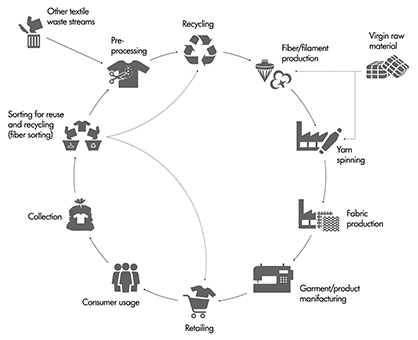
Definitions, standards and specific industry knowledge…Uster Technologies covers the whole story of recycled textile materials in its application report Sustainability Bulletin No. 1. The publication is part of Uster’s commitment to support the use of recycled materials along the entire textile value chain.

Uster Technologies issues practical guidance in its new Sustainability Bulletin

Many consumers today already expect recycled materials to be used in the clothing and home textiles they purchase – and this is clearly pushing innovation throughout the industry. However, there is a degree of uncertainty about what this trend means for yarn producers, both economically and technically. The first Uster Sustainability Bulletin outlines the challenges and presents the solutions. 
© 2023 Uster
© 2023 Uster


Starting positions and results

Upstream in textile processing, spinners are often asked to produce yarns with recycled materials, with comparable quality to those from new fiber. “The use of mechanically recycled fibers in spinning has specific quality considerations. Such fibers have a higher short-fiber and nep content and may often be colored, particularly if post-consumer material is used,” says Gabriela Peters, Head of Product Management Laboratory Systems at Uster Technologies and one of the bulletin’s authors. It is also true that recycled yarns have limitations in terms of yarn fineness. But thermo-mechanically and chemically recycled fibers and filaments are thought to present fewer processing challenges, as they are expected to have similar processing behavior to new fibers and filaments from synthetic and viscose materials.


The Sustainability Bulletin is focused on the more problematic recycled raw material. For example, it deals with the potential difficulties in the various process steps in spinning. The aim is to bring clarity and understanding about mechanically recycled materials and provide ideas on how they can be processed. 

Studies have shown that yarns and fabrics produced from recycled fibers may be better for applications where the strength of yarns and fabric is less critical, but where control of unevenness, imperfections, and handle properties is required. Consequently, recycled fibers are most suitable for manufacturing casual clothes such as T-shirts, sweatshirts, and sleepwear. In China, tons of denim jeans trousers are already made of mechanically recycled fibers.

The guardian of quality

Uster Technologies sees its role as knowledge provider, setting definitions and standards, to accelerate this ongoing industry transformation. As a long-term trusted supplier of quality control systems to the textile manufacturing industry, Uster assists the industry by evaluating test results. This helps to guide spinners on the current possibilities for dealing with recycled material in its many forms.

The Uster Statistics benchmarks will be helpful in the requirement to measure, control, and improve the quality. The new edition, launched at ITMA 2023, includes for the first time a section for recycled yarn. The Uster Statistics 2023 edition also features an extended range of fiber data, supporting sustainability goals. It’s a fact that an ideal fiber mix – with or without recycled content – must also meet quality requirements for minimal waste.

Uster understands its function as a kind of neutral arbiter, reporting what quality can be expected when processing different recycled materials. Uster know-how on using recycled raw material is collected in the Sustainability Bulletin No. 1 and ready to download free of charge at http://www.uster.com/sustainabilitybulletin

Cooperation for a sustainable future

Using recycled materials effectively and efficiently will be a key to success in future years. To achieve acceptable results and profitability, all sections of the textile chain will need to cooperate and learn from each other, to avoid collective failure. “At Uster Technologies, we firmly believe it’s a great opportunity for textile manufacturers to lead this momentous industry transformation, as recycled fibers are the raw material of a sustainable future to be processed into new products,” says Peters.


More News from Uster Technologies AG

#Spinning

Measure and control the fiber – optimize yarn quality

Producing consistent yarn quality is an everyday challenge – and a very difficult one. Detailed knowledge and understanding of the fiber raw material is absolutely critical to achieving the best possible quality in the yarn. To help spinners, Uster experts have put together guidelines for avoiding yarn irregularity claims, in a special edition of the Uster News Bulletin.

#ITMA Asia + CITME Singapore 2025

Uster presents novelties at ITMA Asia + CITME 2025

There’s news from Uster Technologies to be announced for the industry’s upcoming event in Singapore. The Uster 360Q universe is growing with new products, solutions and services. Innovation developments can also be recorded in the fields of man-made fiber testing and fabric inspection. Uster innovations address the industry’s trending topics as mill management and process control, optimization of delivered fabric quality and yield.

#Spinning

Uster Technologies marks 150 years of empowering quality excellence

Uster Technologies marks 150 years of excellence – a milestone that reflects continuous adaptation to customer needs and industry change. Over the decades, Uster has evolved from manufacturing quality testing instruments into a trusted partner shaping the future of textile production.

#Recycling / Circular Economy

Challenges of making yarn from recycled fibers

What does it take to spin quality yarn from recycled fibers? Uster Technologies brought textile industry leaders together to discuss the role of technology, data and automation – as well as the current challenges in using recycled raw material. Experts from Rieter, Säntis Textiles, Otto Yarns, and TVU commented on the current situation and looked into the future of spinning in a panel discussion organized at Uster headquarters.

More News on Recycling / Circular Economy

#Recycling / Circular Economy

Europe needs tipping point to scale textile-to-textile recycling, BCG and ReHubs say

A new report from Boston Consulting Group (BCG) and ReHubs, titled “Advancing Textile Circularity – Europe’s textile waste challenge: Scaling Textile-to-Textile requires enabling mechanisms”, highlights the urgent need for systemic action to tackle Europe’s growing textile waste and scale a circular textile economy.

#Recycling / Circular Economy

AI Circular Economy Conference 2026 fuels innovation at the intersection of AI and Circular Economy

The AI Circular Economy Conference 2026, organised by nova-Institute, brought together 116 participants from 15 countries in Cologne and online to explore the transformation of the chemical and materials industry supported and accelerated by artificial intelligence. During the two-day event, leading experts from industry, research, start-ups and the investment community discussed how AI can maximise the potential of renewable carbon creating efficient circular value chains. The conference featured 24 presentations and multiple panel discussions, highlighting the growing convergence of digital technologies and circular material systems. It demonstrated how artificial intelligence is progressing from the experimental stage to real industrial implementation within the circular economy.

#Recycled_Fibers

Circ deepens access to recycled fibers with Xinxiang Bailu Chemical Fiber Co., Ltd. partnership agreement

Circ®, a global leader in textile‑to‑textile recycling, today announced a new partnership agreement with Xinxiang Bailu Chemical Fiber Co., a Canopy Dark Green Shirt producer and one of the world’s leading producers of viscose filament. The agreement marks a significant step in Circ’s continued expansion in China and strengthens its position within the country’s rapidly evolving circular textile ecosystem; further supporting Circ’s ability to supply recycled fibers near existing fashion supply chains.

#Recycled_Fibers

Worn Again Technologies unveils the Accelerator

Worn Again Technologies unveils the Accelerator, the next major step towards commercialising its pioneering Textile-to-Fibre recycling process and proving the technical and economic feasibility of polycotton recycling.

Latest News

#Research & Development

Textilfabrik 7.0 launched: Mönchengladbach becomes a real-world lab for sustainable textile production

With the official kick-off event of the Textilfabrik 7.0 (T7), a major transformation project for the German textile and apparel industry has been launched in the Monforts Quarter in Mönchengladbach. At the “Textile Roundtable,” an event format organized by the Zukunftsagentur Rheinisches Revier, representatives from industry, research, politics, and the regional economy came together to jointly lay the foundation for CO₂-neutral, circular, and economically viable textile production in Germany.

#Techtextil 2026

Future ready nonwovens and fiber processing solutions – Meet Trützschler at Techtextil 2026

From April 21 to 24, 2026, the Trützschler Group will present its future‑ready solutions at Techtextil in Frankfurt, Germany. At Booth C61 in Hall 12.0, Trützschler Nonwovens will showcase its latest developments for efficient nonwovens production, including comprehensive service and consulting solutions. Highlights include the fully upgraded X‑Series nonwoven cards suitable for spunlace, needle‑punching and air‑through bonding (ATB) processes, as well as the T‑ONE digital working environment enhanced with new features. Trützschler Card Clothing will complement the presentation with a new card wire designed with a specially engineered surface for high‑performance nonwoven applications. Visitors can also take a closer look at Trützschler’s complete solution for the recycling of textile waste, TRUECYCLED.

#Digital Printing

Former ASOS CEO Nick Beighton joins Kornit Digital to help shape the future of on-demand fashion

Kornit Digital LTD. (NASDAQ: KRNT) ("Kornit" or the "Company"), a global leader in sustainable, on-demand digital fashion and textile production technologies, today announced it has appointed Nick Beighton, former Chief Executive Officer of ASOS, as a strategic advisor to the Company and its Board of Directors. His appointment reflects Kornit’s continued focus on strengthening its connection to global brands, retailers, and digital commerce platforms as the industry transitions toward on-demand production. The Company plans to nominate Mr. Beighton for election to the Board at Kornit’s 2026 Annual Shareholder Meeting.

#Techtextil 2026

Gebr. Otto highlights versatility at Techtextil with regional supply chains, yarn innovations and new hygiene segment

At this year’s Techtextil, Gebr. Otto places its versatility at the center of its presentation. In addition to spinning, twisting and dyeing – traditionally focused on fine cotton – textile processors will also find a competent development partner for technical specialty solutions. The Dietenheim-based spinning mill has now built up a decade of experience in the production of technical yarns, particularly from aramids. A new hygiene segment has also been established, where yarns for medical and hygiene products are currently being produced. In the future, this department could also develop textile products for the food sector. Gebr. Otto will once again be present at the BW-i joint stand, booth D81, hall 12.1. What is wound onto the spool is determined by the customer: Gebr. Otto develops according to specific customer requirements and transforms its own ideas into yarn innovations.

TOP