[pageLogInLogOut]

#Smart Textiles

3D-printed insoles measure sole pressure directly in the shoe
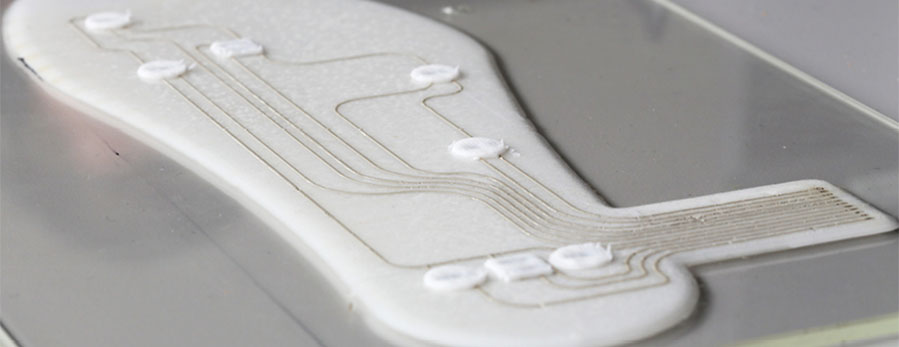
The personalized insole with integrated sensors can measure the pressure of the sole in the shoe during different activities. Image: Marco Binelli, ETH Zurich
Researchers at ETH Zurich, Empa and EPFL are developing a 3D-printed insole with integrated sensors that allows the pressure of the sole to be measured in the shoe and thus during any activity. This helps athletes or patients to determine performance and therapy progress.

In elite sports, fractions of a second sometimes make the difference between victory and defeat. To optimize their performance, athletes use custom-made insoles. But people with musculoskeletal pain also turn to insoles to combat their discomfort.

Before specialists can accurately fit such insoles, they must first create a pressure profile of the feet. To this end, athletes or patients have to walk barefoot over pressure-sensitive mats, where they leave their individual footprints. Based on this pressure profile, orthopaedists then create customised insoles by hand. The problem with this approach is that optimisations and adjustments take time. Another disadvantage is that the pressure-sensitive mats allow measurements only in a confined space, but not during workouts or outdoor activities.

Now an invention by a research team from ETH Zurich, Empa and EPFL could greatly improve things. The researchers used 3D printing to produce a customised insole with integrated pressure sensors that can measure the pressure on the sole of the foot directly in the shoe during various activities.

“You can tell from the pressure patterns detected whether someone is walking, running, climbing stairs, or even carrying a heavy load on their back – in which case the pressure shifts more to the heel,” explains co-project leader Gilberto Siqueira, Senior Assistant at Empa and at ETH Complex Materials Laboratory. This makes tedious mat tests a thing of the past. The invention was recently featured in the journal Scientific Reports.

One device, multiple inks

These insoles aren’t just easy to use, they’re also easy to make. They are produced in just one step – including the integrated sensors and conductors – using a single 3D printer, called an extruder.

For printing, the researchers use various inks developed specifically for this application. As the basis for the insole, the materials scientists use a mixture of silicone and cellulose nanoparticles.

Next, they print the conductors on this first layer using a conductive ink containing silver. They then print the sensors on the conductors in individual places using ink that contains carbon black. The sensors aren’t distributed at random: they are placed exactly where the foot sole pressure is greatest. To protect the sensors and conductors, the researchers coat them with another layer of silicone.


An initial difficulty was to achieve good adhesion between the different material layers. The researchers resolved this by treating the surface of the silicone layers with hot plasma.

As sensors for measuring normal and shear forces, they use piezo components, which convert mechanical pressure into electrical signals. In addition, the researchers have built an interface into the sole for reading out the generated data.
In the future, the insole could support athletes or measure progress in physiotherapy. Video: ETH Zurich

https://www.youtube.com/watch?v=6ao7fig8gGU&t=1s


Running data soon to be read out wirelessly

Tests showed the researchers that the additively manufactured insole works well. “So with data analysis, we can actually identify different activities based on which sensors responded and how strong that response was,” Siqueira says.

At the moment, Siqueira and his colleagues still need a cable connection to read out the data; to this end, they have installed a contact on the side of the insole. One of the next development steps, he says, will be to create a wireless connection. “However, reading out the data hasn’t been the main focus of our work so far.”
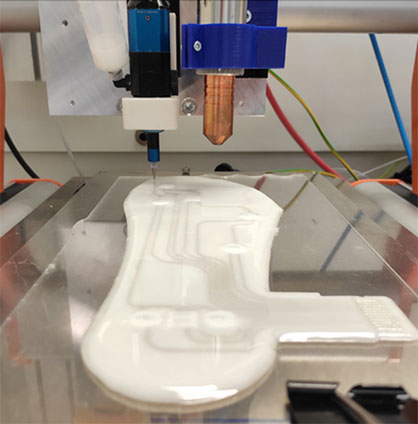
In the final step, the conductors and sensors are covered with another silicone layer to protect them. Image: Marco Binelli, ETH Zurich


In the future, 3D-printed insoles with integrated sensors could be used by athletes or in physiotherapy, for example to measure training or therapy progress. Based on such measurement data, training plans can then be adjusted and permanent shoe insoles with different hard and soft zones can be produced using 3D printing.

Although Siqueira believes there is strong market potential for their product, especially in elite sports, his team hasn’t yet taken any steps towards commercialisation.

Researchers from Empa, ETH Zurich and EPFL were involved in the development of the insole. EPFL researcher Danick Briand coordinated the project, and his group supplied the sensors, while the ETH and Empa researchers developed the inks and the printing platform. Also involved in the project were the Lausanne University Hospital (CHUV) and orthopaedics company Numo. The project was funded by the ETH Domain’s Advanced Manufacturing Strategic Focus Areas programme.




More News from TEXDATA International

#Recycling / Circular Economy

textile.4U publishes special edition “Top 100 Textile Recycling Companies 2025”

With a comprehensive 176-page special edition, textile.4U is dedicating its latest issue entirely to one of the most dynamic and influential topics in today’s textile industry: textile recycling. The new issue, published exclusively in high-quality print, presents the Top 100 textile recycling companies researched and selected by TexData – organizations that already play a key role in the transition to circular textiles or are expected to have a significant impact in the near future.

#Recycling / Circular Economy

Responsible Textile Recovery Act of 2024 signed by Governor

Senator Josh Newman (D-Fullerton) is proud to announce that Senate Bill 707 (SB 707), the Responsible Textile Recovery Act of 2024, has been signed into law by the Governor of California, Gavin Newsom. This groundbreaking legislation establishes the country’s first Extended Producer Responsibility (EPR) textile recycling program, marking a significant step forward in the state’s efforts to combat waste and promote sustainability.

#Textiles & Apparel / Garment

Modtissimo promotes sustainability with 28 coordinates in the Green Circle

Modtissimo is proving more and more to be a textile and clothing show that delivers the latest innovations in the area of sustainability, with the iTechStyle Green Circle being the main showcase for companies' creations. In this 60+4 edition, taking place on 12 and 13 September, 28 coordinates will be exhibited in a section organised by CITEVE and curated by Paulo Gomes.

#Europe

The EU and Egypt team up to mobilise private sector investments at Investment Conference and sign a Memorandum of Understanding underpinning €1 billion in macro-financial assistance for Egypt

At the EU-Egypt Investment Conference, co-organised by the EU and the Government of Egypt on 29-30 June, the EU and Egypt are teaming up to intensify private sector investments in Egypt. They are also signing a Memorandum of Understanding (MoU) for the disbursement to Egypt of up to €1 billion in Macro-Financial Assistance.

More News on Smart Textiles

#Research & Development

Catching heart disease early with AI-based sensor system

It slips on like a normal vest: Fraunhofer IZM has created a smart sensor system in cooperation with the Charité and the Technical University of Berlin. The vest records a vast array of cardiovascular parameters, which an AI-based system uses to support medical diagnostics and spot potentially dangerous developments.

#Research & Development

Soft interfaces: Textile-integrated light switches, made possible by printable Liquid Metal Ink

A gentle tap on the knitted lampshade is enough to switch on the light. The lamp developed by Fraunhofer IZM in cooperation with WINT Design Lab works with a revolutionary conductive ink. Visitors can find out more and try the lamp themselves at the Berlin Science Week on November 1st and 2nd.

#Smart Textiles

Intelligent textiles for construction, architecture and mobility: Smart Textiles User Forum in Stuttgart

When textiles are equipped with electronic components, conductive yarns and textile sensors, the application possibilities are almost unlimited. These high-tech textiles are a global growth market. In Stuttgart, manufacturers, users and researchers presented amazing examples of applications in construction, architecture and mobility. The appropriate standards ensure quality and safety.

#Smart Textiles

Innovations with smart textiles

The second free online masterclass of the AddTex project will take place on March 5 from 15:30 to approx. 17:00. Industry partners and textile researchers will present the latest innovations in the field of functional and smart textiles.

Latest News

#Home Textiles

Beaulieu International Group announces the sale of its upholstery business to GH Private Equity

Beaulieu International Group (B.I.G.) has signed a Share Purchase Agreement with GH Private Equity to sell all shares of its upholstery activities, known under the brand name Tessutica. The closing was officially finalized on Thursday 27 November 2025.

#Yarn & Fiber

Fulgar voice at the Milan Fashion Institute

Daniela Antunes, Marketing Manager at Fulgar, participated as an expert speaker at the XVII edition of the Master in Brand & Product Management of the prestigious Milano Fashion Institute, which trains well-rounded professionals capable of managing both the creative and strategic-managerial aspects of the fashion & luxury sector.

#Fabrics

SENSIL® by NILIT and ROICA™ by Asahi Kasei collaborate to reduce apparel’s footprint

Rapidly transforming apparel into a lower-carbon industry requires collaboration, innovation, and creativity. In this spirit, SENSIL® by NILIT and ROICA™ by Asahi Kasei have collaborated to introduce the concept of a new fabric with less environmental impact, combining SENSIL® ByNature, a NILIT Biomass Balanced Nylon 6.6 yarn, and Biomass Balanced ROICA™ premium stretch fiber, both designed for high-performance apparel.

#Textiles & Apparel / Garment

Texworld Apparel Sourcing Paris unveils redesigned show layout for 2026

From February 2 to 4, 2026, Texworld Apparel Sourcing Paris will once again bring together all the key players in textiles and clothing at the Paris-Le Bourget Exhibition Center. For 3 days, visitors will discover, compare and select among 1,300 suppliers who will shape the collections of tomorrow, from ready-to-wear to luxury.

TOP