[pageLogInLogOut]

#Research & Development

The German Institutes of Textile and Fiber Research Denkendorf (DITF) mourn the loss of Professor Dr. Dr. h.c. Franz Effenberger

The former head of the previous Institute for Textile Chemistry and Chemical Fibers (ITCF) at the DITF passed away on December 11 at the age of 94.

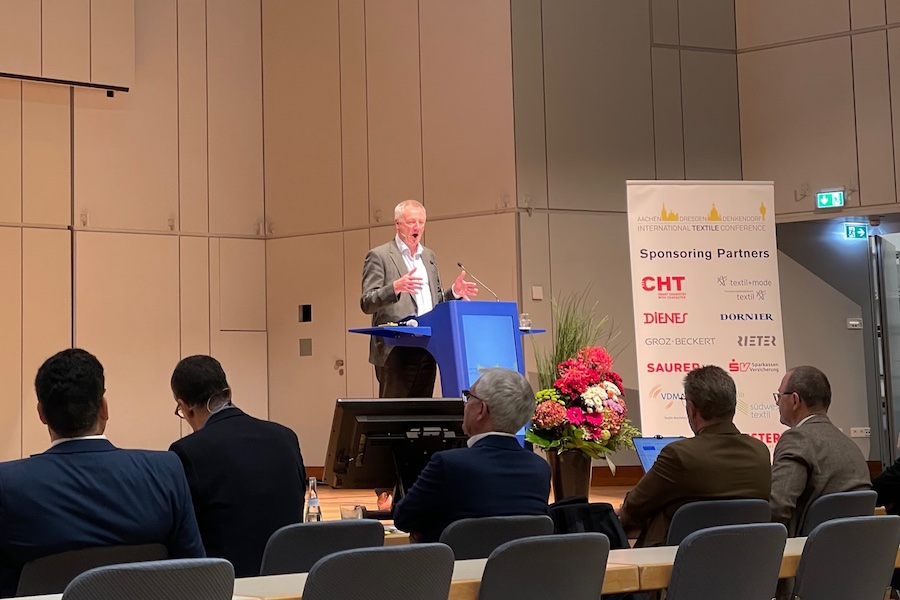
“Professor Effenberger was a brilliant chemist, researcher and university lecturer. With him, we lost an important companion of our research center - first as a member of the Board of Trustees and later as Institute Director. As recently as November, we were privileged to welcome Professor Effenberger as a guest of honor at the Aachen-Dresden-Denkendorf International Textile Conference organized by the DITF. The DITF owe Professor Effenberger a considerable debt of gratitude and will honor his memory,” stated Professor Dr. rer. nat. habil. Michael R. Buchmeiser, Chairman of the Board of the DITF.

Franz Effenberger studied textile engineering in Krefeld, then chemistry at the Technical University of Stuttgart, received his doctorate in 1958 under Hellmut Bredereck at the Technical University of Stuttgart with the topic "Investigations of condensed heterocyclic ring systems" and habilitated in organic chemistry in 1964. After a one-year research stay at the University of Michigan in the USA in 1965 and years as a Winnacker Fellow, he was appointed Professor of Organic Chemistry at the University of Stuttgart in 1971 and Director of the Institute of Organic Chemistry at the University of Stuttgart. He filled both positions with great passion and success until 2002.
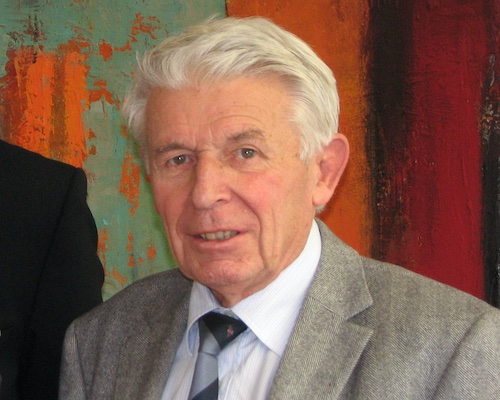
Professor Effenberger † © 2024 DITF


At the University of Stuttgart, of which he was prorector (1980 - 1986) and rector (1986 -1990), Franz Effenberger contributed to the reform of the study of chemistry and was involved in establishing the major field of bioprocess engineering. In addition, he was active abroad: As a visiting professor he taught at Cornell University in Ithaca/USA in 1977 and at the Ecole Supérieure de Physique et Chimie in Paris in 1989.

His most important fields of work were the chemistry of aromatics, heterocycles and amino acids, the chemical principles of molecular electronics, applications of enzymes in synthesis and the development of ultra-thin organic layers. Franz Effenberger has published around 350 papers and 55 patents in cooperation with renowned companies - impressive proof of his scientific achievements and his professional life's work, which was entirely devoted to research. In 2023, he published his autobiography “Von Aromaten und Heterocyclen zur Bio- und Nanotechnologie” in the series “Lebenswerke in der Chemie”.

In 2003, Franz Effenberger took over as head of the Institute of Textile Chemistry and Chemical Fibers (ITCF) of the German Institutes of Textile and Fiber Research (DITF) for six years, having already been a member of the DITF board of trustees until 2003. With untiring commitment, outstanding expertise and an open ear for his employees, colleagues and the interests of the industry, Effenberger succeeded in further expanding the excellent national and international reputation of the ITCF Denkendorf. As a scientist with strategic skills and a feeling for the right topics, he initiated numerous pioneering research projects, pushed ahead with targeted cooperation with the industry and thus set the course for a successful future of research in Denkendorf. Together with the SGL Group, Franz Effenberger initiated the development of carbon fiber technology at the ITCF, thus setting a milestone on the way to independent European carbon fiber production technology, the mastery of which is of decisive importance for Germany as a high-tech location.

Franz Effenberger has received many awards. For his scientific work and his overall achievements, which have had a lasting impact on the field of chemistry through discoveries and new findings, he received, among others, the Humboldt Research Award and the Federal Cross of Merit 1st Class. His achievements have also been honored abroad. The Kei? University honored him with the Japan Society for the Promotion of Science -Fellowship Award, the University of Strasbourg honored him with the Louis Pasteur Medal, and in France he was made a Knight of the Legion of Honor. The Universidade Federal de Santa Maria (Brazil) awarded Franz Effenberger an honorary doctorate.

More News from Deutsche Institute für Textil- und Faserforschung Denkendorf

#Research & Development

More safety and comfort for protective clothing thanks to auxetic fabrics

When everyday materials are pulled, they stretch or elongate in the direction of the pull and become narrower in cross-section. We can also observe this property in two-dimensional textiles. Auxetic structures behave differently here. They have the striking property of not changing under tensile stress or even increasing their width or thickness. These properties are advantageous, for example, in protective textiles or textile filter media. The DITF are researching auxetic fabrics for various applications.

#Research & Development

Panty liners prevent bacterial vaginosis

Worldwide, almost one third of women of childbearing age suffer from bacterial vaginosis. This is when the sensitive microbiome of the vagina becomes unbalanced. Such a disorder of the vaginal flora can cause urogenital infections, abscesses on the ovaries or fallopian tubes or premature births. This significantly increases the risk of infertility in women and of contracting a sexually transmitted disease or HIV.

#Research & Development

DITF send a signal for climate protection

The German Institutes of Textile and Fiber Research Denkendorf (DITF) have successfully implemented extensive investments in photovoltaic systems at their site in Denkendorf. The systems installed on the roofs of the buildings and covered parking lots have a total installed capacity of 840 kilowatt peak (kWp). The DITF invested 1.6 million euros in this with the support of the state of Baden-Württemberg. The system was ceremonially put into operation on September 17, 2025.

#Research & Development

4.2 million Euros for research into textile recycling

Around the world, used textiles are still rarely recycled and pile up into huge mountains of waste. A recent study by the Boston Consulting Group (BCG) drew attention to this problem. However, the low recycling rate is also due to the fact that only a small percentage of used textiles are actually suitable for recycling into high-quality materials and for demanding applications. The German Institutes of Textile and Fiber Research Denkendorf (DITF) are addressing this problem with their research.

More News on Research & Development

#Research & Development

Sustainable athletic wear made from bio-based Polyethylene

Conventional sports textiles made from petroleum-based synthetic fibres are to be replaced in the future by sustainable, bio-based, cooling textiles. Polyethylene, previously used mainly in the packaging industry, is thus qualified for use in textiles and, as a bio-based drop-in solution, offers a cost-effective, sustainable alternative for the future.

#Research & Development

Innovation center for textile circular economy inaugurated

Just over eight months after the foundation stone was laid, the new Innovation Center for Textile Circular Economy was officially inaugurated today at TITK Rudolstadt. Thuringia's Minister President Mario Voigt, TITK Director Benjamin Redlingshöfer, and other guests of honor cut the ribbon to the modern building complex and viewed the premises, which are now ready for occupancy. The “DICE – Demonstration and Innovation Center for Textile Circular Economy” is TITK's largest single investment to date. The Free State of Thuringia supported the total cost of €11.5 million with €8 million in GRW and FTI funding.

#Research & Development

Sustainable design of Geosynthetics and roof underlayments made from recyclates

Is it possible to recover plastic recyclates from previously unused waste streams in order to produce high-quality fibers and films? How can bio-based polymer fibers be manufactured so as to allow adjustable biodegradability? These are the questions being addressed by researchers from the Fraunhofer Cluster of Excellence Circular Plastics Economy CCPE in the Zirk-Tex project.

#Research & Development

India, ITA and innovation – enhanced cooperation in research, implementation and bilateral projects such as hydrogen mobility

The Indian Consul General, Dr Shuchita Kishore, visited the Institut für Textiltechnik (ITA) of RWTH Aachen University on 15 December to inspect the joint project between the ITA, the Indian Institute of Technology (IIT) Bombay and industrial partners from India and Germany and to tour the ITA.

Latest News

#Textile chemistry

Devan unveils innovative textile solutions to enhance comfort during sleep at Heimtextil 2026

From 13 to 16 January 2026, Devan was exhibiting at Heimtextil in Frankfurt, the world’s leading international trade fair for home and contract textiles. The event brought together key players from across the global textile value chain, providing the ideal platform for Devan to present its latest innovations.

#Heimtextil 2026

Confidence driving the textile industry: Heimtextil 2026 sharpened its global market relevance by attracting more top-level decision-makers

With 148 participating nations, rising global relevance and a marked increase in visitor quality, Heimtextil 2026 stood for stability and reliability in a volatile market environment. Once again, 3,000 exhibitors from across the globe placed their trust in the industry’s central platform in Frankfurt, presenting current collections, materials and textile solutions for holistic interior design to over 48,000 buyers. Under the motto “Lead the Change”, Heimtextil brought evolving market dynamics, Artificial Intelligence (AI) and new business opportunities to life.

#Recycled_Fibers

Borealis invests EUR 49 million in Burghausen, Germany to accelerate design for circularity

Borealis announces a EUR 49 million strategic investment to scale up production of Borstar® Nextension polypropylene (PP) at its manufacturing site in Burghausen, Germany. This will expand commercial production of next-generation single-site polypropylene (ssPP) grades that deliver enhanced purity, processability, and performance - supporting customers in key sectors including packaging, healthcare, mobility, and fibers, to meet evolving market and regulatory demands.

#Associations

Latest news from Bremen: ICAC Plenary Meeting to take place right before the International Cotton Conference

The International Cotton Advisory Committee (ICAC) will hold its 83rd Plenary Meeting on 23–24 March 2026 at the Parliament building in Bremen. The meeting will take place immediately ahead of the 38th International Cotton Conference Bremen (25–27 March 2026) and marks a historic premiere: for the first time, the ICAC Plenary will be hosted in close cooperation with the Bremen Cotton Exchange and the Faserinstitut Bremen e.V. (FIBRE).

TOP