[pageLogInLogOut]

#Research & Development

Fungal mycelium as the basis for sustainable products
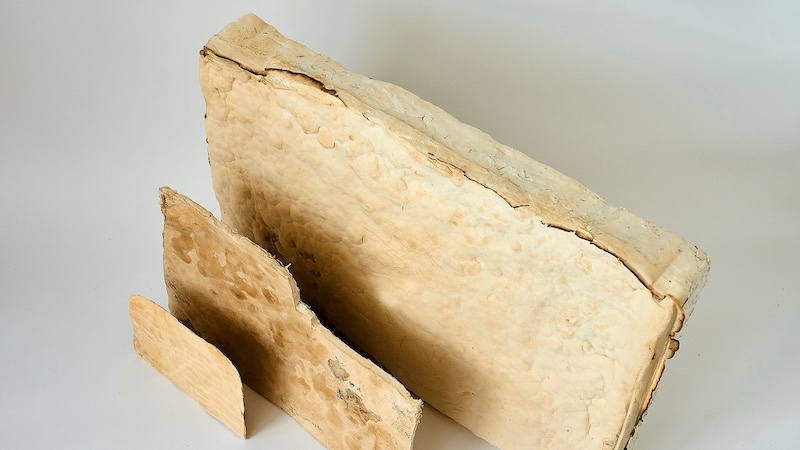
Fungi have more to offer than meets the eye. Their thread-like cells, which grow extensively and out of sight underground like a network of roots, offer huge potential for producing sustainable, biodegradable materials. Researchers at the Fraunhofer Institute for Applied Polymer Research IAP in Potsdam Science Park are using this mycelium to develop a wide range of recyclable products, from wallets and insulation to packaging.
Flexible mycelium materials in different thicknesses can be used as upholstery material, insulation board or alternatives to leather © Fraunhofer IAP / Jadwiga Galties


To most of us, fungi look like a curved cap and a stem. However, the largest part of the organism consists of a network of cell filaments called mycelium, which mainly spreads below ground and can reach significant proportions. This finely branched network has been underutilized until now. However, for researchers at the Fraunhofer Institute for Applied Polymer Research IAP in Potsdam, mycelium represents a pioneering raw material with the potential to replace petroleum-based products with natural, organic mycelium composites. Organic residues from regional agricultural and forestry activities are used as the substrate for the fungal cultures. In various projects, the researchers are using mycelium-based materials to produce insulation, packaging, and animal-free alternatives to leather products.

Mycelium-based materials from regional agricultural residues

“Faced with climate change and dwindling fossil raw materials, there is an urgent need for biodegradable materials that can be produced with lower energy consumption,” says Dr. Hannes Hinneburg, a biotechnologist at Fraunhofer IAP. Together with his team, he is using mycelium — for instance, from edible mushrooms or bracket fungi such as the oyster mushroom or tinder fungus — to transform locally available plant residues into sustainable materials. “The mycelium has properties that can be used to produce environmentally friendly, energy-efficient materials, since the growth of the fungi takes place under ambient conditions and CO2 remains stored in the residues. When cellulose and other organic residues decompose, a compact, three-dimensional network forms, enabling a self-sustaining structure to develop,” explains Hinneburg. This produces a material that is a complex compound with an organic substrate such as cereal residues, wood chips, hemp, reeds, rape or other agricultural residues. These substances are a source of nutrients for the fungus and are permeated entirely by a fine network of mycelia during the metabolic process. This produces a fully organic composite that can be made into the required shape and stabilized through thermal treatment. “First, you mix water together with agricultural residues such as straw, wood chips and sawdust to form a mass. Once the level of humidity and particle size have been determined, and the subsequent heat treatment to kill off competing germs has been completed, the substrate is ready. It provides food for the fungi and is mixed with the mycelium. Following a growth phase of around two to three weeks in the incubator, the mixture will produce, depending on the formulation and process used, a substance similar to leather or a composite that can be processed further,” says Hinneburg, summarizing the production process. No light is required for this process — a bonus as far as energy efficiency is concerned.

Versatile applications: strength and elasticity can be specifically configured

The fungal materials can be cultivated with a wide range of properties. Depending on the application, they can be hard-wearing, stretchable, tear-resistant, impermeable, elastic, soft and fluffy, or open-pored. The result is determined by the combination of the type of fungus and agricultural residues, plus variable parameters such as temperature and humidity. The duration of mycelial growth also influences the end product. The versatility of the material means it can take on a huge variety of forms, from thick blocks to wafer-thin layers, and be used in a multitude of scenarios. This makes it possible to use fungi-based materials for textile upholstery, packaging, furniture, bags or insulation boards for interiors. When used as a construction material, the fungus primarily functions as a biological adhesive since a wide range of organic particles are joined together via the mycelium.

“The many positive properties of the material, heat-insulating, electrically insulating, moisture-regulating and fire-resistant, enable an important step toward circular and climate-positive construction,” says Hinneburg, one of whose current projects involves developing a novel polystyrene alternative for thermal insulation. In another project, he is working alongside the Institute for Food and Environmental Research and Agro Saarmund e.G. to produce environmentally friendly, mycelium-based packaging trays from residues and raw materials sourced from local agricultural and forestry activities. In work he has done with designers, he has also developed the base material for animal-free alternatives to leather products such as bags and wallets. As the mycelium-based materials look similar to their leather counterparts, they can be used to complement leather items in certain areas.

Developing industrial processes

In Europe, only a few companies are currently developing mycelium-based materials for commercial use. The challenges in this area include access to biogenic residues, the ability to ensure consistent product quality and the means to scale up activities efficiently.

To address these challenges, the researchers are using a newly developed roll-to-roll method, for which they have already created a prototype. This method offers significant advantages over standard manufacturing processes involving boxes and shelving systems: By using a standardized, continuous production method under controlled process conditions (such as temperature and humidity), the researchers can ensure that the mycelium-based products have consistent material properties. What’s more, resources can be used more efficiently, and production can be scaled to an industrial level. “This is crucial in order to meet growing industry demand for sustainable materials and to become less dependent on petroleum in the long term. Production can also be improved further by using innovative technologies such as artificial intelligence to optimize the combination of residues and types of fungi,” says Hinneburg.

More News from Fraunhofer Institute for Applied Polymer Research (IAP)

#Research & Development

Feasibility study shows potential to convert textile waste into PHB bioplastic

Textile waste could serve as a valuable source of raw materials for sustainable plastics in the future, according to the joint TexPHB feasibility study conducted by the Fraunhofer Institute for Applied Polymer Research IAP, Beneficial Design Institute GmbH and matterr GmbH. The study will be presented to the public for the first time at a network meeting on 25 November 2025 at the State Chancellery in Potsdam.

#Recycling / Circular Economy

Closing the Loop in the Textile Industry: Value Creation in the State of Brandenburg

How can the state of Brandenburg benefit from a circular textile industry? This question is addressed in the new policy paper "Closing the loop in the textile industry: Value creation in the state of Brandenburg." Based on the „TexPHB“ feasibility study funded by the Brandenburg Ministry of Climate Protection, it shows how textile waste can be integrated into new value chains.

#Research & Development

Better, faster, bio-based: Functional new Plastic alternatives

How can new bio-based and biohybrid materials with improved features be developed faster? Six Fraunhofer institutes are jointly exploring this question in the SUBI²MA flagship project, using an innovative bio-based polyamide developed by Fraunhofer researchers as a model. Its specific properties make it a promising alternative to fossil-based plastics.

#Research & Development

Next-generation sustainable carbon fibers: versatile, high-performance and economical

Whether in hydrogen tanks, batteries, fuel cells or for shielding sensitive electronics – carbon fibers are used in a wide range of advanced applications. At the Potsdam Science Park, the Fraunhofer Institute for Applied Polymer Research IAP, in collaboration with Brandenburg University of Technology Cottbus-Senftenberg, is developing novel carbon fibers based on cellulose.

More News on Research & Development

#Research & Development

The region of renewable raw materials: Central German Alliance for Bioplastics

The development of sustainable plastic solutions is rapidly gaining importance in light of global environ- mental pollution, dwindling fossil resources and ambitious climate protection targets. As part of the re- gional alliance RUBIO, which brings together 18 partners from central Germany and the Berlin-Branden- burg area, the bio-based and biodegradable plastic polybutylene succinate (PBS) was comprehensively investigated, starting with the raw material, through the manufacturing process, to industrial application.

#Nonwoven machines

Cooperation in the field of meltblown laboratory technology

The Nonwoven Institute (NWI) at North Carolina State University and Oerlikon Nonwoven will be collaborating in the field of meltblown laboratory technology in the future. This was announced by Professor Raoul Farer, Executive Deputy Director of the NWI and Professor at the Wilson College of Textiles at North Carolina State University, and Dr. Ingo Mählmann, Sales Director Nonwoven at Oerlikon Neumag, during this year's ITMA Asia and CITME in Singapore.

#Recycling / Circular Economy

European research project addresses textile waste through integrated recycling technologies

A major European research initiative coordinated by Fraunhofer UMSICHT has been launched to develop integrated solutions for textile waste recycling. The AUTOLOOP project aims to create a comprehensive system that could process 1.24 million tonnes of textile waste annually by 2050, whilst potentially creating over 130,000 green jobs across the EU. This project aims to develop, test and integrate automated sorting, tracing, and closed-loop recycling technologies for polyester-based textiles (NRT), addressing the pressing challenge of textile waste management.

#Research & Development

IRG Polymer Recycling wraps up productive 2025 project cycle

The Industry Research Group (IRG) Polymer Recycling has completed another successful project year. Last week, partners from across the textile value chain met at the Institute for Textile Technology (ITA) at RWTH Aachen University for the full-term project meeting.

Latest News

#Recycling / Circular Economy

Advanced Recycling Conference 2025 fuels innovation across key waste streams

The Advanced Recycling Conference (ARC) 2025 brought together nearly 220 experts from 28 countries to spotlight pioneering advancements and foster industry collaboration in recycling across diverse waste streams including plastics, textiles, automotive and other materials.

#Dyeing, Drying, Finishing

Navis TubeTex announces U.S. partnership with Icomatex

Navis TubeTex, a global leader in advanced dyeing and finishing machinery solutions, is pleased to announce a new partnership with Icomatex (www.icomatex.com), a respected European manufacturer of high-quality stenters and textile finishing equipment. Under this agreement, Navis TubeTex will exclusively represent the Icomatex stenter line in the United States.

#Recycling / Circular Economy

ADVANSA launches ADVA®tex: A new step toward textile-to-textile recycling

ADVANSA has introduced ADVA®tex, a new filling fibre made entirely from recycled pre-consumer textile waste, positioning the material as a significant step forward in textile-to-textile (T2T) recycling. The fibre is designed for use in duvets, pillows, mattresses, and furniture applications and is available in three versions.

#Knitting & Hosiery

KARL MAYER celebrates 35 years of EL pattern drive

KARL MAYER is celebrating an anniversary this year: on 30 November 1990, the first warp knitting machine with electronic guide bar control, the KS 4 EL, was delivered – another milestone for patterning. As early as 1980, the SU gearbox with the MRS42SU had initiated the transition from mechanical chains to digital data.

TOP