[pageLogInLogOut]

#Research & Development

Sustainable production based on individual demand
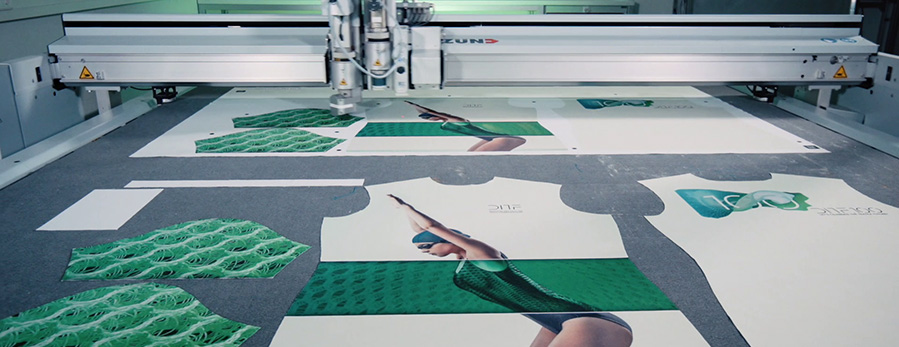
(c) 2024 DITF - Micro Factory Cutting
DITF present the Digital Textile Micro Factory at drupa. Together with international partners from industry and research, the DITF will be presenting a fully networked on-demand production of sports products at drupa's touchpoint textile - from virtual design to the finished product.

One highlight is the material buffer between the printer and cutter, which links the continuous printing process with the step-by-step cutting process. At the end of the production chain, a robot arm sorts all the cut parts belonging to a product, such as the front and back sections, sleeves and collar trim of a T-shirt, into the corresponding boxes. Manual handling is only necessary in exceptional cases.

In future, digitally networked design and production chains will make it possible to react quickly and specifically to customer wishes and trends. This approach protects the environment and conserves resources: instead of producing mass-produced goods for the trash, the products are tailored precisely to requirements. At the trade fair, the carbon footprint from virtual development to the finished product will also be determined and explained using a model.

drupa is the world's leading trade fair for the printing industry and the meeting place for the international print & packaging sector. It will take place from May 28 to June 7, 2024 at Messe Düsseldorf.

The touchpoint textile is located in Hall 4.

More News from Deutsche Institute für Textil- und Faserforschung Denkendorf

#Research & Development

Textile climate control system in workwear – exhibition at the 2026 SME Innovation Day!

Conventional protective workwear often reaches its limits during strenuous physical activity. In particular, the transport of sweat and excess body heat poses a problem. The German Institutes of Textile and Fiber Research (DITF) conducted research on flow-optimized, air-conducting textile structures that enable targeted climate control directly on the body. These structures can be integrated straight into protective work garments. The textile climate control system supports the body’s natural thermoregulation. This contributes to improved workplace safety and comfort.

#Techtextil 2026

Stylish design made from sustainable materials – two DITF research projects receive Techtextil Innovation Awards

Materials made from domestic, renewable raw materials reduce CO₂ emissions, prevent microplastics from entering the environment, and close the material cycle. The German Institutes for Textile and Fiber Research Denkendorf (DITF) are developing nature-based alternatives to synthetically produced and predominantly petroleum-based materials. Two research projects have received a prestigious Techtextil Innovation Award. NUO Flexholz and the lignin-coated material FormLig demonstrate that sustainable concepts can meet high standards of functionality and design. Both projects were carried out in close collaboration with industry.

#Research & Development

Textile cascade filter for removing microplastics from wastewater

Microplastics are now found almost everywhere, even in remote regions of Antarctica. They enter the human body through the food chain. Studies indicate that microplastics may have negative effects on the human health.

#Research & Development

Fabolose: Fabricating vegan and circular leather alternatives from bio-tech-derived cellulose

Fabulose is an EU funded project coordinated by the German Institutes of Textile and Fiber Research (DITF). Its consortium consists of leading research institutes, biotech innovators, and industry stakeholders who aim to create high-performance, biobased and recyclable leather-like fabrics, using efficient biotech production routes for bacterial cellulose, cyanophycin and bacterial pigments

More News on Research & Development

#Research & Development

TCLF: Resilient value chains in times of crises

The textiles, clothing, leather and footwear (TCLF) industry was at the centre of the webinar “Resilient value chains in times of crises”, which took place on 28 April 2026. Global supply chains continue to face increasing pressure, raw material dependencies are growing and economic uncertainties are affecting the entire sector.

#Research & Development

Elastic yarns to become more recyclable and environmentally friendly in future

On 29 April 2026, ITA student Tobias Dickmeiß was awarded a sponsorship prize by the Wilhelm Lorch-Stiftung for his innovative approach, to replacing conventional elastane with elastic yarns made from thermoplastic copolyester elastomers (TPC). Thanks to their thermoplastic nature and compatibility with typical polyesters used in the textile industry, elastic TPC yarns offer improved recyclability. Furthermore, the use of the melt-spinning process in yarn production eliminates the need for solvents that are harmful to the environment and human health.

#Research & Development

Walter Reiners Foundation Prize awarded to three ITA graduates

Sabina Dann, Lukas Balon and Annegret Storm from the Institut für Textiltechnik (ITA) of RWTH Aachen University were awarded the Walter Reiners Foundation Prize by the German Engineering Federation (VDMA) for their master’s and bachelor’s theses. Peter Dornier, Chairman of the Walter Reiners Foundation, presented the awards during Techtextil at the VDMA stand in Frankfurt am Main, Germany.

#Techtextil 2026

Young talents honoured – 60 years Walter Reiners Foundation

At the Techtextil trade fair in Frankfurt at the end of April, Peter D. Dornier, chairman of the VDMA’s Walter Reiners Foundation, presented awards to five successful young engineers. Promotion and sustainability awards were presented in the categories of bachelor’s/project theses and diploma/master’s theses. Academic theses are eligible for the sustainability awards if, for example, they develop solutions for resource-efficient products and technologies.

Latest News

#Recycling / Circular Economy

Textiles Recycling Expo 2026 to spotlight the companies turning textile circularity into industrial reality

As the textile industry faces mounting pressure to scale circular solutions, improve recycling infrastructure, and respond to evolving regulation, Textiles Recycling Expo 2026 will bring together the organisations leading that transformation in practice.

#ITM 2026

Driving digitalization, efficiency, and Smart Manufacturing across textiles and carpets

At this year’s ITM, BMSvision proudly showcases its next leap forward in digital manufacturing excellence. As a long-standing global pioneer in Manufacturing Execution Systems (MES) for the textile and plastics industries, BMSvision continues to accelerate digital transformation by delivering powerful, data-driven solutions that boost productivity, enhance quality and support sustainable growth. Visit BMSvision at the Vandewiele booth in Hall 7, Booth 710, to experience the future of textiles manufacturing.

#Natural Fibers

The Good Cashmere Standard expands Animal Welfare Assessment on audited farms

With the Animal-related Animal Welfare Assessment (ARAWA), the Aid by Trade Foundation (AbTF) conducts a pioneering project for the second consecutive year in 2025, parallel to the independent verifications of The Good Cashmere Standard® (GCS). ARAWA assessments provide a comprehensive overview of the health status of a herd on an audited farm, going beyond standard verification procedures. They are inherently complex, which still makes them a rarity in the standard sector, but offer support in identifying non-conformities and provide a holistic overview of the herd's well-being. Therefore, the Aid by Trade Foundation will continue this crucial project and even further expand it by 2027.

#INDEX 2026

INDEX™26: A strong edition in a challenging context, confirming Geneva’s role as a global hub for innovation in the nonwovens sector

EDANA’s INDEX™26, the world’s leading trade fair for nonwovens, co-organised with Palexpo, officially concluded last Friday 22 May with a successful edition. In a context marked by uncertainty and continued pressure, the 2026 edition of INDEX™ concluded successfully. With a diverse range of 625 exhibiting companies from 44 countries, an important number of visitors, and an expanded international reach, the event confirmed its role as a central hub for innovation and a representative showcase of the nonwovens’ ecosystem.

TOP