[pageLogInLogOut]

#ITMA 2023

MultiMode®: from lab to production of biobased textile and technical filament yarns

Given the anticipated rapid increase in demand for textile fibres in the years to come, it is crucial to implement transformative sustainable consumption and production models both in the garment and technical textile industries. In order to make out of biobased fibres a real competitor to established polymers like polyester or nylon, both securing feedstocks and a further development of spinning technologies will be essential.

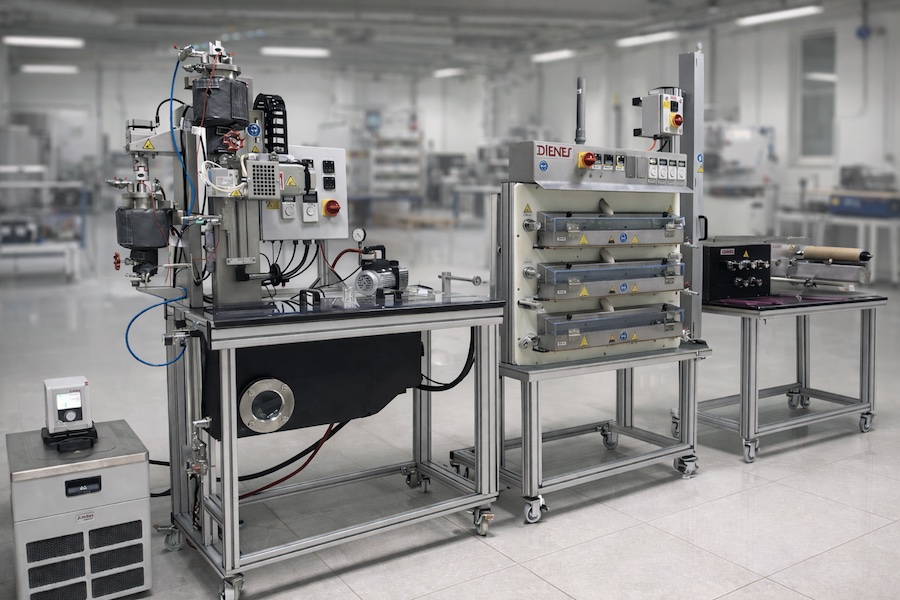
DIENES supports its customers in their work developing cutting-edge fibre products from the first laboratory tests to the modular construction of their production lines. Innovative products like precursor yarns for carbon fibres made from renewable raw materials are produced and improved with DIENES spinning systems.

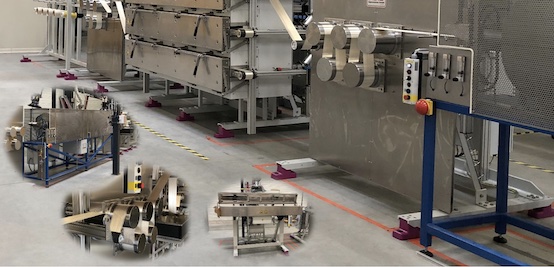
A reliable development of textile and technical filament yarns demands an efficient, systematic and, in part, self-optimising experimental working system, which must be intelligent in gathering data from the process and flexible in enabling the rearrangement of the process. DIENES’s approach to meet such demands is called MultiMode®. In a MultiMode® plant, each process step is represented by a module which can be individually adapted to customer-specific requirements and has its own decentralised control. Thus, DIENES production lines consist of several intelligent modular units which can be easily exchanged and rearranged at any time with a reduced programming effort. Moreover, all production parameters can be permanently visualised and recorded, enabling a complete traceability of the process. The MultiMode® concept has been validated according to GMP guidelines and GAMP standards in the manufacturing of medical products. Thus, MultiMode® is a qualified solution for customers from the pharmaceutical and biomedical sector.


MultiMode® Explorer is the tool for control and visualisation of a MultiMode® line. A completely new graphical user interface will be presented by DIENES at the ITMA in Milano. MultiMode® Explorer allows for instance a real-time evaluation of all sensors, recipe management, long-term-monitoring of operation parameters and remote access to the plant for service and operation. Relevant data can be monitored and controlled to improve the production process with the highest degree of precision.

Have a look at the Dienes booth No. B201 in Hall 1 – Dienes is looking forward to meeting you in Milano.



More News from Dienes Apparatebau GmbH

#Techtextil 2026

DIENES at Techtextil 2026: Flexible pilot lines for bio-based fiber development

The growing relevance of bio-based materials in technical textiles is accompanied by increasing demands for reproducibility, high-quality data, and scalable process routes. Especially when working with cellulose and its derivatives, chitosan, lignin-based approaches, or bio-based PAN as a carbon-fiber precursor, R&D teams face variable feedstock quality, tighter process windows, and the need for reliable comparability across trials. This calls for flexible, data-driven experimental setups that can be reconfigured efficiently when recipes, solvents, and raw-material batches change.

#Composites

DIENES showcases MultiMode®: Pioneering solutions for the development of sustainable carbon fibres at JEC World 2025

DIENES Apparatebau GmbH, a global leader in innovative fibre processing technologies, is delighted to announce its participation at JEC World 2025 in Paris. The company will present its state-of-the-art MultiMode® modular platform, a revolutionary approach to developing sustainable carbon fibres. Visitors can explore DIENES’s advanced solutions at the Baden-Württemberg International stand in hall 6 stand N82.4.

#Techtextil 2024

DIENES at Techtextil 2024

The current accelerated growing demand for technical textile demands a more proactive approach which includes implementing frameworks and technologies for recycling and a broad use of biobased materials as an alternative to conventional polymers. Research work in this field is characterised by a high degree of adaptation needs, hence demanding an efficient, systematic and, in part, self-optimising experimental working system, which must be intelligent in gathering data from the process and flexible in enabling its rearrangement.

More News on ITMA 2023

Latest News

#Composites

KARL MAYER strengthens partnerships in the composites industry at JEC World 2026

KARL MAYER further strengthened its role as a reliable and competent partner to the composites industry at JEC World 2026. The global market leader in textile machinery manufacturing used the trade show to meet key customers, establish numerous new contacts, and engage in in-depth technical discussions.

#Recycling / Circular Economy

ABB and Syre partner to explore technologies for industrial-scale textile recycling

ABB has signed a Memorandum of Understanding (MoU) with Swedish textile impact company Syre to jointly explore technologies to support the development of Syre’s first textile-to-textile recycling plant in Vietnam. The agreement establishes a framework for collaboration to investigate how ABB’s automation, electrification and digital technologies could contribute to safe, efficient and scalable operations. It will also explore how these capabilities could further optimize process and quality control performance as Syre advances its ambition to produce circular polyester at industrial scale.

#Techtextil 2026

From Nature Performance to Circular Economy: Techtextil 2026 focuses on the future market for technical textiles

Alternative materials and recycling technologies are one of the most important future segments and drivers of innovation in technical textiles. Sustainability goals and regulatory requirements increase their relevance, while advances in performance and economic viability enhance their market competitiveness. Taking place from 21 to 24 April 2026, Techtextil reflects this key industry trend with a growing number of specialised exhibitors. With the new “Nature Performance” label, the leading global trade fair bundles relevant market offerings and facilitates access to new solutions – from natural fibres and yarns to bio-based materials and circular approaches.

#Research & Development

Textile cascade filter for removing microplastics from wastewater

Microplastics are now found almost everywhere, even in remote regions of Antarctica. They enter the human body through the food chain. Studies indicate that microplastics may have negative effects on the human health.

TOP
