[pageLogInLogOut]

#Research & Development

Protecting the climate during textile production - polyester fibers bind CO2
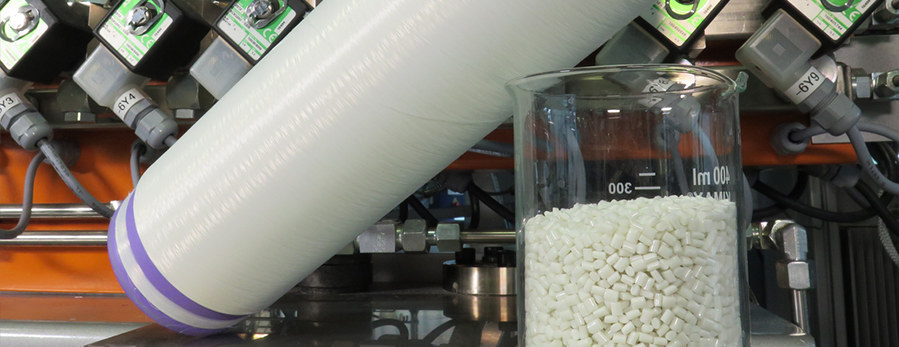
Polyester fibers and granules from the DITF. Photo: DITF
Start for an EU-wide collaborative project: Under the leadership of the French company Fairbrics SAS, 17 project partners from 7 European countries are coming together. The common goal is to produce end products from polyester in a closed cycle using industrial CO2 emissions and to bring them to market maturity. The DITF produce synthetic fibers from plastics of non-fossil origin.

In order to achieve the European climate targets, the aim is to achieve a long-term and sustainable reduction in greenhouse gases. To achieve this, CO2 emissions must be reduced in the energy sector, in industry, and in households and small consumers. This is the starting point for the EU-wide collaborative project 'Threading CO2', which is funded under the EU's Horizon funding program. The project will bring products made of environmentally friendly polyester (PET) to market maturity. The technological basis has been developed by Fairbrics SAS from France. It involves the production of monoethylene glycol (MEG), the starting material for the manufacture of polyester, using CO2 extracted from industrial waste gases. This is a completely new approach, because in the classic process fossil raw materials are consumed for the production of polyester. In this way, not only is the release of CO2 into the atmosphere directly prevented. The CO2 also contributes to increased added value by being incorporated into the production of high-quality textile products. The core of the project is the technological upscaling of the new MEG synthesis process in pilot plants, paving the way for industrial production.

In the EU joint project, 17 project partners will contribute their special expertise and further develop the process technologically and make it suitable for industrial use. Within the consortium, DITF Denkendorf will take on the task of accompanying the upscaling and taking the step 'from molecule to material': From the sustainably produced monoethylene glycol, polyesters are synthesized in our own laboratories, spun into fibers, textured and further processed. The aim is to test whether the quality of the polyester and its spinnability and processability in the textile value chain are comparable with conventional polyester.


The project partners Faurecia and Les Tissages de Charlieu process the fibers and textiles into car seats and clothing so that the quality can also be assessed in the end product. The subsequent recyclability of the products will also be tested at the DITF. In addition, a security marking is to be developed for this CO2-based polyester to protect it from product piracy.

The scientists at the DITF have many years of experience in polymer production and processing into textiles. This enables them to specifically impart a specific property profile to plastics and the synthetic fibers spun from them. Through their work on the collaborative project, they are helping to produce fiber-based materials from the sustainably and environmentally friendly produced MEG that perfectly meet the requirements of end users.



More News from TEXDATA International

#Techtextil 2026

Textile Chemicals & Dyes: Innovation in Textile Chemistry moves into focus at Techtextil 2026

From PFAS-free finishes and water-saving dyeing technologies to advanced coatings and recycling-compatible formulations, innovation in textile chemistry is accelerating across the industry. Reflecting this development, Techtextil 2026 introduces Textile Chemicals & Dyes as a dedicated product segment, highlighting the growing role of chemical solutions in shaping the next generation of technical textiles.

#Recycling / Circular Economy

textile.4U publishes special edition “Top 100 Textile Recycling Companies 2025”

With a comprehensive 176-page special edition, textile.4U is dedicating its latest issue entirely to one of the most dynamic and influential topics in today’s textile industry: textile recycling. The new issue, published exclusively in high-quality print, presents the Top 100 textile recycling companies researched and selected by TexData – organizations that already play a key role in the transition to circular textiles or are expected to have a significant impact in the near future.

#Recycling / Circular Economy

Responsible Textile Recovery Act of 2024 signed by Governor

Senator Josh Newman (D-Fullerton) is proud to announce that Senate Bill 707 (SB 707), the Responsible Textile Recovery Act of 2024, has been signed into law by the Governor of California, Gavin Newsom. This groundbreaking legislation establishes the country’s first Extended Producer Responsibility (EPR) textile recycling program, marking a significant step forward in the state’s efforts to combat waste and promote sustainability.

#Textiles & Apparel / Garment

Modtissimo promotes sustainability with 28 coordinates in the Green Circle

Modtissimo is proving more and more to be a textile and clothing show that delivers the latest innovations in the area of sustainability, with the iTechStyle Green Circle being the main showcase for companies' creations. In this 60+4 edition, taking place on 12 and 13 September, 28 coordinates will be exhibited in a section organised by CITEVE and curated by Paulo Gomes.

More News on Research & Development

#Composites

More affordable, environmentally friendly hydrogen pressure tanks at ITA-JEC booth

As a highlight of the JEC, the Institut für Textiltechnik (ITA) of RWTH Aachen University will be presenting hydrogen pressure tanks manufactured using multifilament winding processes at the NRW joint booth in Hall 5, Stand G65.

#Research & Development

Pioneer of the first hour: Michael Carus steps down after more than 30 years from nova-Institute’s Management

After more than three decades at the helm, founder and CEO Michael Carus is set to step down as head of the Renewable Carbon division on 1 March 2026. Lars Börger as the new CEO, will take over this key position of the nova-Institute together with COO Linda Engel, while Carus will remain with the research and consulting company as a senior advisor and shareholder. This change takes place after a one-year transition phase, as planned.

#Man-Made Fibers

Toray develops AURLIST™ polyester filament fiber with luxurious luster and ultra-fine structure

Toray Industries has developed AURLIST™, a new polyester filament fiber designed to combine luxurious luster, soft loft and a subtle fibrillated surface texture. The company primarily targets applications in women’s apparel such as tops, bottoms and dresses.

#Sustainability

The nova-Institute establishes new Renewable Feedstock Department to lay the groundwork for industrial defossilisation

The transition from fossil-based to renewable carbon – sourced from biomass, CO₂ utilisation and recycling – is the cornerstone of a climate-neutral chemical industry. The nova-Institute’s new department is dedicated to providing the essential data, analyses and strategic roadmaps required to secure a reliable future feedstock supply and make this transition a commercial and ecological reality.

Latest News

#INDEX 2026

EDANA unveils nominees for INDEX™26 Awards: Highlighting the next generation of nonwoven excellence

EDANA is proud to unveil the highly anticipated nominees for the INDEX™26 Awards, the nonwoven industry’s highest accolade for technical and sustainable excellence. Out of a record-breaking field of entries, these finalists represent the cutting edge of material science—from bio-based hygiene fibers and PFAS-free protective textiles to revolutionary water-filtration machinery. Each nominee has been selected by a jury of industry experts for their ability to solve critical global challenges, including the transition to a circular economy and the pursuit of enhanced consumer performance.

#Raw Materials

Lenzing Group positions bio‑based materials as a strategic asset for Europe’s economic security

The Lenzing Group, a leading supplier of regenerated cellulose fibers for the textile and nonwovens industries, hosted a high‑level roundtable in Brussels to discuss how bio‑based materials can strengthen Europe’s economic security and support the shift toward a fossil‑free future. Organized in cooperation with Euractiv, the event brought together representatives of the European Commission, the UK Mission to the EU, academia, civil society, and industry.

#Natural Fibers

Beyond Cotton: Natural Fibres in the Spotlight at the Bremen Cotton Conference - Branded by DNFI

Climate targets, fragile supply chains, and rising regulatory requirements are fundamentally changing the perspective of the textile industry - the focus is increasingly shifting toward the base material. Not only cotton, but natural fibres are gaining significant importance: they stand out not only because of their outstanding functional properties, but also because they make a valuable contribution to the bioeconomy and responsible product development.

#Textiles & Apparel / Garment

Coats to showcase innovative reinforcement and filler materials for leather goods and accessories at APLF 2026

Coats, a world-class Tier 2 manufacturer and trusted partner for the apparel and footwear industries, will be promoting four advanced materials from its ‘Lifestyle Solutions’ portfolio at APLF 2026 in Hong Kong in March. Each innovation has been specifically engineered to help luxury and premium brands elevate the craft, durability, sustainability and creative expression required in the manufacturing of handbags, purses, and other high-end designer accessories.

TOP