[pageLogInLogOut]

#Research & Development

AVK Innovation Award 2022 presented to young engineers from ITM at TU Dresden for near-net-shape 3D meshes for use in FRPs

Innovation Award Ceremony 2022: Gerhard Lettl (AVK), Dipl.-Ing. Dominik Nuss (ITM), Prof. Dr. Chokri Cherif (ITM) and Prof. Dr. Jens Ridzewski (from left to right) © MK-Fotografie & JEC FORUM DACH
As part of the JEC FORUM DACH 2022, the AVK Innovation Awards were presented in Augsburg on November 29th. The innovation price in the category "Research/Science" (first place) was awarded to the team of scientists Dipl.-Ing. Dominik Nuss, Dr.-Ing. Cornelia Sennewald and Prof. Dr.-Ing. habil. Chokri Cherif.

With the development of the pull-off-free Jacquard weaving technology including the technological know-how in the field of highly complex 2D and 3D fabric geometries, which has been established at the ITM of the TU Dresden for many years, Dominik Nuss has succeeded in including different yarn lengths locally into the fabric structure solely through targeted variation of the fabric weave. There- fore, it is now possible to produce completely new types of fabrics without additional draping, espe- cially spherically curved fabrics, but also large-format spiral or even curved fabrics. The fact that the required near-net-shape geometry of the component to be reinforced can be reproduced with sig- nificantly reduced preforming steps is to be emphasized. Continuous simulation aided engineering from CAD design to integrally woven 2D and 3D preforms by means of highly complex weave devel- opment for spatial constructions is a unique at the ITM, which was indispensable for the develop- ment of these promising woven high-tech structures. This technology is completely new and has never been carried out in this way before. The fabric structures are characterised by a high innovation level due to their geometric diversity and purposes. It can be used in numerous applications and further more contributes to the development of completely new fields of application. The tech- nology can be implemented on all Jacquard weaving machines with only an additional device and the preform geometry is only determined by the control of the Jacquard machine. The preform geometry can be used in the full working width of the weaving machine.
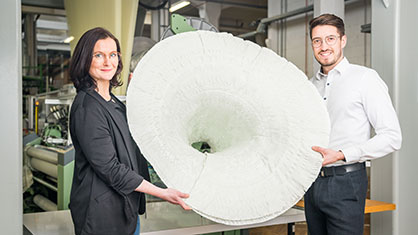
Dr.-Ing. Cornelia Sennewald and Dipl.-Ing. Dominik Nuss show their spherical curved preform, developed and produced at the ITM at TU Dresden  © ITM TUD
Dr.-Ing. Cornelia Sennewald and Dipl.-Ing. Dominik Nuss show their spherical curved preform, developed and produced at the ITM at TU Dresden © ITM TUD


Professor Chokri Cherif, Institute Director of the ITM, and his team are very pleased about these continuous research success in the constantly growing research field of 3D weaving technology, which are achieved at the ITM in close cooperation with industry and users. "This award is a special honour for our institute and confirms that the many years of our excellent research in the field of near-net-shape 3D weaving for the fibre-reinforced plastics sector plays a significant role and that we are making a significant contribution to the sustainable and resource-efficient production of lightweight structures with our development".


AVK awards innovations in fibre-reinforced plastics (FRP) / composites

The German Federation of Reinforced Plastics (AVK) awards the winners in fibre-reinforced plastics / composites, covering the categories Innovative products/components or applications, Innovative procedures/processes, and Research and science. One goal of the AVK Innovation Award is to promote new products/components and applications made from fibre-reinforced plastics (FRP) and to promote new processes and methods for the manufacturing of FRP products. A further award is given to universities, colleges and institutes for outstanding work in science and research. In each of the categories special emphasis will be placed on the issue of sustainability. Another goal of the AVK Innovation Award is to give prominence to the innova- tions and also to the companies/institutions that are behind them, thus publicising their performance throughout the indus- try. The submissions will be evaluated by a jury of experts from the composites sector.
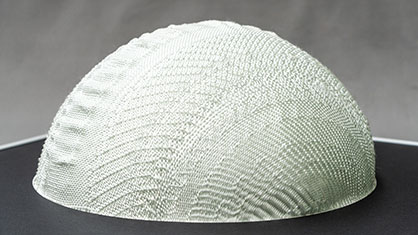

Woven hemisphere for usage in radome antennaes © ITM TUD


More News from TEXDATA International

#ITM 2026

ITM 2026: The new geography of textile production

New production hubs are emerging across North Africa and Central Asia, while Türkiye is accelerating its transformation toward higher-value, technology-driven and more sustainable textile manufacturing.

#Research & Development

“Production is a product”

From technical textiles and AI-driven robotics to the limitations of textile circularity: Professor Dr Thomas Gries looks back on more than two decades of development at ITA Aachen. In the interview, he explains why production technology remains a decisive success factor, discusses international collaborations and innovation ecosystems, and shares his views on the transformation of production landscapes and the challenges facing an increasingly regulated industry.

#Knitting & Hosiery

“We need to move away from the price trap and return to a value-driven mindset.”

With its new Textile Innovation Center, KARL MAYER is sending a strong signal for innovation, collaboration, and the future of textile applications. In this interview, Karl Josef Mayer discusses new opportunities in warp knitting, the processing of staple fibres, recycling, the changing role of machinery manufacturers, and why the textile industry must once again focus more strongly on the value of textiles. by Oliver Schmidt

#Associations

“Innovation, resilience and international experience remain the great strengths of the Swiss textile machinery industry”

Geopolitical uncertainty, growing competitive pressure from China, new free trade agreements and the shift towards a circular economy are currently reshaping the global textile industry. In this interview, Cornelia Buchwalder discusses the current mood within the Swiss textile machinery sector, the industry’s distinctive innovative strength, new market opportunities in India and Asia, and the technological trends that could shape the upcoming trade fair cycle leading up to ITMA 2027.

More News on Research & Development

#Research & Development

GenuTrace client advisory: Is your cotton supply chain UFLPA ready?

U.S. Customs and Border Protection has released updated operational guidance (CBP Publication No. 5560-0526) expanding its forced labor enforcement framework. The guidance supersedes the original 2022 UFLPA Operational Guidance and now covers all forced labor enforcement authorities — UFLPA, CAATSA, and WROs/Findings — in a single unified document. For cotton importers, the enforcement posture has not softened. It has become more structured, more documented, and more demanding. Learn more about UFLPA.

#Research & Development

TERNAfil wins first place at PitchMiUp Night 2026 in Minden

The RWTH spin-off TERNAfil has developed MAXCarbon, a new high-performance hybrid fibre that combines the mechanical performance of carbon with the temperature and corrosion resistance of ceramic materials. For this development, TERNAfil was awarded first prize at the PitchMiUp Night in Minden on 21 May 2026.

#Research & Development

Carbon-ceramic hybrid fibre proves its worth – NRW Minister for Science Mona Neubaur congratulates ITA start-up TERNAfil

MAXCarbon technology, a novel carbon-ceramic hybrid fibre developed by ITA spin-off TERNAfil, secured third place at the HIGH-TECH.NRW Demo Day on the TÜV NORD campus in Essen. The technology combines the strength of carbon fibres with the temperature and corrosion resistance of ceramic materials. Mona Neubaur, Minister for Science in North Rhine-Westphalia, congratulated the team on their success and on winning prize money of 4,000 euros.

#Research & Development

TCLF: Resilient value chains in times of crises

The textiles, clothing, leather and footwear (TCLF) industry was at the centre of the webinar “Resilient value chains in times of crises”, which took place on 28 April 2026. Global supply chains continue to face increasing pressure, raw material dependencies are growing and economic uncertainties are affecting the entire sector.

Latest News

#Carpets

DOMOTEX Hannover 2028 off to a strong start with expanded portfolio

Preparations for DOMOTEX 2028 are already gaining strong momentum. Following its successful repositioning as the Home of Flooring & Interior Finishing, around 100 international manufacturers have already secured their place during the initial registration phase.

#Knitting & Hosiery

STOLL: Agreement signed for the divestiture of selected assets

In early 2025, KARL MAYER announced its strategic decision to focus on its core business areas of WARP KNITTING, WARP PREPARATION, and TECHNICAL TEXTILES. As part of this move, the flat knitting machine business under the STOLL brand was discontinued and the production site in Reutlingen was closed in October 2025.

#Nonwovens

Lenzing Group highlights scalable, bio-based nonwovens solutions at leading global industry fairs

From CIDPEX in China to Techtextil in Frankfurt and INDEX in Geneva, the Lenzing Group showcases ready-for-market, bio-based nonwoven solutions and receives industry recognition for LENZING™ Nonwoven Technology.

#Digital Printing

DTF vs DTG Printing - The technologies shaping today’s custom merchandise market

From sportswear to branded tote bags, custom merchandise continues to grow in popularity across sectors, driving print shops to cater to short runs, personalisation, and rapid turnaround. As print providers look to this market, two printing technologies often stand out: Direct‑to‑Film (DTF) and Direct‑to‑Garment (DTG). Each offers its own benefits, and understanding these differences helps determine the most suitable production method for print service providers.

TOP