[pageLogInLogOut]

#Recycling / Circular Economy

CARBIOS and TOMRA Textiles join forces to scale circularity of polyester textiles
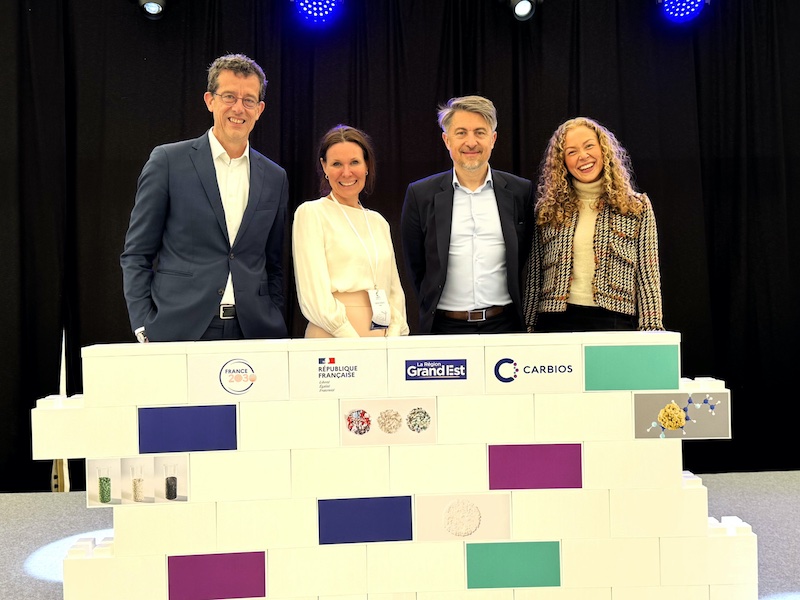
CARBIOS (Euronext Growth Paris: ALCRB), a pioneer in the development and industrialization of biological technologies to reinvent the life cycle of plastic and textiles, and TOMRA Textiles, a tech venture set up by sorting technology leader TOMRA (Oslo Stock Exchange: TOM.OL), announce the signing of an agreement to collaborate on establishing an efficient stream in Northern Europe from textile waste collection, sorting and preparation to recycling using CARBIOS’ enzymatic depolymerization technology at its first commercial plant currently under construction in Longlaville, France.
CARBIOS X Tomra Texiles: Mathieu BERTHOUD, Strategic Sourcing Director, CARBIOS; Vibeke KROHN, Head of TOMRA Textiles; Emmanuel LADENT, CEO, CARBIOS; Mari Larsen SÆTHER, Recycling Lead, TOMRA Textiles © 2024 CARBIOS


The monomers obtained will be used to produce recycled polyester (r-PET) fiber, closing the loop for polyester textile circularity.

The innovations from both TOMRA Textiles and CARBIOS contribute to addressing critical gaps in the value chain and significantly increase textile-to-textile recycling from its current rate of 1%[1]. By accelerating a circular economy for polyester, a sustainable alternative to incineration or landfill is made available.

TOMRA Textiles is on a mission to close the gap in textile circularity, by contributing to designing and scaling textile sorting plants. Under this partnership agreement, TOMRA Textiles will explore specific, tangible measures to enable the preparation of post-consumer polyester waste for biorecycling according to CARBIOS’ specifications.

CARBIOS' biorecycling technology involves breaking down polyester fibers into their basic components using enzymes, which are then used to produce high-quality recycled PET materials such as fibers for the textile industry. The breakthrough collaboration with TOMRA will redirect the challenging PET fraction of polyester textile waste towards biorecycling, showcasing a mutual dedication to pioneering recycling solutions for a circular economy.

CARBIOS is taking the lead in forming an efficient value chain for textile circularity and actively engages with global industry leaders such as TOMRA to shape the future of sustainable textiles", says Emmanuel Ladent, CEO of CARBIOS. Vibeke Krohn, Head of TOMRA Textiles, comments: "The textile industry has been optimized for cost and efficiency for centuries. Closing the gap means scaling all the elements of a circular value chain – from collection to sorting to recycling technologies. Future recycling solutions depend on reliable access to feedstock. Through the collaboration with CARBIOS we hope to stimulate further investments needed to scale textile circularity."

[1] Ellen MacArthur Foundation, 2017


More News from CARBIOS

#Recycled Fibers

Carbios and Wankai postpone startup of China’s first PET biorecycling plant to 2028

The industrial deployment of enzymatic PET recycling in Asia is progressing, but at a slower pace than initially planned. French recycling technology company Carbios and its Chinese partner Wankai New Materials have announced that the commissioning of their planned PET biorecycling facility in Haining, Zhejiang Province, has been postponed and is now expected in the first half of 2028.

#Recycling / Circular Economy

Carbios confirms Longlaville plant in France following financing progress

Carbios has reaffirmed its plans to build its Longlaville plant in France within a project financing framework, targeting the start of production in the first half of 2028. The company also reports a solid cash position of around €60 million at the end of 2025 and has appointed Benoît Grenot as Deputy Chief Executive Officer to support the execution of its strategic projects.

#Recycled Fibers

CARBIOS and Wankai sign strategic PET biorecycling pact

CARBIOS (Euronext Growth Paris: ALCRB) and Wankai New Materials (“Wankai”), a listed subsidiary of Zhink Group, the 3rd largest PET producer in China and 4th worldwide, announce the signing of the definitive agreement establishing a strategic partnership for the industrial rollout of CARBIOS’s PET biorecycling technology in Asia. The first milestone will be the construction of a PET biorecycling plant in China.

#Recycled Fibers

CARBIOS and Wankai plan 1 million tonnes of PET biorecycling capacity in Asia

CARBIOS and Wankai New Materials, a subsidiary of Zhink Group, are committed to the large-scale deployment of CARBIOS’ PET biorecycling technology in Asia, with the first step being the construction of a PET biorecycling plant in China.

More News on Recycling / Circular Economy

#Recycling / Circular Economy

Indorama Ventures advances circularity tthrough PETValue Philippines' “Zero Waste to Landfill Partnership” with Republic Cement

Indorama Ventures Public Company Limited, a global sustainable chemical company, is advancing the circular economy through a new Zero Waste to Landfill initiative at its recycling site PETValue Philippines, further demonstrating how collaboration across industries can maximize resource efficiency and reduce waste.

#Research & Development

Networking Day 2026: Industry stakeholders unite around textile recycling

In 2026, the Industry Research Group (IRG) Polymer Recycling once again brought together some of the key stakeholders in textile recycling for its annual Networking Day. This year, the event took place at EREMA’s premises in Ansfelden, Austria. It brought together key players from across the textile recycling value chain for a day of structured exchange and in-depth discussions.

#Europe

EU ban on destroying unsold clothing and footwear now in force

The European Union's ban on the destruction of unsold clothing, clothing accessories and footwear has entered into force. Since July 19, 2026, large companies across the EU have been prohibited from destroying unsold textile products, while medium-sized companies will be required to comply with the same rules from 2030.

#Recycling / Circular Economy

Circ launches first denim collection with H&M featuring TENCEL™ | Circ® with REFIBRA™ technology

Circ today announced that the first men's denim collection featuring TENCEL™ | Circ® with REFIBRA™ technology is now available at H&M, marking the commercial delivery of this unique pilot project first announced in October 2025. Featuring two styles available across the UK, Scandinavia, Central Europe, Eastern Europe, South Europe, Turkey, North America, Mexico, Canada, and the Middle East, the launch brings TENCEL™ | Circ® with REFIBRA™ technology into H&M's standard men's denim assortment for the first time.

Latest News

#Man-Made Fibers

Ministry of Industry Delegation visits NatureWorks’ second global manufacturing site at Nakhon Sawan Biocomplex

NatureWorks Asia Pacific Limited welcomed a high-level delegation led by Mr. Varawut Silpa-archa, Minister of Industry, to its manufacturing site at the Nakhon Sawan Biocomplex (NBC). The visit follows the successful inauguration of the site on April 29, 2026, and highlights the role of public-private collaboration in advancing Thailand’s sustainable industrial development and bioeconomy ambitions.

#Associations

IVGT membership: expertise that pays off

For energy-intensive textile companies, government compensation mechanisms are an important economic factor. The IVGT successfully supports its member companies in applying for state aid and thereby regularly contributes to significant financial relief.

#Knitting & Hosiery

The new RDJ 7/3 defines the design footprint of modern athletic shoes

Stylish, functional, and efficient to produce – spacer fabrics are the all-arounders among textile materials. These versatile fabrics are particularly in demand in the sports and casual footwear sector, as they combine comfort, breathability, and design freedom. At the same time, this industry is trend-driven, dynamic, and price-sensitive like few others. Innovations are therefore a decisive factor for success. With the RDJ 7/3, KARL MAYER offers a solution specifically tailored to these requirements. The particular strength of the new double raschel machine: its exceptional flexibility, thanks to its three jacquard bars.

#Research & Development

Smart textiles reversibly change shape in an energy-efficient manner in response to ambient temperature

Self-actuating textile structures are used in a wide range of applications, such as medical technology, automation, architecture, agriculture, and the apparel industry. An example is the use of shading nets in greenhouses, which can be deployed and retracted depending on the sunlight intensity. The German Institutes of Textile and Fiber Research Denkendorf (DITF) are developing textiles based on shape-memory polymers with reversibly controllable geometry.

TOP