[pageLogInLogOut]

#Recycling / Circular Economy

CARBIOS and Landbell Group join forces to increase circularity of PET waste at first biorecycling plant

CARBIOS (Euronext Growth Paris: ALCRB), a pioneer in the development and industrialization of biological technologies to reinvent the life cycle of plastic and textiles, and Landbell Group, a global operator of more than 40 producer responsibility organizations (PROs) and a leading provider of closed-loop recycling solutions, announce the signing of a non-binding Memorandum of Understanding for the sourcing, preparation and recycling of post-consumer PET waste using CARBIOS’ biorecycling technology at its first commercial plant in Longlaville from 2026.
  • CARBIOS and Landbell Group sign agreement to develop and implement solutions for the sorting, preparation and enzymatic recycling of post-consumer PET waste
  • CARBIOS and Landbell Group combine expertise and innovation to significantly increase PET recycling from packaging and textile waste
  • This partnership contributes 15kt/year of PET flakes to CARBIOS’ sourcing roadmap for its first commercial plant, 70% of which has been sourced
  • This collaboration demonstrates Landbell Group’s commitment towards building closed-loop solutions for plastic waste through innovative recycling technologies

The partnership will leverage Landbell Group’s expertise and network in the sourcing of PET packaging and textile waste which will be prepared for biorecycling. Thanks to CARBIOS’ highly selective enzyme, less sorting and washing is required compared to current recycling technologies, offering future savings in energy and water use. From 2026, Landbell Group will supply CARBIOS with 15 kt/year of PET flakes, ensuring a steady supply chain for sustainable PET production. These flakes will serve as essential feedstock for CARBIOS’ production of food-grade PTA and MEG, further re-polymerized into PET.

Through the partnership with Landbell Group in Germany, the supply of multilayer trays through the CITEO tender in France and the MoU with Indorama Ventures, CARBIOS will have sourced over 70% of its feedstock required for the 50kt/year capacity when its first commercial plant in Longlaville, France, will operate at full capacity. Close to the borders with Belgium, Germany and Luxembourg, the plant’s location is strategic for nearby waste supplies.

Through this partnership with CARBIOS, Landbell Group will ensure that the problematic PET fractions such as multilayered, colored and opaque trays from packaging waste and polyester textile waste are redirected towards recycling. In this way, Landbell Group strengthens its commitment to the development of innovative recycling solutions to enable a circular economy.

Emmanuel Ladent, CEO of CARBIOS, says: "Through our new partnership with Landbell Group, CARBIOS secures a significant feedstock supply for our first commercial plant, and we are pleased to make biorecycled PET available to Landbell’s extensive client portfolio, powering a circular economy for plastic. CARBIOS’ innovative biorecycling technology enables the conversion of diverse wastes into valuable products, enhancing flexibility and competitiveness. By minimizing bottle usage and diversifying raw material sources, we’re advancing sustainability while meeting market demands effectively. Together, we’re forging a future where waste becomes a valuable resource." 
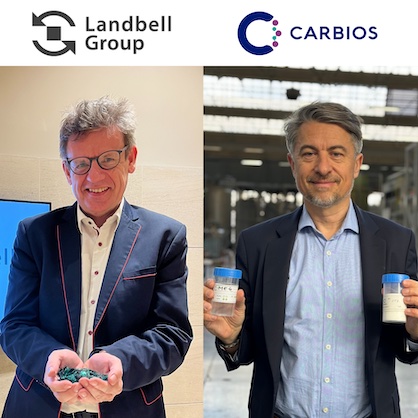
Uwe Echteler - COO Landbell Group and Emmanuel Ladent - CEO CARBIOS © 2024 CARBIOS


And Uwe Echteler, COO of Landbell Group, adds: "PET trays are extensively used in food packaging due to their excellent barrier properties, transparency and strength. However, PET trays, especially with a multi-layered structure, currently pose a challenge for mechanical recycling. The innovative depolymerization process developed by CARBIOS facilitates the recycling of PET waste into high-quality recycled PET. Landbell Group and CARBIOS together will enable closed-loop recycling of problematic PET waste to allow its customers – packaging manufacturers and brands – to use recycled content in food packaging and meet their sustainability targets."

The environmental benefits of CARBIOS’ biorecycling technology

Recent life-cycle analyses[1] show a 57% reduction in CO2 emissions compared with the production of virgin plastic[2], and for every ton of recycled PET produced, 1.3 tons of oil are avoided. Compared with conventional recycling, enzymatic recycling is 5 times more circular (calculated according to the Ellen MacArthur Foundation's Material Circularity Indicator[3]). Thanks to its highly selective enzyme, optimized for efficient PET degradation, CARBIOS’ depolymerization process can process all types of PET waste, including colored, multilayer or textile waste that cannot be recycled using current technologies. Furthermore, the two monomers produced (PTA and MEG) make it possible to recreate recycled PET products of identical quality to petro-sourced ones, and suitable for food contact.


[1] Database ecoinvent 3.8
[2] French scenario, taking into account the detour of 50% of PET waste from conventional end-of-life. Virgin PET: 2.53 kg CO2/kg (cradle to gate)
[3] The Material Circularity Indicator (MCI) is a methodology developed by the Ellen MacArthur Foundation to measure how restorative the material flows are. The MCI gives a value between 0 and 1 where higher values indicate a higher circularity. The MCI value for CARBIOS’ enzymatic recycling is 0.8.




More News from CARBIOS

#Recycled Fibers

Carbios and Wankai postpone startup of China’s first PET biorecycling plant to 2028

The industrial deployment of enzymatic PET recycling in Asia is progressing, but at a slower pace than initially planned. French recycling technology company Carbios and its Chinese partner Wankai New Materials have announced that the commissioning of their planned PET biorecycling facility in Haining, Zhejiang Province, has been postponed and is now expected in the first half of 2028.

#Recycling / Circular Economy

Carbios confirms Longlaville plant in France following financing progress

Carbios has reaffirmed its plans to build its Longlaville plant in France within a project financing framework, targeting the start of production in the first half of 2028. The company also reports a solid cash position of around €60 million at the end of 2025 and has appointed Benoît Grenot as Deputy Chief Executive Officer to support the execution of its strategic projects.

#Recycled Fibers

CARBIOS and Wankai sign strategic PET biorecycling pact

CARBIOS (Euronext Growth Paris: ALCRB) and Wankai New Materials (“Wankai”), a listed subsidiary of Zhink Group, the 3rd largest PET producer in China and 4th worldwide, announce the signing of the definitive agreement establishing a strategic partnership for the industrial rollout of CARBIOS’s PET biorecycling technology in Asia. The first milestone will be the construction of a PET biorecycling plant in China.

#Recycled Fibers

CARBIOS and Wankai plan 1 million tonnes of PET biorecycling capacity in Asia

CARBIOS and Wankai New Materials, a subsidiary of Zhink Group, are committed to the large-scale deployment of CARBIOS’ PET biorecycling technology in Asia, with the first step being the construction of a PET biorecycling plant in China.

More News on Recycling / Circular Economy

#Recycling / Circular Economy

HKRITA signs MoU with Jeanologia and Looptworks to establish the Green Machine Circular Textile Ecosystem

The Hong Kong Research Institute of Textiles and Apparel (HKRITA) yesterday officially signed a landmark Memorandum of Understanding (MoU) with two key global partners, Jeanologia and Looptworks, to establish the Green Machine Circular Textile Ecosystem – a first-of-its-kind collaboration to accelerate the large-scale recycling of blended textiles.

#Spinning

Object Carpet tests production of rPET BCF yarn on Neumag BCF line

In a joint project with Object Carpet GmbH, Denkendorf; the Institute for Textile Technology (ITA), Augsburg; and Next Generation Recyclingmaschinen GmbH (NGR), Feldkirchen, Austria, Barmag investigated the processing of recycled polyester for BCF yarn. The goal was to evaluate the fundamental suitability of 100% recycled carpet material for reuse in carpet yarn production to create a closed-loop system in carpet manufacturing. To date, commercial rPET BCF processes have been based solely on rPET from bottle pellets.

#Recycling / Circular Economy

Albany International reports progress with Cyclezyme on industrial textile recycling project

Albany International Corp. (NYSE:AIN) reports continued progress in the ongoing project with Cyclezyme AB, a leader in advanced enzyme-based plastic recycling, based in Sweden. The project exemplifies leading edge innovation in materials science, focusing on the development of enzyme-based recycling of industrial textiles primarily consisting of polyester and polyamide, where there is currently a significant lack of effective solutions for circular material flows. The objective of the project is to establish enzymatic processes for depolymerization and recycling of technical textiles and high-performance industrial materials.

#Recycling / Circular Economy

The textile industry in transition

Recycling, traceability, eco-design and digitalisation are among the key future challenges facing the European textile industry. The Erasmus+ project Skills4Circularity, involving 21 partners from twelve countries, is investigating the skills required to address these challenges. As the German industry partner, the Industry Association for Finishing – Yarns – Fabrics – Technical Textiles (IVGT) is bringing the industry’s perspective to the project.

Latest News

#Research & Development

2026 general meeting of the Friends and Supporters of RWTH Aachen at ITA

The Friends and Supporters of RWTH Aachen e. V. (proRWTH) looked back on a successful year of support at their 2026 general meeting. The meeting took place at Institut für Textiltechnik (ITA) of RWTH Aachen and was combined with a joint session of the Executive Board and the Administrative Board. Before the general meeting began, participants were given a guided tour of ITA, providing them with fascinating insights into current research and development topics in textile engineering.

#Natural Fibers

Cotton ConneXions Insight to Impact brings supply chain leaders together around cotton innovation

Cotton Incorporated’s Cotton ConneXions Insight to Impact brought together more than 300 industry leaders from 140 companies across 10 countries, including more than 45 top global brands and sourcing organizations, underscoring strong global interest in cotton-rich product development, sourcing and supply chain collaboration.

#Knitting & Hosiery

Footwear innovation enabled by warp knitting technology– insights from New Balance

The future of the athletic shoe is increasingly being shaped on warp knitting machines. For KARL MAYER, the footwear industry is one of the most important growth markets – and one of the sectors where innovative textiles can realize their full potential. In his keynote address at the opening of KARL MAYER’s TEXTILE INNOVATION CENTER in Obertshausen in April, Vishnu Prakash Muthusamy, Senior Textile and Materials Engineer at New Balance, explained the opportunities that warp knitting technology opens up for performance, sustainability, and faster development processes, and why textile manufacturers are transitioning from suppliers to development partners.

#Natural Fibers

Cashmere specialist joins AbTF Board of Trustees

The Aid by Trade Foundation (AbTF) is pleased to welcome Brian Yu, the chief executive officer of the Artwell Group, to its board of trustees. As CEO, Brian Yu developed Artwell into the world’s largest supplier of responsibly produced cashmere knitwear.

TOP