[pageLogInLogOut]

#Recycling / Circular Economy

HAKRO en route to a circular economy

The global Cradle to Cradle Certified® standard is awarded by the Cradle to Cradle Products Innovation Institute (C2CPII), a non-profit organisation which works to advance the circular economy and guarantee safe products. In its certification process the Institute assesses materials and products in reference to five categories: material health, material cycle, renewable energies, water management and social responsibility.

The standard is awarded according to strict criteria and based on the levels Bronze, Silver, Gold and Platinum. The levels reflect both the quality of the individual elements of a product as well as the depth of the data collection. 

The medium-sized textile company achieves the Cradle to Cradle Certified® standard for 14 models in its NOS collection.

  • Cradle to Cradle (C2C) Certified® is a product standard based on the circular economy principle.
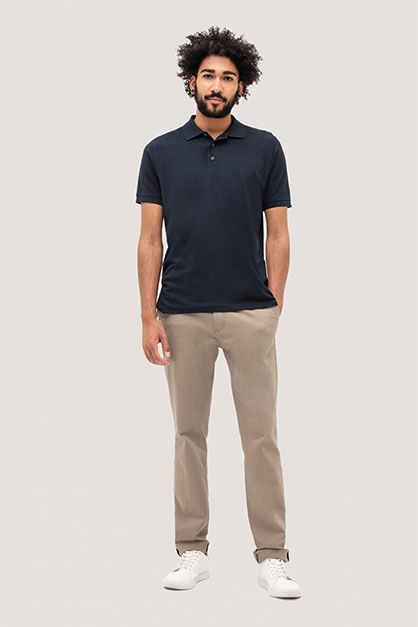
  • Corporate wear supplier HAKRO achieved the Bronze certification level from the Cradle to Cradle Products Innovation Institute (C2CPII) for 14 T-shirts and polo shirts.
  • The C2C Certified® standard covers the entire model range of textiles made from 100% cotton by HAKRO’s production partner in Bangladesh.
  • HAKRO GmbH is planning to obtain the C2C Certified® standard in more locations and for other products.

Corporate wear supplier HAKRO GmbH achieved the Bronze certification level at the first attempt with 14 T-shirts and polo shirts and 100% cotton made by their partner company in Bangladesh. “By 2030 we want to be the leading provider for integrated sustainable corporate wear,” says Carmen Kroll, second-generation manager of the medium-sized company with 200 employees. “After we made our entire collection climate neutral at the start of 2022, achieving the C2C standard for our cotton products from Bangladesh was the next milestone in our sustainable business strategy.“ She considers the first C2C Certified® certification process as a pilot project and already has her eye on the widescale expansion of C2C Certified® standards for HAKRO. 

© 2023 Hakro
© 2023 Hakro


Antonia Hammel, in charge of C2C Certified® standards at HAKRO: “A C2C Certified® certification is a very demanding and complex process in all respects. To achieve Bronze status with 14 products at the same time is a huge success, but it’s just the beginning for HAKRO. True to our high standards in sustainability we want to have our range from other manufacturing locations certified too.”


On the decision to start the first certification process for HAKRO T-shirts and polo shirts from Bangladesh, project manager Antonia Hammel from team Purchasing, Quality and Development said the following: “Our long-standing production partner in Bangladesh runs a vertically integrated operation that combines multiple production levels in one location, which meant we could collect all the data we needed for the certification from a single source.”
© 2023 Hakro
© 2023 Hakro


Implementing a real circular economy still remains a challenge in many areas, including in the textile industry. While the Cradle to Cradle Certified® standard guarantees the product circularity of textiles and thus their suitability for closed material cycles, the certificate alone is not enough to make this a reality. “Completely transferring material product circularity into a real circular system requires more than corporate commitment. A suitable sector infrastructure is currently lacking in Germany. But HAKRO has staying power and we are working closely with likeminded competitors, pioneers, NGOs and community solution providers in order to reach this goal,” Antonia Hammel says, describing HAKRO company management.

HAKRO managing director Carmen Kroll explains why the company has already been doing sustainable business in many areas for a long time already. “Sustainability is not just a marketing trend for us. At HAKRO, sustainability is our highest priority and is a fixed part of our integrated sustainable management strategy. We want to set an example in the textile industry, to show the possibilities and thus encourage other companies to seriously start working towards a sustainable future.”




More News from TEXDATA International

#Texprocess 2026

Texprocess 2026: Automation, digitalisation and AI redefine textile processing

Making investment decisions in textile processing has become significantly more demanding. Increasing energy costs, a shortage of skilled labour and ongoing geopolitical uncertainties are compelling companies to focus on technologies that deliver clear gains in efficiency and process reliability. This applies equally to apparel manufacturing and to the processing of technical textiles and high-performance materials. As a result, modernisation initiatives are assessed more carefully – even as the need to upgrade production systems continues to intensify.

#Techtextil 2026

Techtextil 2026: Between innovation pressure & market reality

From 21 to 24 April 2026, Techtextil in Frankfurt am Main will once again become the central meeting point for the international technical textiles and nonwovens industry. Running in parallel, Texprocess will focus on the industrial implementation of textile processing technologies as the leading platform in this field. Together, the two trade fairs form a closely integrated presentation and working platform along the entire textile value chain – from material development to finished applications.

#Techtextil 2026

Between geopolitical pressure and industrial resilience

In this interview, Dr. Janpeter Horn (VDMA) discusses the current challenges facing textile machinery manufacturers, shaped by geopolitical tensions, regulatory developments and subdued investment. He also outlines why innovation strength, integrated solutions and strategic positioning remain key to global competitiveness.

#Texprocess 2026

Between investment restraint and modernization pressure

Texprocess 2026 takes place in a complex market environment shaped by uncertainty and innovation pressure. In this interview, Elgar Straub (VDMA) explains why the trade fair is particularly relevant this year and which technologies are driving efficiency and competitiveness.

More News on Recycling / Circular Economy

#Recycling / Circular Economy

RE&UP contributes to Global Fashion Summit 2026 circularity discussion

RE&UP contributed to the global conversation on textile circularity at Global Fashion Summit 2026 in Copenhagen, where Fatih Konukoğlu, Chairman of RE&UP and Vice Chairman of Sanko Holding, took part in both the keynote session “The New Rules” and the panel discussion “A Reckoning and Renewal for Circular Horizons”, alongside leaders from H&M Group, Looper Textile Co. and Sourcing Journal.

#Recycling / Circular Economy

Europe’s textile future at a turning point: New 2030 Circularity Blueprint aims to scale recycling and unlock investment opportunities

The EU textile system is at a critical crossroads. Today, less than 1% of discarded garments are recycled into new garments, despite EU-wide obligations for separate collection. In response, Global Fashion Agenda (GFA) is launching the 2030 Circularity Blueprint, in partnership with ReHubs. This ambitious initiative is designed to support the transformation of the EU textile ecosystem to advance textile-to-textile recycling and drive the transition to a circular economy.

#Recycling / Circular Economy

Efficient recycling of textile PET

At the upcoming Plastics Recycling Show Europe in Amsterdam on May 5–6, BB Engineering will present its portfolio of PET recycling technologies. The German machinery manufacturer will once again focus on textile recycling and melt filtration.

#Recycled Fibers

Circulose and CTA announce collaboration to enable lyocell fibers using CIRCULOSE® pulp

Circulose has announced an agreement with China Textile Academy Green Fibre (CTA) to offer lyocell fibers produced using CIRCULOSE® pulp. Producing lyocell from recycled pulp at commercial scale is an important step in making textile-to-textile recycled materials available across a wider range of textile applications.

Latest News

#INDEX 2026

STFI highlights textile circular economy and alternative fibres at INDEX™ 2026

From 19 to 22 May 2026, INDEX will invite visitors to Lake Geneva for the world's leading nonwovens trade fair. The Centre of Excellence in Nonwovens at the Sächsisches Textilforschung- sinstitut e.V. (STFI) will be in attendance to present the latest developments in nonwovens research. In the field of the textile circular economy, the STFI will present acoustically effective nonwovens made from chemical recycling residues. The range also includes innovations aimed at replacing conventional raw materials, such as the biobased and biodegradable polymer polybutylene succinate (PBS) and Kendyr as an alternative to cotton.

#Associations

Italian textile machinery sector faces weak start to 2026 despite domestic growth

In the first quarter of 2026, order intake for Italian textile machinery manufacturers recorded a decrease of 5% compared to the same period in 2025, reflecting a still challenging start to the year. The decline affected foreign markets (-7%), while the domestic market showed growth (+21%).

#Nonwovens

Temafa Maschinenfabrik GmbH supplies a complete decortication plant for processing hemp straw to Hanffaser Geiseltal eG

Temafa Maschinenfabrik GmbH, a leading supplier of machinery and plants for fibre processing, has successfully secured an order to supply a complete plant for processing hemp straw to Hanffaser Geiseltal eG, based in Mücheln.

#Techtextil 2026

FET’s revolutionary gel spinning system wins Techtextil Innovation Award

FET has received the prestigious Techtextil Innovation Award 2026 in the New Production Technology category. The Techtextil Innovation Award honours outstanding ideas in textile technology, sustainability, AI and the creation of technical textiles, selected by an international jury of experts. Ranging from new materials to new production technologies, this award recognises progressive ideas that are driving forces for numerous industries, such as automotive, medical and construction.

TOP