[pageLogInLogOut]

#Recycling / Circular Economy

When talking about recycled materials, origin matters
© 2022 Recover
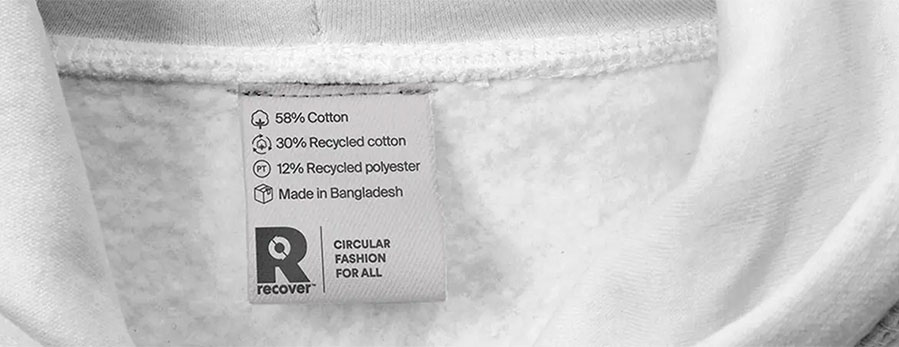
Campaigns advertising textile products made of recycled materials are becoming more frequent. But do we have a clear idea of where these recycled materials come from? Do consumers assume recycled cotton or recycled polyester come from used clothes? Because, in most cases, they do not.

Recycled material refers to a material that would have otherwise been disposed of as waste or used for energy recovery, but has instead been reprocessed as a material input, in lieu of new primary material, for a recycling process.

The items diverted from the waste stream can be used garments, but also plastic bottles, fishing nets, yarns, wool carpets or industrial waste generated in garment manufacturing, among many other sources. Recycled polyester for example can come from post-consumer bottles (collected from the consumer or from beaches and oceans) and from post-industrial polyester fabrics or even from post-consumer textile fabrics.

In most cases, the origin matters. Not only because it might be more challenging to process one or the other (post-consumer usually being the most challenging), but also because the environmental urgency to recycle certain streams can be higher (because this waste has a higher chance of polluting the environment).

Consumers are left to make assumptions

There are currently no clear standards or regulations that specify how the supply chain and brands should communicate about the feedstock origin of the recycled material towards other industry stakeholders (B2B) nor to final consumers. We leave it to the consumer to assume the origin, which lacks full awareness about the different options and the environmental considerations associated with them. Most of the recycled polyester in the textile sector currently does not come from recycled garments, but from bottles. It is great to have this lower footprint recycled polyester in the market, however, to achieve circularity in textiles we need scaled textile-to-textile recycling solutions for polyester textiles. Otherwise, all the garments made with recycled polyester from bottles will just end up in landfill or incinerated after one round of recycling. At the same time, PET bottles are fit for being recycled back into PET bottles many times, in a closed-loop recycling system, when they are part of a clean, separated waste stream.

When Talking About Recycled Materials, Origin Matters

Ideally, the recycled polyester fibers of the future will come from recycled polyester garments, a notional so supported by the new EU strategy for Sustainable and Circular Textiles that encourages businesses to prioritize their efforts on fiber-to-fiber recycling. Luckily, several different technologies for recycling polyester garments are already preparing to ramp up in scale.

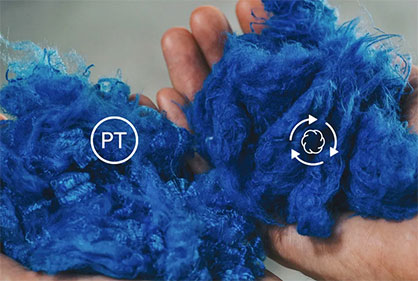
Fiber-to-fiber recycling scope also covers different textile waste sources. Post-industrial, pre-consumer and post-consumer materials are accepted.

Post-industrial textile waste is generated during textile production, for example fabric waste from garment manufacturing, also called clips or scraps. Pre-consumer textiles are finished garments that could not be sold or used (default goods or overstock, for example). Finally, there is post-consumer waste. This is the material generated by the end user of the product that can no longer be used for its intended purpose (clothes no longer suitable to wear that need to be recycled).

Nevertheless, there are no mandatory requirements for specifying the origin of the feedstock on a product care label. In the case of cotton, European legislation does not even allow the word “recycled”to be added to the care label yet. Meanwhile, in the U.S., the regulation is only focused on disclosing the country of origin of the cotton but not mentioning the type of reclaimed material used.


For hangtags and campaigns, where mandatory regulation does not apply, there are no clear guidelines either. Voluntary certifications, like RCS or GRS for tracking and verifying the content of recycled materials, do distinguish among pre-consumer and post-consumer content. However, they do not include the disclosure of the origin of the feedstock as mandatory but leave it up to the brand to decide.

While it is positive to recycle all types of textile waste, to make a distinction on the origin is important since the environmental problem and the challenges to face are much bigger for recycling post-consumer garments, the holy grail of circular textiles. If we only look to the environmental footprint of a final recycled product without that distinction, it could be that post-industrial materials come out better than post-consumer recycled materials due to the extra manual/automated sorting and processing steps required to prepare post-consumer garments for recycling. This can be confusing for consumers.
© 2022 Recover
© 2022 Recover


Upcoming policies like the Green Claims Initiative are supposed to set up minimum criteria for environmental claims and will introduce mandatory disclosure of information such as durability or reparability via a Digital Product Passport. This is clearly needed in the textile sector.

As a basis for this Product Passport, the environmental footprint method will probably be used. This will require consumer education as this information can be complex. As a recycler we argue that aside from environmental footprint, the origin of recycled material matters and therefore this information should also be included on a product. We believe this can help accelerate circularity in textiles and support the consumer in becoming more aware about nuances of circularity which can help inform their purchasing decisions.

Currently, Recover™ mainly uses post-industrial textile waste as inputs for their mechanical recycling process. However, the company has set a clear goal to scale the recycling of post-consumer textiles and for this to represent a significant amount of its feedstock inputs as it scales worldwide.



More News from TEXDATA International

#Recycling / Circular Economy

textile.4U publishes special edition “Top 100 Textile Recycling Companies 2025”

With a comprehensive 176-page special edition, textile.4U is dedicating its latest issue entirely to one of the most dynamic and influential topics in today’s textile industry: textile recycling. The new issue, published exclusively in high-quality print, presents the Top 100 textile recycling companies researched and selected by TexData – organizations that already play a key role in the transition to circular textiles or are expected to have a significant impact in the near future.

#Recycling / Circular Economy

Responsible Textile Recovery Act of 2024 signed by Governor

Senator Josh Newman (D-Fullerton) is proud to announce that Senate Bill 707 (SB 707), the Responsible Textile Recovery Act of 2024, has been signed into law by the Governor of California, Gavin Newsom. This groundbreaking legislation establishes the country’s first Extended Producer Responsibility (EPR) textile recycling program, marking a significant step forward in the state’s efforts to combat waste and promote sustainability.

#Textiles & Apparel / Garment

Modtissimo promotes sustainability with 28 coordinates in the Green Circle

Modtissimo is proving more and more to be a textile and clothing show that delivers the latest innovations in the area of sustainability, with the iTechStyle Green Circle being the main showcase for companies' creations. In this 60+4 edition, taking place on 12 and 13 September, 28 coordinates will be exhibited in a section organised by CITEVE and curated by Paulo Gomes.

#Europe

The EU and Egypt team up to mobilise private sector investments at Investment Conference and sign a Memorandum of Understanding underpinning €1 billion in macro-financial assistance for Egypt

At the EU-Egypt Investment Conference, co-organised by the EU and the Government of Egypt on 29-30 June, the EU and Egypt are teaming up to intensify private sector investments in Egypt. They are also signing a Memorandum of Understanding (MoU) for the disbursement to Egypt of up to €1 billion in Macro-Financial Assistance.

More News on Recycling / Circular Economy

#Research & Development

How innovations drive BASF’s success

“Innovation has always been part of BASF’s DNA. Especially in these volatile times, it is crucial to leverage our innovative strength to develop competitive solutions that differentiate us as a company in our markets and give us a competitive edge,” said Dr. Stephan Kothrade, Member of the Board of Executive Directors of BASF and Chief Technology Officer, at the company’s Research Press Briefing held today. To achieve this, BASF implemented its “Winning Ways” strategy about a year ago with the clear goal of becoming the preferred chemical company to enable its customers’ green transformation.

#Recycling / Circular Economy

Textiles Recycling Expo announces collaboration with Future Fabrics Expo for 2026

The Textiles Recycling Expo has entered a major new collaboration with the Future Fabrics Expo which means that both events will run alongside each other at the Brussels Expo, Belgium on 24–25 June 2026. This co-location marks a significant step forward for the textile and fashion industries, bringing together two influential and complementary events under one roof.

#Recycling / Circular Economy

Between 121 and 142 million people are employed in the circular economy globally, new study finds

Between 121 and 142 million people worldwide are employed in sectors that contribute to the circular economy, such as repair, recycling, second-hand trade and waste management. This represents roughly between 5 and 5.8 percent of total global employment (excluding agriculture), according to a new joint report by Circle Economy, the International Labour Organization (ILO) and the World Bank Group, in partnership with the UN Partnership for Action on Green Economy (UN-PAGE).

Latest News

#Spinning

First PA66 spinning plant with EvoQuench successfully commissioned

With the successful commissioning of a multi-digit PA66 spinning line for microfiber yarns, Chinese textile company Shandong Nanshan Fashion Technology Co., Ltd. has added yarn production to its textile value chain.

#Knitting & Hosiery

SHIMA SEIKI returns to ShanghaiTex

Leading flat knitting solutions provider SHIMA SEIKI MFG., LTD. of Wakayama, Japan, together with its Hong Kong and Chinese market subsidiary SHIMA SEIKI (HONG KONG) LTD., will exhibit at the ShanghaiTex 2025 exhibition (Booth No.: Hall N3, Booth A20) held in Shanghai, China this month. This marks the return of SHIMA SEIKI to ShanghaiTex after a 14-year hiatus, its last exhibit at the show having been in 2011.

#Research & Development

Fraunhofer CCPE presents the “Monomaterial Design Set” – Innovative solutions for circular product design

Composite materials made from different types of plastic often extend the lifetime of products but make recycling more difficult in the circular economy. That is why Fraunhofer CCPE has developed the “Monomaterial Design Set”. This new approach helps to reduce the variety of plastics used in durable products and offers circular solutions for designers and product developers.

#Man-Made Fibers

arena introduces renewable LYCRA® EcoMade fiber in its latest swimwear collection

Italian swimwear specialist arena has unveiled a new collection that brings sustainability and performance even closer together. Launched on December 4, the line features swimsuits made from recycled nylon and renewable LYCRA® EcoMade fiber — the first time the bio-based spandex has been used commercially in swimwear.

TOP