[pageLogInLogOut]

#Recycling / Circular Economy

GANNI introduces styles made with Circulose® in main collection

GANNI pants made with Circulose® – Photo: GANNI
Danish affordable luxury brand GANNI announces their first launch of products made partly with Circulose® within their ‘Fabrics of the Future’ initiative, an ambitious in-house programme dedicated to researching and developing innovative materials that will help inform the transition towards a more circular and lower impact fashion industry. The launch of these exclusive styles coincides with the Global Fashion Summit, the world’s leading summit on sustainability in Fashion. During the summit, GANNI will host pop-ups around Copenhagen and in the brand’s Copenhagen Flagship Store.

“Through Fabrics of the Future we are committed to supporting start-ups in scaling their innovations. Fabric innovations will play a crucial role in making fashion more circular as well as creating lower impact materials, but for that to happen brands need to place bets and take risks. We refuse to accept the industry status quo and with this initiative, we have created a solid framework where research, innovation and cross-industry knowledge sharing can live together. ” — Nicolaj Reffstrup, GANNI Founder

GANNI pants made with Circulose® – Photo: GANNI


Circulose® is a new natural material made by recovering discarded cotton textiles into a dissolving pulp. In a breakthrough process powered by 100% renewable energy, Circulose® transforms discarded textiles into a new material that needs no cotton fields, no oil, and no trees. As a soft introduction, two pants in the Pre-Fall collection will be made of 100% viscose of which 15% is Circulose® recycled from discarded textiles at Renewcell’s plant in Sweden. GANNI is committed to incorporating more of the material into future collections and is already working on other styles upcoming collections.


“Working with progressive brands like GANNI is essential to our effort to make fashion circular at scale — we need their help to prove the quality and style potential of Circulose®. It’s a major milestone for us to make it into GANNI’s main collection. Circulose® changes fashion from the inside by liberating designers from the old constraints of textile-to-textile recycled materials. We are grateful for GANNI’s leadership and look forward to expanding our collaboration as we proceed to open our new commercial scale recycling plant Renewcell 1 in Sundsvall, Sweden, this summer.” — Patrik Lundström, Renewcell CEO
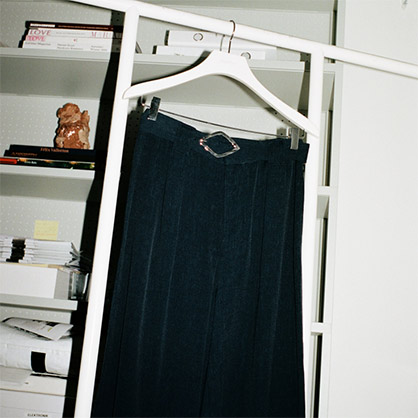
GANNI pants made with Circulose® – Photo: GANNI


More News from TEXDATA International

#Texprocess 2026

Texprocess 2026: Automation, digitalisation and AI redefine textile processing

Making investment decisions in textile processing has become significantly more demanding. Increasing energy costs, a shortage of skilled labour and ongoing geopolitical uncertainties are compelling companies to focus on technologies that deliver clear gains in efficiency and process reliability. This applies equally to apparel manufacturing and to the processing of technical textiles and high-performance materials. As a result, modernisation initiatives are assessed more carefully – even as the need to upgrade production systems continues to intensify.

#Techtextil 2026

Techtextil 2026: Between innovation pressure & market reality

From 21 to 24 April 2026, Techtextil in Frankfurt am Main will once again become the central meeting point for the international technical textiles and nonwovens industry. Running in parallel, Texprocess will focus on the industrial implementation of textile processing technologies as the leading platform in this field. Together, the two trade fairs form a closely integrated presentation and working platform along the entire textile value chain – from material development to finished applications.

#Techtextil 2026

Between geopolitical pressure and industrial resilience

In this interview, Dr. Janpeter Horn (VDMA) discusses the current challenges facing textile machinery manufacturers, shaped by geopolitical tensions, regulatory developments and subdued investment. He also outlines why innovation strength, integrated solutions and strategic positioning remain key to global competitiveness.

#Texprocess 2026

Between investment restraint and modernization pressure

Texprocess 2026 takes place in a complex market environment shaped by uncertainty and innovation pressure. In this interview, Elgar Straub (VDMA) explains why the trade fair is particularly relevant this year and which technologies are driving efficiency and competitiveness.

More News on Recycling / Circular Economy

#Recycling / Circular Economy

Efficient recycling of textile PET

At the upcoming Plastics Recycling Show Europe in Amsterdam on May 5–6, BB Engineering will present its portfolio of PET recycling technologies. The German machinery manufacturer will once again focus on textile recycling and melt filtration.

#Recycled Fibers

Circulose and CTA announce collaboration to enable lyocell fibers using CIRCULOSE® pulp

Circulose has announced an agreement with China Textile Academy Green Fibre (CTA) to offer lyocell fibers produced using CIRCULOSE® pulp. Producing lyocell from recycled pulp at commercial scale is an important step in making textile-to-textile recycled materials available across a wider range of textile applications.

#Recycling / Circular Economy

Solving the Feedstock Gap: Unlocking Post-consumer Feedstocks for Textile-to-Textile Recycling in Europe

Fashion for Good launches Project FAE (Feedstock Activation Europe) to develop the sorting and pre-processing infrastructure needed to channel non-rewearable post-consumer textiles into textile-to-textile (T2T) recycling at scale. The project is a practical response to one of the most pressing problems in textile circularity: making post-consumer waste a viable, commercially competitive raw material for recyclers.

#Techtextil 2026

BASF at Techtextil 2026: Helping to shape the future of the textile industry with tangible solutions

At the leading international trade fair for technical textiles and nonwovens from April 21 to 24, 2026 at the Messe Frankfurt, BASF will present numerous solutions and new projects in the textile sector to customers and partners at booth B 68 in hall 11.0. The focus is on product innovations and future-oriented technologies.

Latest News

#Texprocess 2026

Texprocess 2026: Style3D | ASSYST showcases AI, 3D, 2D and automation and meets strong industry response

Four days, countless discussions and a clear signal from the industry: the future of fashion is digital and AI-driven. At Texprocess 2026, Style3D | ASSYST demonstrated how AI, 3D and automation are already fundamentally transforming processes from design to production.

#Dyeing, Drying, Finishing

Smart Quality Control for Technical Textiles

In the end, what matters is the result: a filter that performs reliably, a membrane that remains stable in storm conditions, a composite material with precisely defined properties. But the path to achieving this is demanding. In the production of technical textiles, numerous parameters interact – and even the smallest deviations can have major consequences.

#Digital Printing

FESPA’s new textile event set to debut in Barcelona this May

In less than one month, the first edition of FESPA’s new Textile event will take place at the Gran Via, Fira de Barcelona, from 19 – 22 May 2026. Co-located with FESPA Global Print Expo, European Sign Expo, Personalisation Experience, WrapFest and the brand-new Corrugated, each of the events will serve as the ideal meeting point for experts across each field to discover the latest technologies and trends, and explore cross-sector opportunities for business growth.

#Raw Materials

Fiber traceability - A vehicle to ensure sustainability or injustice?

The Bremen Cotton Exchange is making a new paper available for download. In this paper, analyst Veronica Bates Kassatly and statistician Terry Townsend examine the justifications behind this approach and assess the consequences for textile and apparel sustainability claims and global legislation.

TOP