[pageLogInLogOut]

#Recycling / Circular Economy

ATKO Planning realizes leather waste circulation

ATKO Planning Inc. (CEO G-ON Kim), a Korean company producing recycled leather, announced that it is receiving offers from global luxury brands for its innovative textile materials, amid the fierce competition in the global textile market.

ATKO collects leather waste from leather tanneries and produces recycled leather yarns and textiles using the world’s first eco-friendly dry processing technology. The company’s recycled leather textile won the grand prize at Premiere Vision Paris 2019, one of the most prestigious events for fashion and textile. It was praised for “the most exceptional, symbolic, and pertinent leather of the season.” 
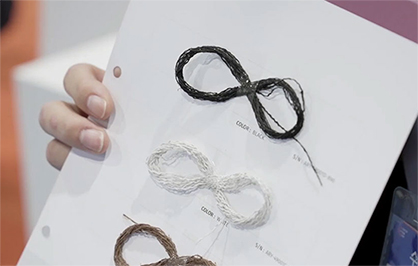
ATKO Planning collects leather waste from leather tanneries and produces recycled leather yarns and textiles using the world’s first eco-friendly dry processing technology. © 2022 ATKO PLANNING


Leather waste used by ATKO is leather scraps collected from LWG Silver and Gold rated leather tanneries. This is why it is possible to produce high-quality leather fibers that enjoy the unique texture and durability of natural leather, unlike the existing regenerated leather that recycles shaving scraps.

Leather scrap is classified as industrial waste because it contains chromium, a heavy metal. Incineration is impossible for this reason, and most are disposed in landfills or dumped in the sea.

However, ocean dumping of leather scrap is becoming more difficult due to a London Convention agreement. While leather scrap accounts for 10% of the world's total waste, only 13.7% of it is recycled. Using ATKO’s recycled leather fabrics will provide a superior solution for manufacturing companies to meet the demands of ESG management without harming the conventional business model that consumes materials and manufactures products.


The key technology of ATKO is selecting only high-quality cow leather waste, obtaining recycled leather fibers through the fiberization process, and mixing them with recycled PET fibers to produce spun yarn. It is a dry process that does not use a single drop of water or chemicals, so it is environmentally friendly because it does not discharge wastewater. In addition, ATKO focuses on the circular economy and has already developed continuous resource circular technology to produce futuristic and sustainable products in balance with the environment. Based on it, ATKO can recycle not only leather waste but also ATKO’s products again and again.

Meanwhile, ATKO supplied recycled leather spun yarn to Hyundai Transys’ future mobility seat concept, which was unveiled at the Lineapelle International Leather Fair held in Milano in February. An official from ATKO expressed aspirations that ATKO Planning will take the exhibition as an opportunity as well as accelerate collaboration projects with Hyundai on mobility interior application and prepare mass production supply. 


More News from TEXDATA International

#ITM 2026

ITM 2026: The new geography of textile production

New production hubs are emerging across North Africa and Central Asia, while Türkiye is accelerating its transformation toward higher-value, technology-driven and more sustainable textile manufacturing.

#Research & Development

“Production is a product”

From technical textiles and AI-driven robotics to the limitations of textile circularity: Professor Dr Thomas Gries looks back on more than two decades of development at ITA Aachen. In the interview, he explains why production technology remains a decisive success factor, discusses international collaborations and innovation ecosystems, and shares his views on the transformation of production landscapes and the challenges facing an increasingly regulated industry.

#Knitting & Hosiery

“We need to move away from the price trap and return to a value-driven mindset.”

With its new Textile Innovation Center, KARL MAYER is sending a strong signal for innovation, collaboration, and the future of textile applications. In this interview, Karl Josef Mayer discusses new opportunities in warp knitting, the processing of staple fibres, recycling, the changing role of machinery manufacturers, and why the textile industry must once again focus more strongly on the value of textiles. by Oliver Schmidt

#Associations

“Innovation, resilience and international experience remain the great strengths of the Swiss textile machinery industry”

Geopolitical uncertainty, growing competitive pressure from China, new free trade agreements and the shift towards a circular economy are currently reshaping the global textile industry. In this interview, Cornelia Buchwalder discusses the current mood within the Swiss textile machinery sector, the industry’s distinctive innovative strength, new market opportunities in India and Asia, and the technological trends that could shape the upcoming trade fair cycle leading up to ITMA 2027.

More News on Recycling / Circular Economy

#Recycling / Circular Economy

The textile industry in transition

Recycling, traceability, eco-design and digitalisation are among the key future challenges facing the European textile industry. The Erasmus+ project Skills4Circularity, involving 21 partners from twelve countries, is investigating the skills required to address these challenges. As the German industry partner, the Industry Association for Finishing – Yarns – Fabrics – Technical Textiles (IVGT) is bringing the industry’s perspective to the project.

#Spinning

"We will become a recycling powerhouse"

The textile industry is now in its fourth consecutive year of crisis, while automation, artificial intelligence and recycling are reshaping the rules of the game. In this interview, Rieter CEO Thomas Oetterli discusses the first signs of a market recovery, reflects on his first three years at the helm of the company, explains the integration of Barmag, outlines Rieter’s vision of the fully automated spinning mill and highlights the strategic importance of recycling. In doing so, he explains why the new Rieter Group aims to play a leading role in transforming the textile value chain into a circular economy.

#Recycling / Circular Economy

Countdown to Textiles Recycling Expo 2026: Brussels prepares for Europe’s textile recycling gathering

With only two weeks remaining until the start of the second edition of the Textiles Recycling Expo 2026, preparations are entering the final phase. The exhibition and conference, dedicated exclusively to textile recycling and circularity, will take place on 24–25 June 2026 at Brussels Expo and is expected to attract stakeholders from across the textile recycling value chain.

#Recycled Fibers

Indorama Ventures enables brands to scale circular textiles through proven, traceable supply chains

Indorama Ventures, a global leader in recycled polyester staple fibers and filament yarns, will exhibit at Textiles Recycling Expo in Brussels on June 24–25. At the event, the company will show how brands and textile manufacturers can build traceable, circular textile supply chains by working with proven partners who deliver recycled materials on an industrial scale.

Latest News

#Spinning

New spinning package with two-step filtration for recycled yarns and more

At the ITM in Istanbul, BB Engineering unveiled its new, patented ValuePack spinning package for the first time, which features a two-stage filtration system. This is particularly beneficial for re-cycling processes. Until now, spinning packs have used either metal powder (“sand”) or filter candles as filter media. Both options are suitable for differ-ent applications, and each has its own specific advantages and dis-advantages.

#ITMA 2027

ITMA 2027 gains strong momentum

In line with the theme "Co-creating the future of textiles", ITMA continues to strengthen its support for start-ups, recognising their role in driving innovation and shaping the future of textile and garment manufacturing. Through the Start-Up Valley, emerging companies gain access to a global marketplace where they can connect with industry leaders, potential partners, investors and customers.

#ITM 2026

Positive market signals for KARL MAYER at ITM 2026

KARL MAYER is pleased with its participation as an exhibitor at ITM 2026. Faced with the challenges of rising domestic costs and fierce competition from low-priced Asian markets, the industry leader had traveled to Istanbul with mixed feelings – yet still draws a really positive conclusion.

#Associations

Mongolia: Workshop on Italian textile technologies kicks off in Ulaanbaatar

The workshop dedicated to Italian textile technologies will kick off in Ulaanbaatar from 21 to 23 June 2026. Focused on the most advanced innovative solutions for the textile industry, the initiative will bring together 13 Italian textile machinery manufacturers, confirming the growing interest in strengthening industrial cooperation between the two countries and highlighting Mongolia’s strategic importance for Italian textile machinery producers.

TOP