[pageLogInLogOut]

#Recycling / Circular Economy

Breaking new ground in Turkey’s textile industry
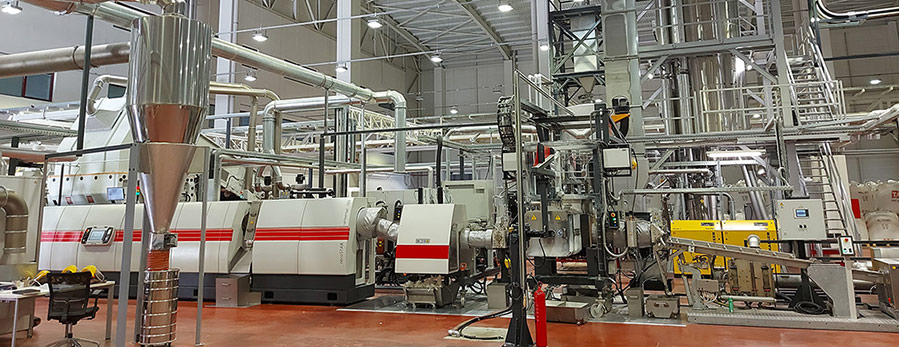
Starlinger recoSTAR universal 165 H-VAC iV+. © Starlinger
The Starlinger recoSTAR universal 165 H-VAC iV+, which is part of Korteks’ 10 million dollars investment in a new polymer recycling facility, took up operation in May 2021. It has a production capacity of 7,200 tons per year and currently processes clean in-house polyester fibers from production scrap together with washed post-consumer PET flakes at a ratio of 50/50.

Korteks, one of the world’s biggest yarn producers based in Bursa, Turkey, has started the production of recycled polyester filament yarn in its production facility using a Starlinger recycling line.

Korteks uses the polyester regranulate at a share of 100 % for its new polyester filament yarn line it is going to market under the name “TAÇ Reborn”. With this investment, the company has made an important step towards establishing a circular economy in the Turkish textile industry.
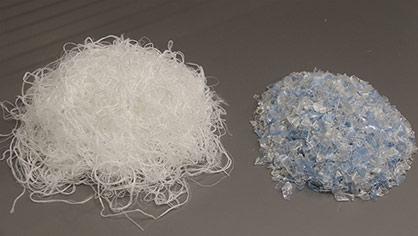
Korteks recycles polyester filament yarn waste and PET bottle flakes. © Korteks


“We have been in extensive cooperation with Starlinger for a long time” said Baris Mert, General Manager of Korteks. “Thanks to their unique and innovative recycling technology we can offer new products in line with the circular economy model. That's why, as Europe's largest integrated and innovative polyester yarn producer, we are very pleased to work with Starlinger, the market leader in PET and polyester recycling and refining.”

Rapid Sleeve Changer: Finest melt filtration for perfect yarn

The Starlinger recycling line is the first of its kind in Turkey and is equipped with special components for filament yarn recycling. A RSC (Rapid Sleeve Changer) candle filter developed by Starlinger ensures finest melt filtration down to 15 micrometer. It has been specially designed for polyester recycling and reaches an output of 1000 kg/h. For continuous operation the filter elements are changed “on the fly” without interrupting production, which significantly limits melt loss.

The viscoSTAR SSP unit at the end of the recycling process guarantees consistent IV increase according to the first-in-first-out principle. This makes sure that the produced regranulate has the ideal properties required for filament yarn production. The technical configuration of the line does not only allow the processing of a polyester fiber/PET flake mix as input materials, but also 100 % polyester filament scrap or 100 % PET bottle flakes.

With the new recycling facility, which comprises a total closed area of 17,000 m² and has a monthly production capacity of 600 tons, Korteks was able to reduce the production waste at its virgin PES yarn site to zero.
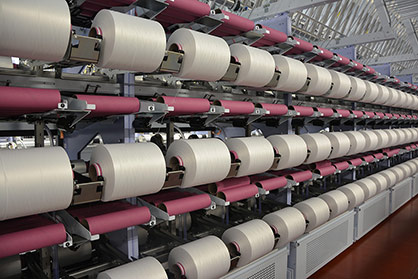
TAÇ polyester yarns are used in a wide variety of applications. © Korteks


A paradigm shift in synthetic fiber production

“We are proud to be a partner in Korteks’ quest for more sustainability in the textile business”, said Paul Niedl, Commercial Head of Starlinger recycling technology. “Turkey is a significant global player in this industry. If more and more Turkish textile manufacturers start using recycled materials, this will be an important signal for the sector and a big step towards a circular economy. We support this development with our extensive know-how in synthetic fiber recycling and supply the fine-tuned and reliable recycling technology required in this field.”
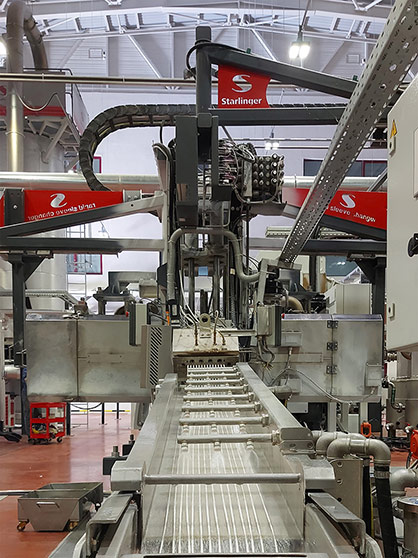
Filter change on the fly: The RSC candle filter before the strand pelletizer operates continuously and has a throughput of 1000 kg/h. © Starlinger


Korteks expects the recycling market in general to grow as there is increased acceptance for recycled products in the society, and predicts the need for recycling solutions also for other synthetic and natural fibers.

“At Korteks, we always aim at sustainable growth that reduces environmental impact and creates value. For this reason, we are gradually expanding our product range in sustainable and smart textiles every day”, said Baris Mert. “The period of the pandemic that the world has been going through has once again strikingly revealed the necessity of building a sustainable living together. The textile industry is also deeply affected by this big transformation on the globe. We believe that those who can manage this change well will also set the global textile agenda in the future. With this belief, we carried out the polyester recycling facility project with an investment of 10 million dollars. Thanks to this project, we broke new ground in Turkey and can produce polyester filament yarn from 100 % PET bottles. Having Starlinger at our side as a business partner gives us strength in our long-term journey towards sustainability.”


More News from Starlinger & Co GmbH

More News on Recycling / Circular Economy

#Recycling / Circular Economy

Reju announces site selection for first U.S. industrial sized facility regeneration hub in Rochester, New York

Reju, the textile-to-textile regeneration company, today announced it has selected the site for its first U.S.-based industrial facility marking a significant milestone in its efforts to scale globally. This future Regeneration Hub will be in Rochester, New York, reinforcing Reju’s commitment to the adoption of circular textile system across key regions worldwide.

#Business

Canopy introduces a first-of-its-kind $2 billion USD investment blueprint to decarbonize global materials supply chains

Today, the global, solutions-driven not-for-profit Canopy joined partners at Davos to introduce a new finance model designed to accelerate the growth of low-carbon materials and transform the paper, packaging, and textile supply chains. The event was anchored by a keynote speech from Sri A Revanth Reddy, Hon’ble Chief Minister of Telangana, with India set to host the first iteration of the new investment blueprint.

#Recycled_Fibers

Borealis invests EUR 49 million in Burghausen, Germany to accelerate design for circularity

Borealis announces a EUR 49 million strategic investment to scale up production of Borstar® Nextension polypropylene (PP) at its manufacturing site in Burghausen, Germany. This will expand commercial production of next-generation single-site polypropylene (ssPP) grades that deliver enhanced purity, processability, and performance - supporting customers in key sectors including packaging, healthcare, mobility, and fibers, to meet evolving market and regulatory demands.

#Recycling / Circular Economy

From local actions to industrial innovations: SOLSTICE shares mid-project results

Since its launch in May 2024, the SOLSTICE project is accelerating the transition from linear models to circular regional ecosystems in the textile industry, focusing on four key territories: Grenoble-Alpes Métropole (France), Berlin (Germany), Prato (Italy), and Catalonia (Spain). By mid-project, SOLSTICE has already revealed both regional disparities and promising solutions to strengthen textile repair, reuse, and recycling infrastructure.

Latest News

#Functional Fabrics

PERFORMANCE DAYS: Focus topic shifts to the beginning of the value chain

Following the last Focus Topic in October 2025, which placed Textile-to-Textile Recycling at its core, PERFORMANCE DAYS continues to drive the conversation around circularity – this time with an expanded and more upstream perspective. The upcoming Focus Topic, “Textile to Textile: The Role of Collectors and Sorters,” presented during the spring edition on March 18–19, will spotlight one of the most essential yet often overlooked components of a functioning circular textile system: the efficient collection and sorting of post-consumer textiles.

#Knitting & Hosiery

Proven performance, optimised costs – the new RE 6 EL

Nowadays textile companies increasingly need to produce small production runs and respond to market changes with instantaneous pattern changes in order to operate profitably – meaning they require machines that offer maximum flexibility, reliability and cost efficiency. KARL MAYER understands the challenges of the market and is launching its new RE 6 EL. The Raschel machine offers the core strengths of the classic RSE 6 EL and essentially the same performance parameters, but has been further cost-optimised largely due to local production advantages. This makes the newcomer an efficiency champion in production, especially when it comes to frequent pattern changes.

#Associations

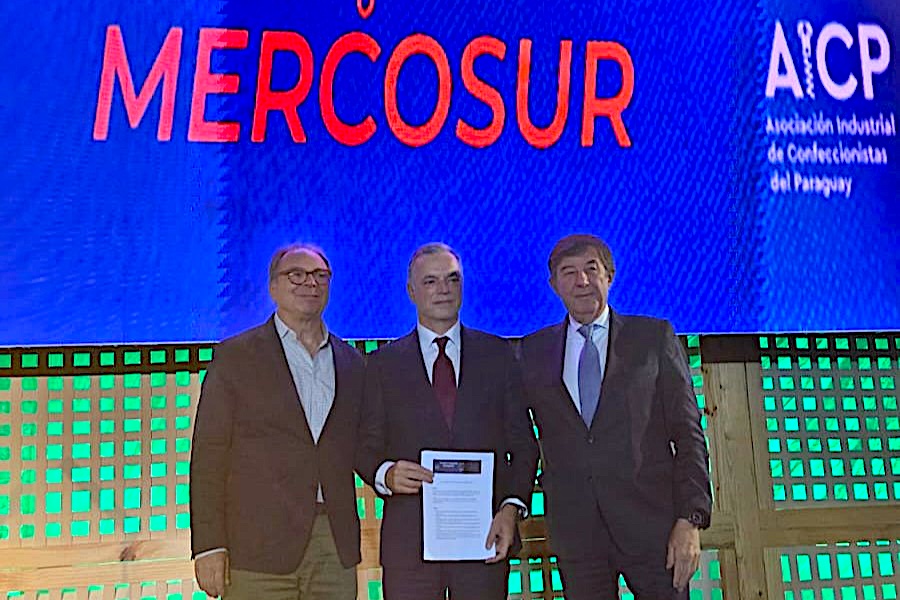
European business associations celebrate the signature of the EU-Mercosur FTA

The 17th January marks a historic milestone with the signing of the EU-Mercosur Trade Agreement, creating the biggest trading block in the world. European business – represented by more than 28 associations across a wide range of sectors – warmly welcomes this signature. It sends a strong and timely signal that the EU remains open and is committed to rules-based global trade. In a time of global uncertainty, this agreement is a key growth booster.

#Carpets

New DOMOTEX impresses across the Board – A complete success

Full halls, innovative products, new synergies, numerous positive discussions, and successful business deals shaped the past four days of the fair. With its new concept, DOMOTEX has reinvented itself and was able to impress both exhibitors and visitors on every level.

TOP