[pageLogInLogOut]

#Recycling / Circular Economy

Recover™, Happy Punt and Hansae Form a strategic partnership to achieve circular fashion for all

Three leading companies in the textiles industry, Recover™, Happy Punt, and Hansae, have entered into a multi-year partnership agreement to provide end-to-end solutions for the design, development, and production of sustainably conscious apparel for the fashion industry. The partnership allows retailers and brands to seamlessly integrate sustainable Recover™ recycled cotton fiber into their products, thereby helping to solve one of the world’s biggest environmental issues.

Using innovative technology, the partnership provides a range of services, including 3D design, patterns, tech packs, samples, and production to support brands and retailers at every step in the supply chain. The partnership offers a unique speed to market solution for the production of fully sustainable apparel and leverages the group’s global reach, with offices in Seoul, Barcelona, and New York. In addition, close customer proximity provides in-market technical design services that develop, review and approve all specifications to ensure correct fit and brand enhancing products.The partnership also provides an end-to-end service that combines the advantages of production nearshore and offshore worldwide.

Dedicated leading edge design and development facilities can produce samples in house from concept to finished sample with a quick turnaround time. Notably, as part of a joint sustainability initiative, the partnership also encourages R&D designs to be replaced by 3D designs to reduce the environmental impact of the sampling process.


The three leading companies have a combined experience of over 130 years in each of their respective fields. Each firm’s commitment to bringing the best technology to the product and the market offers a disruptive approach to the traditional apparel design and production process. The partnership is proud to be actively working with leading global brands to deliver sustainable collections to the market by Spring 2022, and more collections are expected to follow. 

Recover™ will increase its production to 200,000 metric tons of recycled cotton fiber per year by 2025 to support the current market demand. This recycled cotton volume will save nearly three trillion liters of water each year, equivalent to the drinking water consumed by 3 billion people on an annual basis and allow 500,000 acres of land to be directed away from cotton cultivation to other uses.

The Recover™, Happy Punt, and Hansae strategic partnership provides brands and retailers with an easy plug & play solution to achieve their sustainability initiatives and ensures a quality product for the consumer.
More News from TEXDATA International

#ITM 2026

ITM 2026: The new geography of textile production

New production hubs are emerging across North Africa and Central Asia, while Türkiye is accelerating its transformation toward higher-value, technology-driven and more sustainable textile manufacturing.

#Research & Development

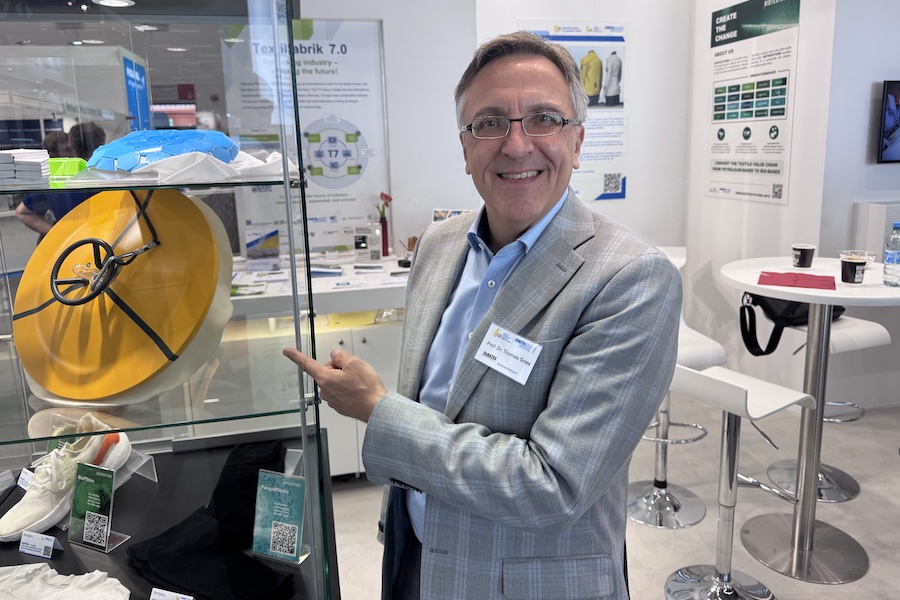
“Production is a product”

From technical textiles and AI-driven robotics to the limitations of textile circularity: Professor Dr Thomas Gries looks back on more than two decades of development at ITA Aachen. In the interview, he explains why production technology remains a decisive success factor, discusses international collaborations and innovation ecosystems, and shares his views on the transformation of production landscapes and the challenges facing an increasingly regulated industry.

#Knitting & Hosiery

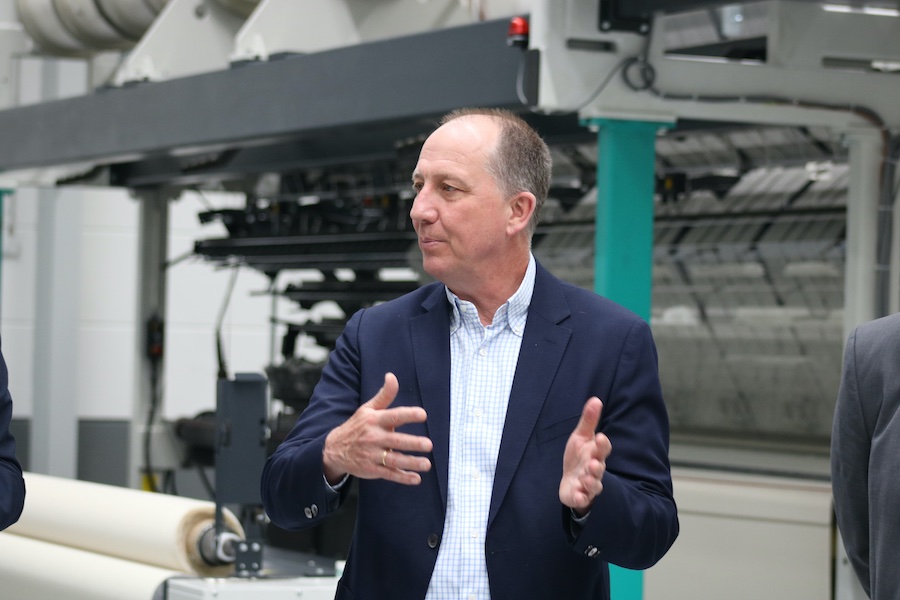
“We need to move away from the price trap and return to a value-driven mindset.”

With its new Textile Innovation Center, KARL MAYER is sending a strong signal for innovation, collaboration, and the future of textile applications. In this interview, Karl Josef Mayer discusses new opportunities in warp knitting, the processing of staple fibres, recycling, the changing role of machinery manufacturers, and why the textile industry must once again focus more strongly on the value of textiles. by Oliver Schmidt

#Associations

“Innovation, resilience and international experience remain the great strengths of the Swiss textile machinery industry”

Geopolitical uncertainty, growing competitive pressure from China, new free trade agreements and the shift towards a circular economy are currently reshaping the global textile industry. In this interview, Cornelia Buchwalder discusses the current mood within the Swiss textile machinery sector, the industry’s distinctive innovative strength, new market opportunities in India and Asia, and the technological trends that could shape the upcoming trade fair cycle leading up to ITMA 2027.

More News on Recycling / Circular Economy

#Recycling / Circular Economy

PURE LOOP's DynaShape® automation increases recycling productivity by up to ten percent

The intelligent automation solution for the ISEC evo recycling machine automatically adjusts operating parameters to changing input materials, improving throughput, melt quality and process stability while reducing operator workload.

#Recycling / Circular Economy

From textile waste to spinning-grade fiber: STADLER Group engineers integrated sorting solution for IGERS in Italy

As technology partner, STADLER worked alongside IGERS on its new plant in San Pietro Mosezzo, Novara, from the first process discussions to the final layout – integrating key treatment equipment into one system and supplying the fully automated sorting line. Together, the two companies have taken IGERS' patented textile recycling process from vision to industrial reality.

#Recycled Fibers

Toray develops Polyester-Nylon fiber containing at least 93% recycled material by mass

Toray Industries, Inc., announced today that it has developed a polyester-nylon fiber with at least 93% recycled content by mass, based on the total weight of the raw yarn. This percentage applies to the newly developed raw yarn and does not represent the recycled content of the finished fabric or garment.

#Recycling / Circular Economy

Canopy shifts focus towards recycling and traceability in updated Hot Button criteria

Environmental non-profit organisation Canopy has introduced revised criteria for its annual Hot Button Report, which evaluates producers of man-made cellulosic fibres (MMCFs), including viscose, lyocell and acetate. The updated framework places greater emphasis on scaling alternative fibre sources, improving supply chain traceability and supporting forest conservation, while maintaining responsible sourcing as a central requirement.

Latest News

TOP