[pageLogInLogOut]

#Recycling / Circular Economy

Collection of Tomorrow closes the loop (again) with circular anorak
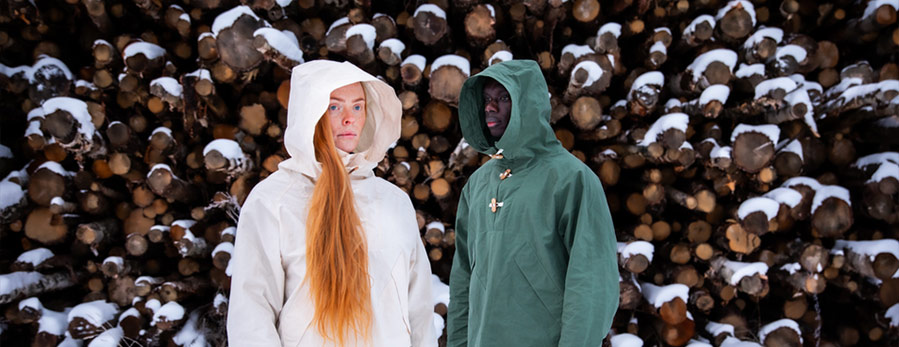
Is this the world's most sustainably made outdoor garment, ask Spinnova, Bergans and Halley Stevensons © 2021 Spinnova
It is quite possible! Spinnova, Bergans and Halley Stevensons have now managed to create a fully circular hiking garment without the use of harmful chemicals. The new anorak is 100% recyclable and can be reproduced several times.

The Collection of Tomorrow is an ambitious innovation collaboration between the Norwegian outdoor brand Bergans, Spinnova and Scottish textile finisher Halley Stevensons. Together, they work to give the textile industry a powerful push towards a more circular future. Spinnova, Bergans and Halley Stevensons are probably the first in the world to close the loop of a textile product without using any harmful chemicals.

– This is a microscopic step for outdoor clothing, but a giant leap for sustainable textile production, says Product Developer in Bergans, Bjørnhild Hoveid Steingrimsen.

The innovative partners have made great progress. They are now ready to launch an outdoor anorak made of Spinnova's cellulose-based material that uses trees as raw material. Spinnova's fiber technology is groundbreaking because the processes take place mechanically, completely without the use of harmful chemicals. The Spinnova team is excited to continue the journey with The Collection of Tomorrow.

– We are thrilled of this next next step in our joint development, through incorporating a high-performance natural wax with Spinnova materials and ageless design by Bergans. This collaboration has played an important role in our efforts in developing commercial fabrics with natural finishings, says Spinnova’s Chief Commercial Officer Lotta Kopra.

To make the fabric more weather-resistant, it has been treated with Halley Stevenson's latest innovation, EverWax Olive - a wax treatment based on olive oil and other plant-based wax types. With this, the garment is 100% recyclable, and the material can be reproduced again and again. Halley Stevensons ensures the fabric gets its technical qualities, without compromising sustainability.

– The opportunity to work with a brand-new material is not something that comes our way every day! It’s been both exciting and challenging to learn how our waxes will work with the Spinnova fibre. We are currently fine tuning a natural plant based wax recipe and gentle process that will complement the circular properties of this innovation, to give lasting performance and recyclability, says Halley Stevensons Managing Director Jimmy Campbell.


Steingrimsen and her product designer colleague Johannes Flem form the main stem in Bergans innovation department – bergans.future.labs. Together with their team they have tested the material and given the anorak its stylish and functional design with a clear reference back in time.

– The transition to a circular economy will require exceptional levels of collaboration across the value chain and the implementation of new sustainable business models. Let’s hope our co-lab will inspire other brands and suppliers to join partners and seek tomorrow's solutions, says Flem.

A new way of owning

The Collection of Tomorrow is not all about materials and technology, it is also about exploring new business models that can help us reduce our consumption of resources. Johannes Flem explains:

– If we are to succeed in this, we have to rethink the concept of owning things. When you buy a piece in The Collection of Tomorrow, you will also become a co-owner in the total amount of Spinnova material that exists in the world. The value of the product is therefore divided in two; one part is the value of the material itself and the second part is the value of the work done to shape the material into a garment.

– The idea is that you can recycle your entire product into a new product once it is worn out or no longer serves its purpose. 100% of the material remains in the loop and reappears as a new product. We do not know if this is possible in a big scale yet, but intend to get there, Steingrimsen concludes.

Anoraks available on pre-order NOW on Bergans Future Labs' online shop!

More News from TEXDATA International

#Techtextil 2026

Performance Apparels: Functional textiles drive innovation at Techtextil 2026

From high-performance fibres and advanced membranes to smart textiles and sustainable material concepts – functional apparel is becoming one of the most dynamic innovation fields in technical textiles. At Techtextil 2026, exhibitors demonstrate how new materials, finishing technologies and digital functions are shaping the next generation of protective, workwear and outdoor systems.

#Texprocess 2026

Texprocess 2026: Automation, digitalisation and AI reshape textile processing

Investment decisions in textile processing have become increasingly complex. Rising energy prices, labour shortages and geopolitical uncertainties are forcing companies to prioritise technologies that deliver measurable improvements in efficiency and process stability. This applies not only to apparel production, but also to the processing of technical textiles and high-performance materials. Modernisation projects are therefore being evaluated more selectively – but the pressure to upgrade production systems continues to grow. Texprocess 2026 reflects this tension between cautious investment behaviour and increasing technological demand.

#Techtextil 2026

Textile Chemicals & Dyes: Innovation in Textile Chemistry moves into focus at Techtextil 2026

From PFAS-free finishes and water-saving dyeing technologies to advanced coatings and recycling-compatible formulations, innovation in textile chemistry is accelerating across the industry. Reflecting this development, Techtextil 2026 introduces Textile Chemicals & Dyes as a dedicated product segment, highlighting the growing role of chemical solutions in shaping the next generation of technical textiles.

#Recycling / Circular Economy

textile.4U publishes special edition “Top 100 Textile Recycling Companies 2025”

With a comprehensive 176-page special edition, textile.4U is dedicating its latest issue entirely to one of the most dynamic and influential topics in today’s textile industry: textile recycling. The new issue, published exclusively in high-quality print, presents the Top 100 textile recycling companies researched and selected by TexData – organizations that already play a key role in the transition to circular textiles or are expected to have a significant impact in the near future.

More News on Recycling / Circular Economy

#Recycling / Circular Economy

Reju secures €135 Million in Dutch NIKI Funding for industrial-scale textile-to-textile regeneration hub at Chemelot Industrial Park, the Netherlands

Reju™, the progressive textile-to-textile regeneration company, has been awarded €135 million in funding under the Netherlands’ Nationale Investeringsregeling Klimaatprojecten Industrie (NIKI) program. The funding will support Reju’s planned industrial-scale Regeneration Hub at Chemelot Industrial Park in Sittard-Geleen, covering both the investment phase and ongoing operations, and represents a critical milestone on the path toward final investment decision.

#Recycling / Circular Economy

eeden is now a Canopy partner

eeden is committed to enable circular textiles by developing recycling technologies that turn textile waste into valuable raw materials. But the commitment goes further – eeden advocates for supply chain solutions that uphold responsible environmental and ethical standards, protecting global ecosystems including Ancient and Endangered Forests.

#Recycling / Circular Economy

Infinited Fiber Company’s environmental permit for Kemi advances to statutory appeal phase

Infinited Fiber has reached an important regulatory milestone in Finland, as the environmental permit process for a potential facility in Kemi has progressed to the statutory appeal phase.

#Recycling / Circular Economy

Carbios confirms Longlaville plant in France following financing progress

Carbios has reaffirmed its plans to build its Longlaville plant in France within a project financing framework, targeting the start of production in the first half of 2028. The company also reports a solid cash position of around €60 million at the end of 2025 and has appointed Benoît Grenot as Deputy Chief Executive Officer to support the execution of its strategic projects.

Latest News

#Techtextil 2026

AI, Start-ups, Research: Techtextil and Texprocess bring together players in the textile industry

From start-ups to universities and research institutes: at Techtextil and Texprocess, the world’s leading innovation trade fairs in Frankfurt am Main, exhibitors present future-oriented concepts for the global textile industry. With the international Campus & Research area, a strong participation from start-ups and the latest AI applications for textile processing, both trade fairs showcase current developments in the textile industry. By bringing together innovation, research and application, they enable new partnerships across the textile value chain.

#Techtextil 2026

IVGT joint stand brings innovation and networking to Techtextil 2026

At Techtextil 2026 and the parallel Texprocess 2026, key transformation topics such as artificial intelligence, digitalisation, sustainability, recycling and the circular economy will be reflected across the show. Against this backdrop, the IVGT, together with 16 member companies, will present its joint stand in Hall 12.1 (Stand D62) as a platform for exchange and networking.

#Man-Made Fibers

Indorama Ventures supports Southeast Asia’s textile customers with reliable regional supply and global innovative portfolio

Indorama Ventures, one of the leading global polyester fiber and filament yarn suppliers globally, will participate in Indo Intertex 2026 in Jakarta this April, making its diverse global portfolio available to apparel, home textile, and hygiene customers across Southeast Asia.

#Raw Materials

New study shows low environmental impact by Cotton made in Africa Organic Cotton from Tanzania

Today, the Aid by Trade Foundation (AbTF) is announcing the results of a comprehensive life-cycle analysis (LCA) for cotton produced in Tanzania under the Cotton made in Africa Organic (CmiA Organic) standard. The study emphasises the small ecological footprint of CmiA Organic verified cotton. This can largely be traced back to the absence of synthetic pesticides, artificial fertilisers, and artificial irrigation. Consequently, CmiA Organic cotton can help the textile industry meet regulatory requirements as well as science-based targets. The results also show that the consequences of climate change threaten the livelihoods of these cotton farmers, even though the type of agriculture they practise barely contributes to climate change.

TOP