[pageLogInLogOut]

#Recycling / Circular Economy

The Fibersort machine is ready to start valorizing global textile waste
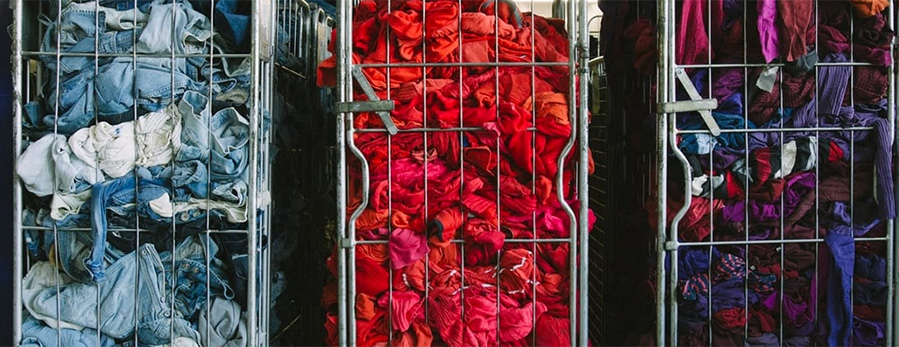
The machine can now sort ~900 kgs of post-consumer textiles per hour, enabling a closed textiles loop (c) 2020 CIRCLE ECONOMY
Today, the Fibersort consortium presents the market ready Fibersort machine to the industry; a cutting edge automated sorting technology that revolutionises textile to textile recycling of post-consumer textiles.

The mountain of used textiles keeps growing

The accelerating consumption and disposal practices in fashion cause textiles entering the market to reach their end-of-use rapidly. In North-West Europe alone, around 4,700 kilo tonnes of post-consumer textile waste is generated every year, a small portion of the global mountain of textile waste. On average, only 30% of these textiles are collected separately- the rest is lost within household waste. In the best-case scenario, these textiles are sold in the second-hand market both locally and internationally. The remaining textiles are considered non-rewearable textiles due to their unsuitability for the second-hand market or the market saturation that second-hand clothing is currently facing. Almost all of these textiles are currently being downcycled, incinerated or landfilled. Nevertheless, 24% of the textiles collected have the potential to be recycled into new textiles, but currently are not. These textiles represent 486 kilo tonnes per year, the equivalent to the weight of 50 eiffel towers!

Automated sorting technologies could enable the industry to turn non-rewearable textiles that currently have no other destination than downcycling, landfill or incineration into valuable feedstock for textile-to-textile recycling. One of these technologies is the Fibersort, a Near Infrared (NIR) based technology able to categorise textiles in 45 different fractions based on their fibre composition and colour. Over the past years, the technology has been optimised, tested and validated to prepare it for commercialisation. The Fibersort is now able to sort ~900 kgs of post-consumer textiles per hour.

Fibersorted materials have been validated by project partners and are ready for the market

The success of the technology is highly dependent on the end-markets that help transform textile waste into new resources. The Fibersort project partners Circle Economy, Valvan Baling Systems, ReShare, Procotex, Worn Again Technologies and Smart Fibersorting have worked with industry stakeholders to better understand these end-markets, assess the potential of the sorted materials and validate the business case of automated sorting as a key enabler of textile-to-textile recycling. Results from these activities are available through project publications and Fibersorted materials are now commercially available for other organisations to test their potential for textile-to-textile recycling.


Challenges remain ahead - what can be done?

There are clear opportunities to successfully integrate automated sorting technologies and recycled post-consumer textiles across the value chain. Over the past years, innovation has spurred across this sector of the industry. However, several challenges remain to ensure the long-term implementation of these technologies in relation to financial and technical feasibility as well as the opportunities to scale. Collectors, sorters, recyclers, manufacturers, brands and policymakers have both opportunities and responsibilities to address these challenges. Although the Interreg NWE Fibersort project reaches its ending date in March 2020, the partners in the Fibersort consortium expect to continue working towards this circular ambition, as well as encouraging others to join the journey.

An end to a project, a start to a new journey

On the 12th of March the Fibersort consortium officially launches the updated Fibersort technology and is hosting an online webinar to explore key project outcomes, share experiences of the collectors, sorters, recyclers, brands, and other stakeholders that made this possible and learn more about how each one of us can contribute to closing the textiles loop, welcoming feedback and insights from the industry to create lasting industry transformation.



More News from TEXDATA International

#Recycling / Circular Economy

textile.4U publishes special edition “Top 100 Textile Recycling Companies 2025”

With a comprehensive 176-page special edition, textile.4U is dedicating its latest issue entirely to one of the most dynamic and influential topics in today’s textile industry: textile recycling. The new issue, published exclusively in high-quality print, presents the Top 100 textile recycling companies researched and selected by TexData – organizations that already play a key role in the transition to circular textiles or are expected to have a significant impact in the near future.

#Recycling / Circular Economy

Responsible Textile Recovery Act of 2024 signed by Governor

Senator Josh Newman (D-Fullerton) is proud to announce that Senate Bill 707 (SB 707), the Responsible Textile Recovery Act of 2024, has been signed into law by the Governor of California, Gavin Newsom. This groundbreaking legislation establishes the country’s first Extended Producer Responsibility (EPR) textile recycling program, marking a significant step forward in the state’s efforts to combat waste and promote sustainability.

#Textiles & Apparel / Garment

Modtissimo promotes sustainability with 28 coordinates in the Green Circle

Modtissimo is proving more and more to be a textile and clothing show that delivers the latest innovations in the area of sustainability, with the iTechStyle Green Circle being the main showcase for companies' creations. In this 60+4 edition, taking place on 12 and 13 September, 28 coordinates will be exhibited in a section organised by CITEVE and curated by Paulo Gomes.

#Europe

The EU and Egypt team up to mobilise private sector investments at Investment Conference and sign a Memorandum of Understanding underpinning €1 billion in macro-financial assistance for Egypt

At the EU-Egypt Investment Conference, co-organised by the EU and the Government of Egypt on 29-30 June, the EU and Egypt are teaming up to intensify private sector investments in Egypt. They are also signing a Memorandum of Understanding (MoU) for the disbursement to Egypt of up to €1 billion in Macro-Financial Assistance.

More News on Recycling / Circular Economy

#Recycled_Fibers

Leading fashion brands step up to unlock the next chapter of Circulose

Since 2024, under new ownership and leadership, Circulose has set a renewed strategic direction focused on securing long-term commitments with partner brands to bring CIRCULOSE® back to market at scale. This strategy has proven successful.

#Recycled_Fibers

Recycling mixed-fibre garments becomes a reality: RadiciGroup, The LYCRA Company and Triumph take circular fashion a step forward

The process, which is both economically and environmentally sustainable, has enabled the production of an underwear set made from 100% recycled nylon and LYCRA® fibre in a closed-loop system.

#Research & Development

How innovations drive BASF’s success

“Innovation has always been part of BASF’s DNA. Especially in these volatile times, it is crucial to leverage our innovative strength to develop competitive solutions that differentiate us as a company in our markets and give us a competitive edge,” said Dr. Stephan Kothrade, Member of the Board of Executive Directors of BASF and Chief Technology Officer, at the company’s Research Press Briefing held today. To achieve this, BASF implemented its “Winning Ways” strategy about a year ago with the clear goal of becoming the preferred chemical company to enable its customers’ green transformation.

#Recycling / Circular Economy

Textiles Recycling Expo announces collaboration with Future Fabrics Expo for 2026

The Textiles Recycling Expo has entered a major new collaboration with the Future Fabrics Expo which means that both events will run alongside each other at the Brussels Expo, Belgium on 24–25 June 2026. This co-location marks a significant step forward for the textile and fashion industries, bringing together two influential and complementary events under one roof.

Latest News

#Associations

Driving innovation in technical textiles, digitalisation and testing

Members of the British Textile Machinery Association (BTMA) can look back on 2025 as a year marked by notable technological advances and continued progress in global trade, despite an uncertain and volatile market.

#Heimtextil 2026

Artificial Intelligence in focus: Heimtextil 2026 prepares global textile industry for the future with strong content programme

Artificial intelligence (AI) rapidly transforms the textile industry - from creation and production to pricing, distribution and communication. But how can AI be applied successfully, and where does it truly add value? Heimtextil addresses these questions from 13 to 16 January 2026: The comprehensive programme dedicated to the key future field AI strengthens the global industry and opens up new business opportunities as well as practical applications for design, retail, industry, architecture, interior design and contract furnishing.

#Weaving

Lindauer Dornier announces leadership transition in weaving machine business

After more than ten successful years at Lindauer DORNIER GmbH, Mr Wolfgang Schöffl will leave the family-owned company at the end of the year to enter well-deserved retirement.

#Heimtextil 2026

Texpertise Focus AI: Messe Frankfurt puts Artificial Intelligence centre stage at its international textile and apparel trade fairs

Under the banner 'Texpertise Focus AI, Messe Frankfurt will place a strong emphasis on Artificial Intelligence (AI) across its international textile and apparel trade fairs from 2026 onwards, setting a future-shaping signal for the industry. The initiative highlights the responsible use of AI along the entire textile value chain, from fibre production to the point of sale. The programme will launch at Heimtextil in Frankfurt in January 2026.

TOP