[pageLogInLogOut]

#Recycling / Circular Economy

The Foundation signs a joint letter on the EU Circular Economy Act

Today, the European Commission has launched a crucial Public Consultation for its upcoming Circular Economy Act (CEA). The Foundation has joined a coalition of seven leading European civil society organisations to issue a joint statement calling for an ambitious and transformative piece of legislation.


The highly anticipated Circular Economy Act, expected to be proposed in Q4 2026, is a cornerstone of the EU's broader Clean Industrial Deal package, which aims to position the EU as the world leader in the circular economy by 2030. This new act will build upon the foundation laid by the 2020 Circular Economy Action Plan, which has already spurred significant legislative initiatives in areas like product design and waste management.

The joint statement is a collaborative effort by seven prominent European civil society organisations: Cambridge Institute for Sustainability Leadership (CISL), Ellen MacArthur Foundation, Environment Coalition on Standards (ECOS), European Environmental Bureau (EEB), Institute for European Environmental Policy (IEEP), Reuse and Recycling European Union Social Enterprises (RREUSE), Zero Waste Europe. The statement aims to ensure that the Act fully embeds circular economy principles in Europe’s entire economic system.

The statement reinforces the role of the circular economy as key for the EU to reach its three main priorities: competitiveness, strategic resilience, and decarbonisation. It urges the European Commission to ensure that the upcoming EU Circular Economy Act delivers an ambitious, systemic shift in how Europe manages its material use, specifically with three asks: 

+ Set science-based targets on resource use.

+ Harness the potential of keeping products and components in use, not just materials.

+ Accelerate safe material circulation by integrating chemical and circular economy legislation.

The publication of this joint letter marks a significant moment in the journey towards a more circular and sustainable Europe. It underscores the urgent need for robust legislation that can accelerate the transition and secure the EU's leadership in the global circular economy.

The letter:

https://content.ellenmacarthurfoundation.org/m/4859b348f9745f3d/original/Circular-Economy-Act-Letter-Aug-1-2025.pdf?_gl=1*ximztn*_ga*NzkzNDE0MTQwLjE3NTQ1OTcxMjI.*_ga_V32N675KJX*czE3NTQ1OTcxMTkkbzEkZzEkdDE3NTQ1OTc1OTQkajUyJGwwJGgw*_gcl_au*MTIxMjY1MTg1LjE3NTQ1OTc1ODc.

More News from Ellen MacArthur Foundation

More News on Recycling / Circular Economy

#Recycling / Circular Economy

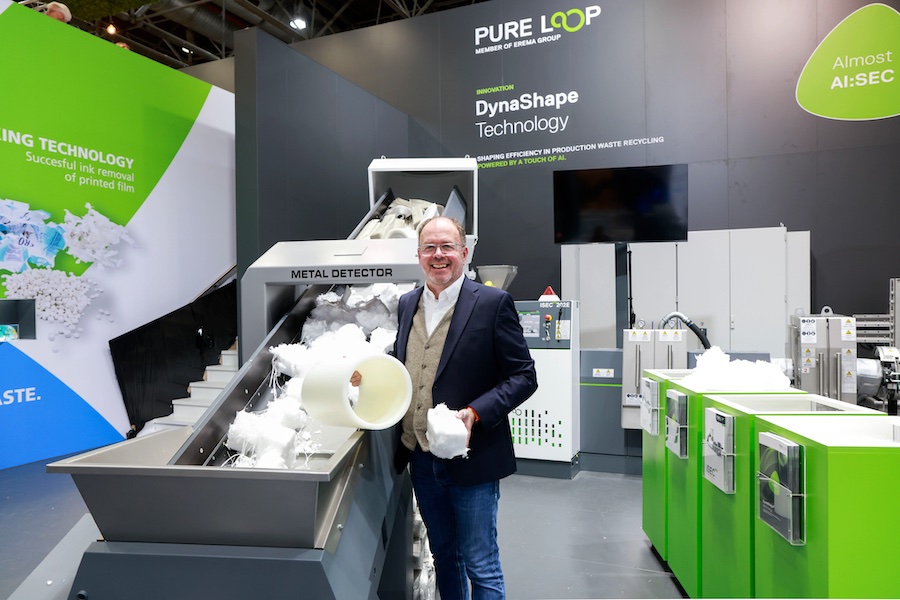
PURE LOOP's DynaShape® automation increases recycling productivity by up to ten percent

The intelligent automation solution for the ISEC evo recycling machine automatically adjusts operating parameters to changing input materials, improving throughput, melt quality and process stability while reducing operator workload.

#Recycling / Circular Economy

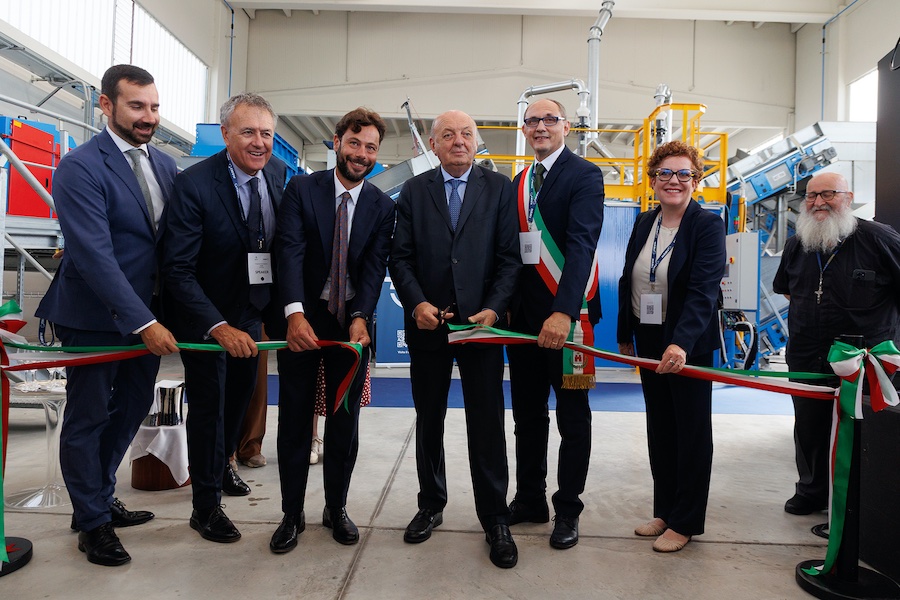
From textile waste to spinning-grade fiber: STADLER Group engineers integrated sorting solution for IGERS in Italy

As technology partner, STADLER worked alongside IGERS on its new plant in San Pietro Mosezzo, Novara, from the first process discussions to the final layout – integrating key treatment equipment into one system and supplying the fully automated sorting line. Together, the two companies have taken IGERS' patented textile recycling process from vision to industrial reality.

#Recycled Fibers

Toray develops Polyester-Nylon fiber containing at least 93% recycled material by mass

Toray Industries, Inc., announced today that it has developed a polyester-nylon fiber with at least 93% recycled content by mass, based on the total weight of the raw yarn. This percentage applies to the newly developed raw yarn and does not represent the recycled content of the finished fabric or garment.

#Recycling / Circular Economy

Canopy shifts focus towards recycling and traceability in updated Hot Button criteria

Environmental non-profit organisation Canopy has introduced revised criteria for its annual Hot Button Report, which evaluates producers of man-made cellulosic fibres (MMCFs), including viscose, lyocell and acetate. The updated framework places greater emphasis on scaling alternative fibre sources, improving supply chain traceability and supporting forest conservation, while maintaining responsible sourcing as a central requirement.

Latest News

TOP