[pageLogInLogOut]

#Recycling / Circular Economy

Syre signs MoU with Binh Dinh Province of Vietnam with intention of establishing Gigascale recycling plant
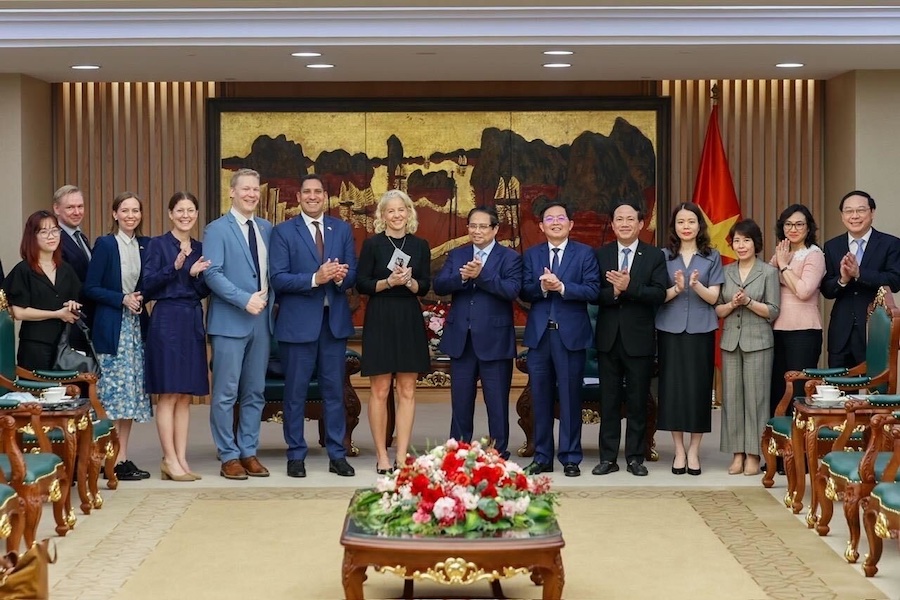
Syre, the textile impact company hyperscaling textile-to-textile recycling, today announces a Memorandum of Understanding (MoU) with the province of Binh Dinh,Vietnam. The MoU reflects a partnership with Binh Dinh with the intention of establishing Syre’s first Gigascale recycling plant in the province.
The MoU was signed during a formal ceremony © 2025 Syre


In connection with the signing of a USD 100M Series A funding round in May 2024, Syre announced it had shortlisted Vietnam as a probable location for its first Gigascale recycling plant. Vietnam was chosen due to its strategic positioning within the textile supply chain, with a long history of a vibrant textile industry and access to know-how. Since then, Syre has been driving an ongoing thorough investigation and site selection process, with a list of key criteria and conditions.

The MoU reflects a partnership with the Binh Dinh Province and Syre, working together to ensure the key criteria and conditions are met for an investment decision of an establishment of Syre’s first Gigascale recycling plant. The key criteria for establishment include access to; Industrial Park with close distance to infrastructure, Green Energy, Feedstock (recyclable textile material), as well as a pilot mechanism with licence to import recyclable textile material from surrounding countries.
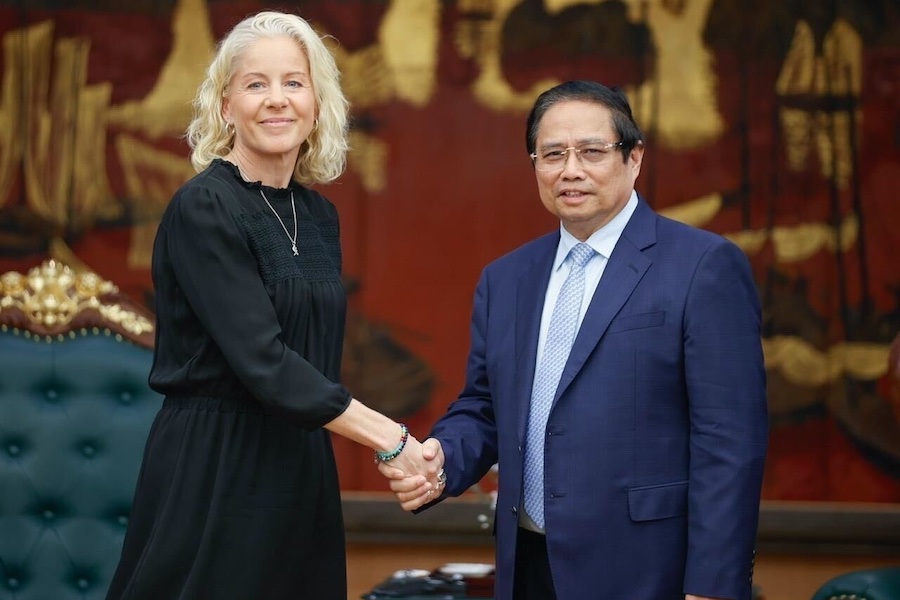
Syre Chair Susanna Campbell and Pham Minh Chinh, Prime Minister of Vietnam © 2025 Syre


In a meeting in Hanoi on April 23, Syre had the opportunity to present its intended plans for Prime Minister of Vietnam, Pham Minh Chinh.

“We are grateful and encouraged by the strong support expressed by the Vietnamese government. Syre has an ambition to support Vietnam in its green transition and as a global leader in the circular textile industry. The partnership with the BinhDinh Province will, with the right conditions in place, be a great opportunity to jointly lead the textile shift. We now need to work together to get all fundamentals in place for an investment decision,” says Dennis Nobelius, CEO of Syre.

Syre aims at establishing several Gigascale textile-to-textile recycling plants across the globe in the coming decade, closing the loop from textile waste to circular polyester in each region. One Gigascale plant is designed for an annual output of 100-250,000 metric tons of high-quality PET chips. Each plant project is expected to generate up to 600 jobs, including skilled manufacturing workers, technical experts and operational support staff.


More News from Syre

More News on Recycling / Circular Economy

#Research & Development

How innovations drive BASF’s success

“Innovation has always been part of BASF’s DNA. Especially in these volatile times, it is crucial to leverage our innovative strength to develop competitive solutions that differentiate us as a company in our markets and give us a competitive edge,” said Dr. Stephan Kothrade, Member of the Board of Executive Directors of BASF and Chief Technology Officer, at the company’s Research Press Briefing held today. To achieve this, BASF implemented its “Winning Ways” strategy about a year ago with the clear goal of becoming the preferred chemical company to enable its customers’ green transformation.

#Recycling / Circular Economy

Textiles Recycling Expo announces collaboration with Future Fabrics Expo for 2026

The Textiles Recycling Expo has entered a major new collaboration with the Future Fabrics Expo which means that both events will run alongside each other at the Brussels Expo, Belgium on 24–25 June 2026. This co-location marks a significant step forward for the textile and fashion industries, bringing together two influential and complementary events under one roof.

#Recycling / Circular Economy

Between 121 and 142 million people are employed in the circular economy globally, new study finds

Between 121 and 142 million people worldwide are employed in sectors that contribute to the circular economy, such as repair, recycling, second-hand trade and waste management. This represents roughly between 5 and 5.8 percent of total global employment (excluding agriculture), according to a new joint report by Circle Economy, the International Labour Organization (ILO) and the World Bank Group, in partnership with the UN Partnership for Action on Green Economy (UN-PAGE).

Latest News

#Spinning

First PA66 spinning plant with EvoQuench successfully commissioned

With the successful commissioning of a multi-digit PA66 spinning line for microfiber yarns, Chinese textile company Shandong Nanshan Fashion Technology Co., Ltd. has added yarn production to its textile value chain.

#Knitting & Hosiery

SHIMA SEIKI returns to ShanghaiTex

Leading flat knitting solutions provider SHIMA SEIKI MFG., LTD. of Wakayama, Japan, together with its Hong Kong and Chinese market subsidiary SHIMA SEIKI (HONG KONG) LTD., will exhibit at the ShanghaiTex 2025 exhibition (Booth No.: Hall N3, Booth A20) held in Shanghai, China this month. This marks the return of SHIMA SEIKI to ShanghaiTex after a 14-year hiatus, its last exhibit at the show having been in 2011.

#Research & Development

Fraunhofer CCPE presents the “Monomaterial Design Set” – Innovative solutions for circular product design

Composite materials made from different types of plastic often extend the lifetime of products but make recycling more difficult in the circular economy. That is why Fraunhofer CCPE has developed the “Monomaterial Design Set”. This new approach helps to reduce the variety of plastics used in durable products and offers circular solutions for designers and product developers.

#Man-Made Fibers

arena introduces renewable LYCRA® EcoMade fiber in its latest swimwear collection

Italian swimwear specialist arena has unveiled a new collection that brings sustainability and performance even closer together. Launched on December 4, the line features swimsuits made from recycled nylon and renewable LYCRA® EcoMade fiber — the first time the bio-based spandex has been used commercially in swimwear.

TOP