[pageLogInLogOut]

#Recycling / Circular Economy

Recycled and Runway Ready: Naia™’s new creative expression leveraging AI technology

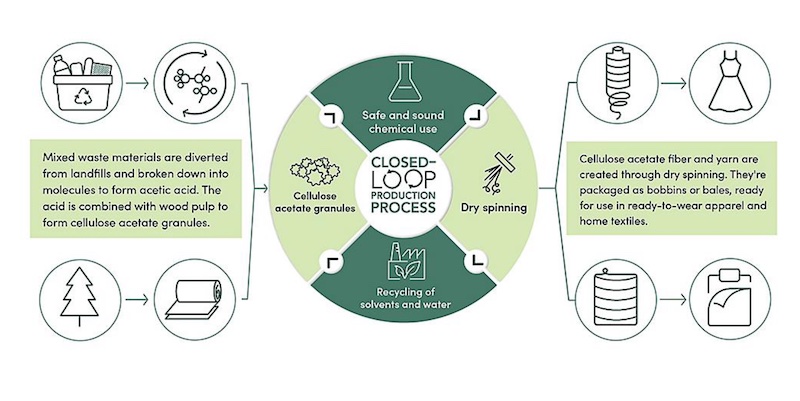
Naia™ from Eastman’s fibers set a superior standard in responsible fashion thanks to a process that changes the paradigm of circularity: Eastman’s carbon renewal technology. This technology breaks hard to recycle waste down into its molecular building blocks and recomposes them into high quality feedstock that can be used to create Naia™ Renew, a versatile, functional, traceable, biodegradable and compostable GRS-certified cellulosic fiber, ready to be transformed into new fashion collections without compromising style and comfort.
Naia™ from Eastman’s fibers set a superior standard in responsible and circular fashion thanks to Eastman’s carbon renewal technology © 2024 Eastman


Eastman is already offering, at scale, a fiber featuring 60% GRS-certified recycled content, Naia™ Renew ES (Enhanced Sustainability) – and the goal is to be even more ambitious. Naia™ Renew ES is made from 40% certified recycled waste material, 20% certified recycled cellulose and 40% sustainably sourced wood pulp.
© 2024 Eastman
© 2024 Eastman


To best convey this extraordinary message the company has introduced its new “Recycled and Runway Ready” creative expression, showcasing the process of transforming waste into beauty through a combination of photography and artificial intelligence (AI). Made with recycled materials, wonderful garments take shape, spanning from the most elegant and formal style to casual streetwear, while adapting to every fashion need under the sign of versatility.

The images evoke a kind of movie magic, but there is, most of all, technology and innovation behind these striking results. The women are wearing real garments, for sale in stores around the world and online. Naia™ recycled-content fibers are available at scale and featured in the collections of top fashion brands. With Eastman’s technology, there is no need to choose between responsible and beautiful because Naia™ Renew fibers can be used in countless applications to achieve fashion-forward looks.

More News from Eastman

#Denim

Eastman Naia™ debuts at Kingpins Amsterdam, transforming Denim from the inside out

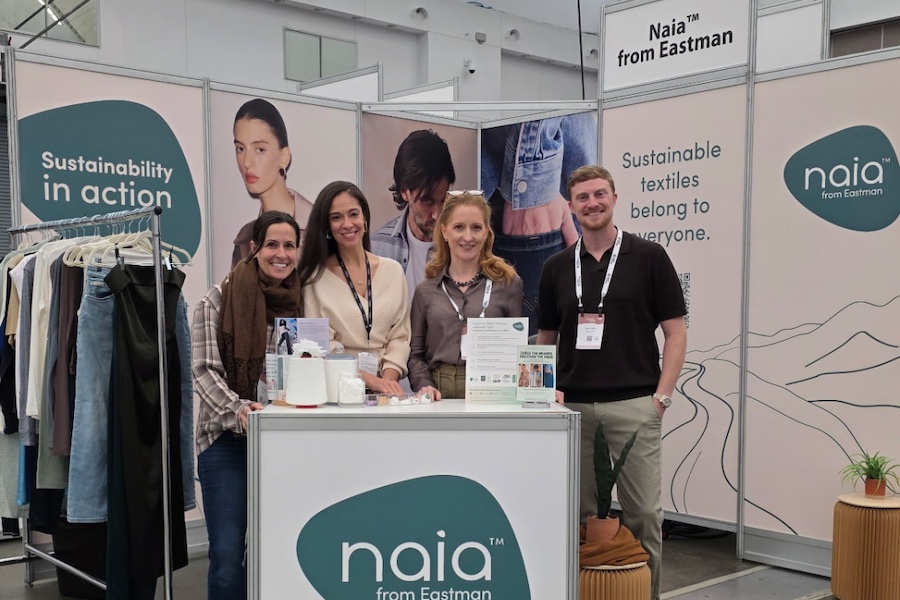
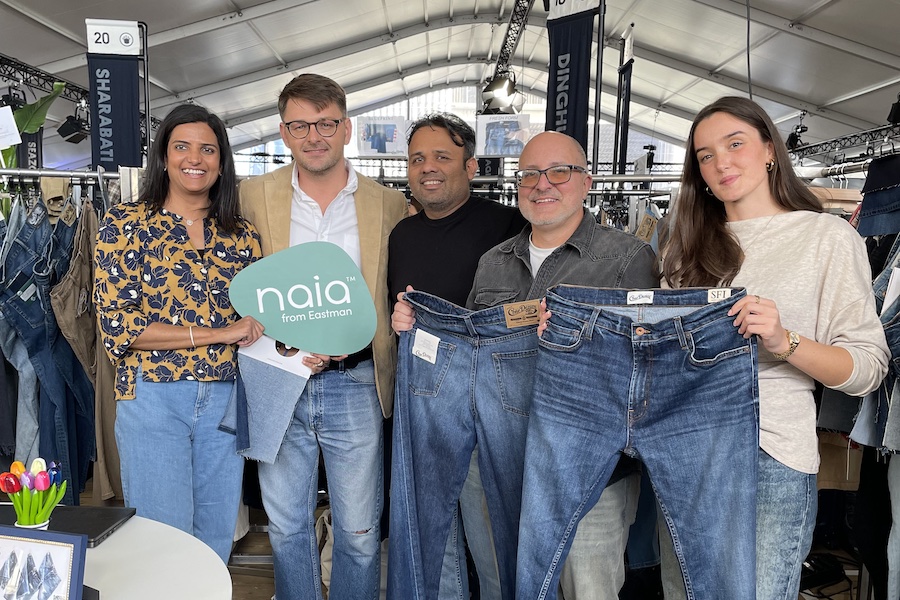
At Kingpins Amsterdam (April 15–16, 2026), Naia™ by Eastman Chemical Company makes its debut, presenting its approach to circularity and comfort in denim at Stand 1, Ground Level (Blue Area). The brand also highlights its growing global ecosystem, connecting mill partners, designers and brands working to expand denim possibilities through fiber innovation.

#Yarns

Eastman introduces Naia™ Lyte at Première Vision Paris, marking a major breakthrough in fiber tenacity for cellulose acetate filament yarn performance

Eastman unveils Naia™ Lyte, a new cellulose acetate filament yarn that represents an important milestone in performance for lightweight and premium fabrics, at Première Vision Paris. Presented for the first time to the international fashion and textile community, Naia™ Lyte expands the capabilities of acetate yarn by introducing enhanced tenacity, unlocking new creative and technical possibilities for designers, mills and brands.

#Heimtextil 2026

Eastman Naia™ expands All-Night Comfort at Heimtextil 2026

New fill solutions and the debut of sleepwear highlight the versatility and performance of Naia™ Renew, its circular fiber, for home textile applications.

#Sustainability

Eastman Naia™ awarded top Canopy rating at Textile Exchange Conference 2025, advancing its sustainability 2025–2030 goals

At the Textile Exchange Conference in Lisbon, Eastman Naia™ was honored with its fourth consecutive “Dark Green Shirt” in Canopy’s Hot Button Report, an annual ranking of man-made cellulosic fiber producers based on forest conservation, sourcing risk, and supply chain transparency. The recognition confirms Naia™’s ongoing leadership in responsible sourcing and environmental stewardship, distinguishing it as one of the industry’s most trusted fiber platforms.

More News on Recycling / Circular Economy

#Research & Development

ALADIN paves the way for circular and demand-driven textile production in Europe

Textile production can be organized sustainably by utilizing short supply chains and preventing overproduction. This can already be achieved today by intelligently connecting and efficiently utilizing existing infrastructure. At the same time, production becomes circular when innovative technologies and materials are used that enable high-quality recycling. The ALADIN research project, launched in May 2026 and co-funded with five million euros under the EU Horizon Europe program, is creating the conditions for this.

#Recycling / Circular Economy

Ence and ShareTex begin initial testing of the ATENEA innovation project to promote textile recycling in Spain

Ence and ShareTex are making progress on the Atenea R&D project, which aims to develop a complete value chain for textile recycling in Spain. Specifically, the goal of the ATENEA project—which is funded by the Center for Technological Development and Innovation (CDTI)—is to connect all the necessary stages for the recovery of textile waste, from collection and management, through recycling and transformation into new raw materials, to their incorporation into new textile products.

#Recycling / Circular Economy

DePoly Inaugurates its Showcase Plant in Monthey Switzerland

What if used plastic bottles, PET packaging material and polyester textiles could become raw materials just as high performing as virgin resources? That is the ambition of DePoly, a circular materials company based in Sion, Switzerland which inaugurated its Showcase Plant in Monthey on July 6th & 7th. The first depolymerization facility of its kind and scale in Switzerland, this industrial Showcase Plant represents a major milestone in the company's growth and its journey toward commercialization.

#Recycling / Circular Economy

Commission clarifies rules on plastic bottles recycling

The European Commission today adopted new rules on recycling of single-use plastic beverage bottles made primarily of polyethylene terephthalate (PET bottles). These rules establish, for the first time, a methodology to calculate, verify and report chemically recycled content. This is part of the Commission’s December 2025 plastics package.

Latest News

#Nonwovens

Katharina Obergruber appointed to the Management Board of Sandler AG

The Supervisory Board of Sandler AG has appointed Katharina Obergruber to the company’s Management Board. Effective September 1, 2026, the Board will consist of Philipp Ebbinghaus (CEO), Dr. Ulrich Hornfeck (currently CCO, future COO), and Katharina Obergruber (CCO). Katharina Obergruber, currently Chief Sales Officer Hygiene and member of the Management Team of Sandler AG, will assume responsibility for all sales activities as Chief Commercial Officer. She will assume this role from Dr. Ulrich Hornfeck, who will focus primarily on production and supply chain topics.

#Sustainability

Global Standards establishes new non-profit foundation to strengthen governance

Global Standards gGmbH, the nonprofit organisation behind the globally recognised Global Organic Textile Standard (GOTS), announced a new governance structure designed to support its long-term mission and reinforce organisational autonomy of its Voluntary Sustainability Standards and programmes.

#Textile chemistry

DyStar releases FY2025 sustainability report, marking a new milestone towards its 2030 targets

DyStar, a leading specialty chemicals company with more than a century of expertise in product development and innovation, today announced the release of its FY2025 Sustainability Report, marking a significant milestone in its sustainability journey and reinforcing its commitment to long-term value creation.

#Research & Development

TERIS reaches milestone: Fraunhofer consortium develops new standards for tire analysis

In the “TERIS” project, the Fraunhofer institutes ICT, IGD, and IWM—led by the Fraunhofer Institute for Structural Durability and System Reliability LBF—have reached a decisive milestone. For the first time, the teams aim to generate, analyse, and predict tire wear in the laboratory in a standardized and practical manner. As part of this milestone, results are now available on reference abrasion, particle analysis, tribological models, AI-based surface analysis, a test bench concept, and methods for accelerated aging and VOC detection. The tire industry, testing services, and environmental agencies will in future benefit from reliable, rapid laboratory procedures for emissions assessment.

TOP