[pageLogInLogOut]

#Recycling / Circular Economy

NILIT goes circular with SENSIL® Flow
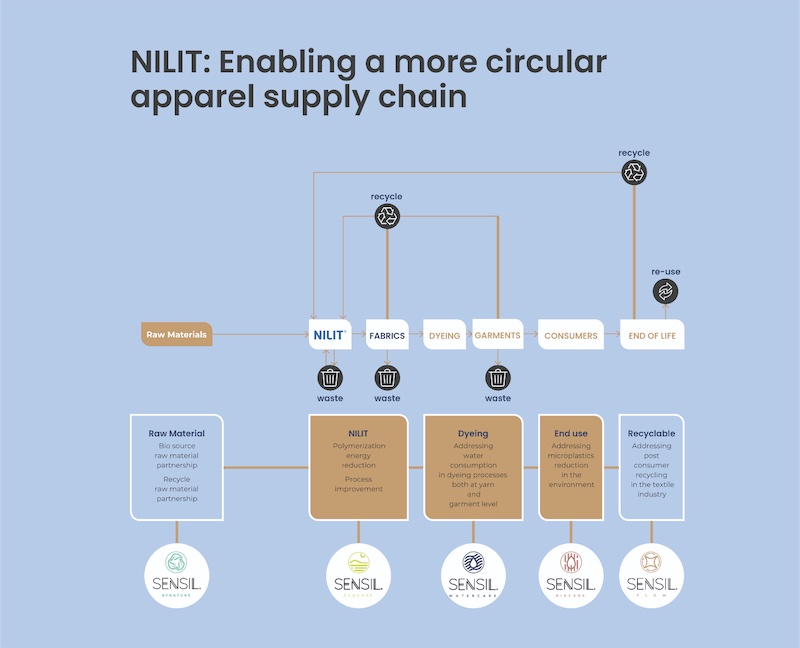
NILIT, the global market leader, and a producer of high quality Nylon 6.6 for apparel and owner of the SENSIL® brand, introduces SENSIL® Flow, a new approach to Nylon 6.6 circularity that enables yarn, fabric, and, ultimately, apparel recycling to eliminate waste and further reduce apparel’s environmental impact. SENSIL® Flow is more than just a sustainable performance product. It is an innovative approach that engages the entire supply chain to truly attain circularity through product design and partnership.
NILITs new SENSIL Flow approach engages the entire textile supply chain to reduce waste throughout, increase the use of recycled content, and ultimately enable apparel recycling with long-lasting garments thoughtfully designed using new mono-component premium SENSIL Flow Nylon 6.6. (Graphic: Business Wire)


“Our mission to create a more sustainable textile industry requires a shift in mindset throughout the value chain,” says Ilan Melamed, NILIT General Manager. “SENSIL® Flow represents an out-of-the-box approach that directly enables yarn and fabric recycling and lays the groundwork for apparel recycling and is part of a broader circularity mission for NILIT. Such a significant industry transformation can only be attained through deep partnerships that create innovative products and processes, visionary designs, and a collaborative reconfiguration of the value chain itself.”

“According to industry experts, more than 90 million tons of apparel end up in landfills each year,” says Michelle Lea, NILIT’s Chief Marketing and Sustainability Officer. “Only about a fifth of discarded clothing is reused or recycled. The SENSIL® Flow approach eliminates waste throughout the production chain and enables brands to design apparel that lasts longer and, at the end of an extensive life, can be more easily recycled.”

Today, apparel recycling is constrained by the complexity of sorting and separating materials before they can be recycled back to their original components, Garments made with blended fibers and fabrics are especially difficult to recycle.

The SENSIL® Flow approach addresses these obstacles on multiple fronts. First, SENSIL® Flow is a yarn that delivers a mono-component fabric with comfort stretch that can be considered as an alternative to elastane in certain end uses. Engineered to provide inherent elasticity and recovery properties, SENSIL® Flow creates comfortable, stretchable performance fabrics for the casual and lifestyle segments. These beautiful fabrics have excellent color absorption and exquisite 3D effects while at the same time making post-consumer recycling possible. Pure premium Nylon 6.6 yarns, fabrics, and garments are easily recycled using a process that requires no additional chemicals and generates minimal CO2 emissions.

Additionally, NILIT partners with recycling experts to facilitate the efficient recovery and recycling of fabric waste and post-consumer fabrics and clothing that would otherwise end up in a landfill or incinerator. These partners are expected to create high quality recycled Nylon chips that can be reintroduced into NILIT’s Nylon fiber spinning process, resulting in high quality outputs, as well as other engineering plastics. Certificates will validate circularity and provide transparency and accountability for partners committed to building a circular textile economy.

Celebrating 50 years of excellence, NILIT offers a comprehensive collection of premium Nylons designed to empower the apparel industry’s shift to a more sustainable position. NILIT launched industry-first SENSIL® ByNature made using bio-gas from reclaimed landfill waste. SENSIL® BioCare is enhanced with a special technology proven to help lessen the persistence of textile waste in sea water and in landfills. SENSIL® EcoCare, crafted with recycled Nylon, improves circularity and LCA. SENSIL® WaterCare with embedded color saves up to 100% of the water used in the traditional wet dyeing process. Plus, the complete SENSIL® portfolio of products is manufactured according to NILIT’s Total Product Sustainability criteria. These responsible yarns give designers the beautiful, environmentally considerate performance fabrics they need to create apparel collections that respond to consumer demands.



More News from NILIT

More News on Recycling / Circular Economy

#Recycling / Circular Economy

Solving the Feedstock Gap: Unlocking Post-consumer Feedstocks for Textile-to-Textile Recycling in Europe

Fashion for Good launches Project FAE (Feedstock Activation Europe) to develop the sorting and pre-processing infrastructure needed to channel non-rewearable post-consumer textiles into textile-to-textile (T2T) recycling at scale. The project is a practical response to one of the most pressing problems in textile circularity: making post-consumer waste a viable, commercially competitive raw material for recyclers.

#Techtextil 2026

BASF at Techtextil 2026: Helping to shape the future of the textile industry with tangible solutions

At the leading international trade fair for technical textiles and nonwovens from April 21 to 24, 2026 at the Messe Frankfurt, BASF will present numerous solutions and new projects in the textile sector to customers and partners at booth B 68 in hall 11.0. The focus is on product innovations and future-oriented technologies.

#Recycled Fibers

RE&UP partners with Madewell and ISKO on textile-to-textile denim capsule

RE&UP Recycling Technologies is accelerating the shift toward a closed-loop textile economy through a collaboration with American denim brand Madewell and global fabric manufacturer ISKO. By transforming approximately 20,000 pairs of post-consumer jeans into recycled feedstock for a textile-to-textile denim capsule, RE&UP demonstrates the commercial viability of circular systems in the denim sector.

#Recycled Fibers

Syre and JEPLAN Announce Strategic Partnership to Accelerate Textile-to-Textile Recycling

JEPLAN, INC. the Japanese pioneer developing and operating chemical recycling technologies for circularity in packaging and textiles, and Syre, the textile impact company on a mission to hyperscale textile-to-textile recycling, announced today a strategic partnership. Together, the companies aim to extensively accelerate the timeline towards commercialization of next generation textile-to-textile polyester recycling technology.

Latest News

#Texprocess 2026

Texprocess 2026: Automation, digitalisation and AI redefine textile processing

Making investment decisions in textile processing has become significantly more demanding. Increasing energy costs, a shortage of skilled labour and ongoing geopolitical uncertainties are compelling companies to focus on technologies that deliver clear gains in efficiency and process reliability. This applies equally to apparel manufacturing and to the processing of technical textiles and high-performance materials. As a result, modernisation initiatives are assessed more carefully – even as the need to upgrade production systems continues to intensify.

#Techtextil 2026

VDMA members at Techtextil: Smart technologies for technical textiles

At Techtextil 2026 in Frankfurt, the members of VDMA Textile Machinery underline their key role as global technology leaders for technical textiles and textile processing. With a strong presence of more than 50 members they will highlight how engineering excellence, innovation strength and sustainability expertise from Germany and Europe are shaping the future of the textile industry. Seven companies will be present at the VDMA group stand in the centre of hall 12.0.

#Techtextil 2026

Techtextil 2026: Between innovation pressure & market reality

From 21 to 24 April 2026, Techtextil in Frankfurt am Main will once again become the central meeting point for the international technical textiles and nonwovens industry. Running in parallel, Texprocess will focus on the industrial implementation of textile processing technologies as the leading platform in this field. Together, the two trade fairs form a closely integrated presentation and working platform along the entire textile value chain – from material development to finished applications.

#Techtextil 2026

Between geopolitical pressure and industrial resilience

In this interview, Dr. Janpeter Horn (VDMA) discusses the current challenges facing textile machinery manufacturers, shaped by geopolitical tensions, regulatory developments and subdued investment. He also outlines why innovation strength, integrated solutions and strategic positioning remain key to global competitiveness.

TOP