[pageLogInLogOut]

#Raw Materials

Better Cotton, in collaboration with African Export-Import Bank, joins WTO and FIFA efforts to scale more sustainable cotton production in africa
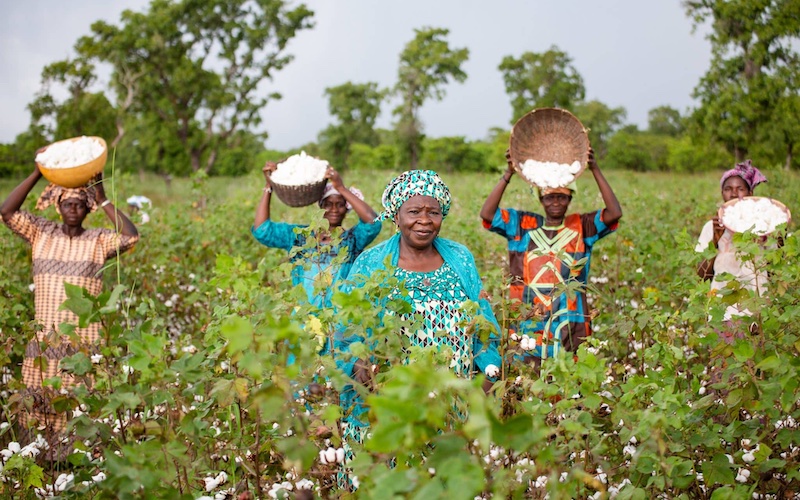
Better Cotton is to conduct sustainability mapping and assessments in West and Central Africa to enhance its understanding of the needs of smallholder farmers in the region and identify context-specific interventions.
Tata Djire, Agronomist, with cotton farmers in a field in Togoya Photo Credit: Better Cotton/Seun Adatsi. Location: Kolondieba, Mali. 2019


Funded by the African Export-Import Bank (Afreximbank), these assessments will inform ways in which targeted support can aid the production of more sustainable and regenerative cotton across Better Cotton’s programmes in Mali and Côte d’Ivoire – which engage a combined 200,000 farmers and farm workers. 

This collaboration between Better Cotton and Afreximbank is part of wider efforts on the continent, led by the World Trade Organization (WTO) and football governing body FIFA, which aim to support the development of the cotton-to-textile value chain in West and Central Africa and improve economic returns for the sector. 

In 2022, the WTO and FIFA formalised a partnership to enhance the participation of Burkina Faso, Benin, Chad and Mali – known as the Cotton Four (C4) – as well as neighbouring countries like Côte d’Ivoire, within apparel value chains.

In February of this year, the pair officially launched a coalition, ‘Partenariat pour le Coton’ – of which Better Cotton is a member – to accelerate work on this front. 

In doing so, they issued a call for investment, emphasising that the current balance of exporting 90% cotton raw material falls short of the region’s economic potential. While raw material exports generate vital revenues, organisations active on the continent believe there is scope to bolster local processing capacities in order to boost incomes. 

Better Cotton’s assessments – conducted with support from its Programme Partners in Mali and Côte d’Ivoire – will connect farming communities to the WTO and FIFA’s mission to strengthen supply chains in the region.? 

Better Cotton remains committed to Africa and continues to build upon its presence on the continent. In November 2023, the organisation launched its programme in Côte d’Ivoire and co-hosted an event in Chad to discuss opportunities to establish a programme in the country. 

"Africa is a vibrant and exciting region for cotton production and our expansion on the continent is demonstrative of that. At the heart of our mission are cotton farmers, workers and the surrounding communities – these assessments will help optimise our efforts and pave the way for continued sustainable economic development across Mali and Côte d’Ivoire", says Alan McClay, Chief Executive Officer at Better Cotton. 

Kanayo Awani, Executive Vice President at Intra-African Trade Bank, Afreximbank, comments:" Through initiatives like these, we are committed to supporting Africa’s smallholder farmers and the entire cotton value chain, enabling them to extract maximum value from their produce, boost value addition, attain higher levels of sustainability and improve quality, all while prioritising superior products with global market potential.”
More News from Better Cotton

More News on Raw Materials

#Raw Materials

Cotton Brazil Dialogues 2026 concludes with 50 international participants immersed in Brazilian cotton production

The Cotton Brazil Dialogues concludes its 2026 edition after a series of technical visits to farms, cotton gins and reference centers, as well as workshops focused on Brazilian cotton production. A total of 50 participants from 14 countries took part in the field trips. The initiative is led by the Brazilian Association of Cotton Growers (Abrapa) and the National Association of Cotton Exporters (Anea), with support from the Brazilian Trade and Investment Promotion Agency (ApexBrasil).

#Raw Materials

Global cotton production projected to outpace consumption, but risks remain

Global cotton production is projected to reach 26.2 million tonnes in the 2026/27 season, marginally outpacing estimated consumption of 25.9 million tonnes. However, early-season production risks — including weather volatility and pest pressures — could narrow that buffer as the crop progresses, according to the September 2026 issue of Cotton This Month, published by the International Cotton Advisory Committee (ICAC).

#Natural Fibers

Global garment trade nears USD 550 billion as competition intensifies

The global garment industry has undergone a dramatic transformation over the past two decades, with knit and woven garments together accounting for nearly 60% of world textile exports in 2025, according to the August 2026 issue of The Textiles Observer, a free publication from the International Cotton Advisory Committee (ICAC).

#Raw Materials

Brazil sets new cotton export record and consolidates global leadership

Brazil ended the 2025/26 commercial year with a new record, consolidating its position as the world’s largest cotton exporter. Between August 2025 and July 2026, the country shipped 3,373,941 tonnes of the fiber, 19% more than in the previous cycle, and reached record revenue of US$5.3 billion. The result represents a milestone in Brazil’s expansion in the international market and reinforces the country’s role as a strategic supplier to the global textile industry.

Latest News

#Weaving

Lindauer DORNIER GmbH welcomes new apprentices and dual-study students

For 22 new “DORNIER Talents”, these days mark the beginning of a new chapter at Lindauer DORNIER. For the family-owned company, in-house training is a key pillar in developing skilled professionals and retaining them within the company for the long term.

#Research & Development

Novel flame-retardant and recyclable fiber-reinforced composite

Airplanes and passenger trains must meet strict safety requirements, including fire safety standards. This calls for materials that are flame-retardant, lightweight, robust, and scalable. Empa researchers, in collaboration with their industry partner Elantas, have now succeeded for the first time in making such a material – a composite – fully recyclable.

#Composites

WHILL selects Teijin’s tough, lightweight Carbon Fiber Composite for new last-mile mobility

Teijin Limited announced today that WHILL Inc., a global leader in inclusive mobility technology, has selected Sereebo® P CFP series, a carbon fiber-reinforced thermoplastic (CFRTP) material, for key structural components of the upcoming WHILL Model C Lite. Sereebo® P CFP series provides high strength, light weight, design flexibility and system cost advantages to the Model C Lite, which is a battery powered, single-seat, last-mile device. This new model combines maneuverability with light weight and one-handed folding to ensure ease of handling and operation.

#Textile chemistry

ZymoChem secures $4 million in renewed federal funding to advance U.S. biomanufacturing of critical materials and their supply chains

ZymoChem, the specialty chemicals company dedicated to bringing decarbonization, sustainability, and supply chain resiliency to the chemical industry through innovative biological manufacturing, today announced the resumption and expansion of its federal research portfolio. The company has been notified that previously paused work under a $5 million U.S. Department of Energy (DOE) program is officially back on, to be joined by continuing collaborations with three of the nation's premier national laboratories.

TOP