[pageLogInLogOut]

#Nonwoven machines

ANDRITZ airlay line for nonwovens production from recycled glass wool starts up at Revibat, France
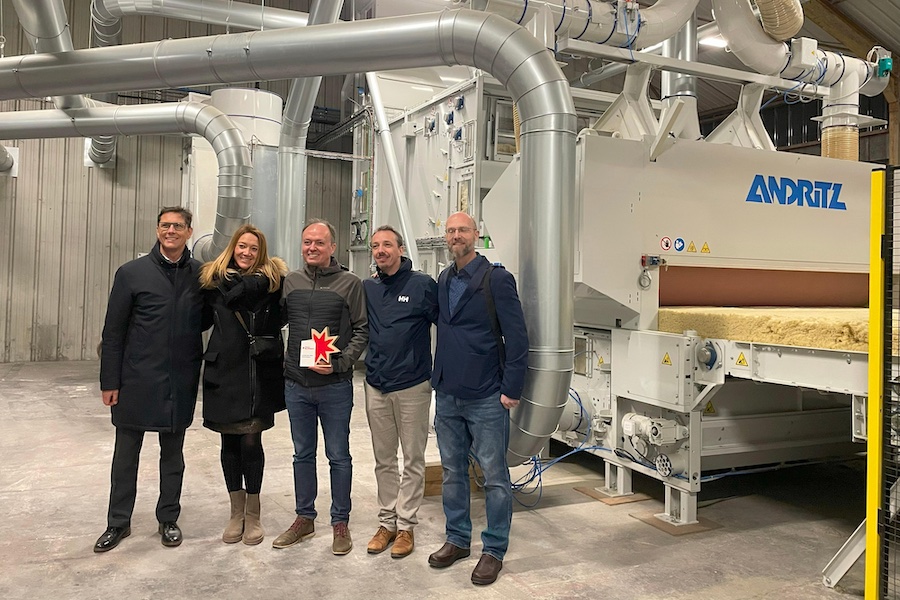
International technology group ANDRITZ supplied and recently commissioned a state-of-the-art neXline airlay system for Revibat, France. This innovative line, inaugurated at the beginning of February, enables the production of building insulation panels from glass wool waste that would otherwise be sent to landfills.
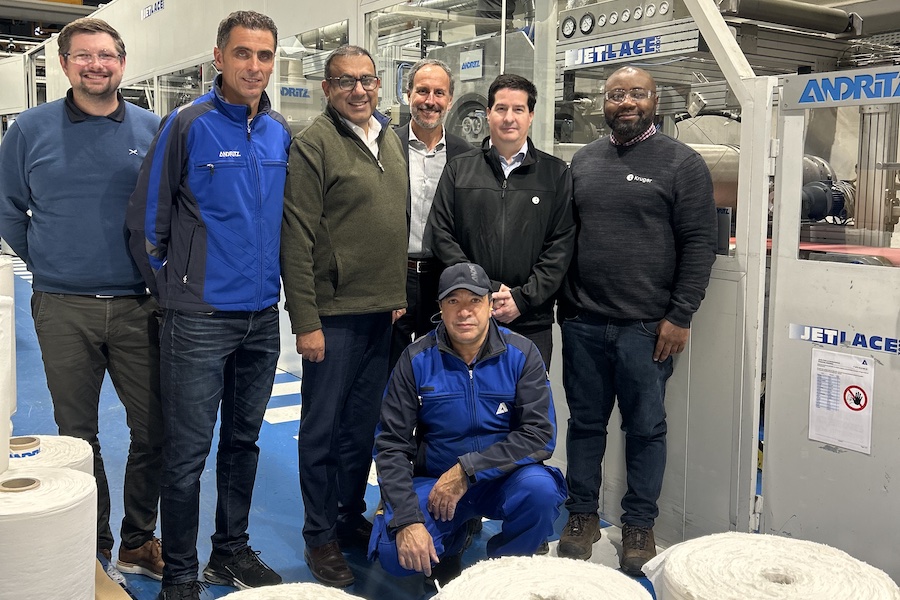
Team in front of ANDRITZ neXline. From left to right: Alexandre Butté, ANDRITZ; Sophie Bretillon Charrier, Revibat; Nicolas Brousse, Revibat; Alexis Gautier, ANDRITZ; Jörg Eberle, Schott & Meissner, in front of the ANDRITZ neXline airlay system at the opening ceremony © 2025 Andritz


With the new ANDRITZ line, Revibat can now transform complex waste collected in the Paris region into valuable products. The patented process addresses two major challenges: giving a second life to insulation glass wool waste and reducing the carbon footprint across the entire production chain.

The line processes up to 1,500 kg of fiber per hour and is specifically designed to produce a unique nonwoven material, marking a significant step toward a circular economy in the insulation industry.

Nicolas Brousse, CEO of Revibat, states: “Our new ANDRITZ neXline airlay system represents a major milestone in our market as it enables us to start producing building insulation panels from glass wool waste. Our goal is to expand this solution across France, getting as close as possible to the waste and thereby minimizing our carbon footprint. Working with the experts at the ANDRITZ technical center in Cours has been a pleasure and essential for the development of this unique product.”

Revibat specializes in manufacturing construction materials from recycled building waste. Its mission has been to find a viable solution for the recycling of glass wool, a challenge that had previously remained unsolved. With a state-of-the-art laboratory, Revibat processes glass wool waste on an industrial scale, aiming to position itself as a key player in supporting eco-organizations in their efforts to collect, consolidate, and recover building waste and materials.
More News from ANDRITZ Nonwoven

#Nonwoven machines

Yanpai expands nonwovens capacity with two new ANDRITZ needlepunch lines

Zhejiang Yanpai Filter Technology Co., Ltd. (hereinafter referred to as “Yanpai”) has placed an order with international technology group ANDRITZ for two high-performance needlepunch lines. The equipment will be installed at Yanpai’s headquarters facility in Tiantai County, China. Commissioning is scheduled for the third quarter of 2026.

#Nonwoven machines

ANDRITZ collaborates with Tandem Repeat on solutions to produce novel sustainable fiber

International technology group ANDRITZ has entered into a collaboration with Tandem Repeat Technologies, a pioneering biotechnology company, to bring to the market industrial-scale solutions for producing ProcellTM, a new sustainable fiber for textiles and nonwovens.

#ITMA Asia + CITME Singapore 2025

ANDRITZ sets focus on textile recycling and durable nonwoven production technologies at ITMA Asia 2025

International technology Group ANDRITZ will be presenting its innovative nonwovens production and textile solutions at ITMA ASIA + CITME 2025 in Singapore, from October 28 to 31, 2025 (Hall 2, D106). ANDRITZ will showcase its MMCF production plants, textile sorting and recycling, bast fiber processing, needlepunch, airlay, and life-cycle service technologies, with a focus on sustainable solutions. Discover how these innovations can grow your business opportunities and support a greener future.

#Nonwoven machines

Mistra-Autex, Estonia, orders new needlepunch line from ANDRITZ

Mistra-Autex AS has awarded ANDRITZ an order to supply a complete needlepunch line for its plant in Raasiku, Estonia. The new line will produce various types of nonwovens for surface applications, 3D molding, and other technical materials, primarily for the automotive industry.

More News on Nonwoven machines

#Nonwoven machines

Three ANDRITZ spunlace lines start operating at Alar Silk Road New Materials in China

Alar Silk Road New Materials and ANDRITZ have successfully commissioned three spunlace lines in crosslapped configuration at Alar’s facility in Aral City, Xinjiang, China.

#HIGHTEX 2026

HIGHTEX 2026: The Gateway to the Future of Sportech Textiles

HIGHTEX 2026, which will take place on 9–13 June 2026, is preparing to become a strategic meeting point for the most innovative manufacturers, technology developers, and global buyers in the field of sportech textiles. At the HIGHTEX 2026 Exhibition, where sportswear, outdoor equipment, footwear, protective sports products, and smart textile manufacturers will have the opportunity to closely explore the latest technologies, the event will stand out as one of the industry’s most comprehensive trade platforms.

#Techtextil 2026

Techtextil and Texprocess 2026: Innovation as a Key Driver of the Textile Future

Innovations are the textile industry’s response to economic uncertainty, geopolitical tensions and continued restraint in investment. Today, this became clear at the press conference of the leading international trade fairs Techtextil and Texprocess. In a panel discussion, industry representatives explored how innovation is accelerating the transformation of the textile sector – from artificial intelligence to sustainable materials and new production models. This innovative strength is concentrated in the Techtextil and Texprocess Innovation Awards, which showcase pioneering solutions driving the textile transformation.

#HIGHTEX 2026

Global vision in medical textiles meets at HIGHTEX 2026

Developments in the medical textile sector are already making HIGHTEX 2026 one of the most remarkable international meeting points in the region. A wide technological spectrum—from nonwoven technologies to meltblown lines, from spunbond production systems to advanced composite healthcare textiles—will come together at HIGHTEX 2026.

Latest News

#Digital Printing

Epson launches SureColor G9000: high-production Direct-To-Film printer delivering greater productivity and reliability

Epson today announces the launch of the SureColor G9000, a new high-production Direct-To-Film (DTFilm) printer designed to meet growing global demand for flexible and efficient textile transfer printing. Expanding Epson’s DTFilm line-up alongside the SC-G6000, the SC-G9000 introduces enhanced speed, reliability and ease of maintenance for commercial garment decorators and textile producers.

#Raw Materials

Better Cotton Initiative opens enrollment in the US with promising opportunities for producers

Producer enrollment for the US Program of the Better Cotton Initiative (BCI) is open until May 15 for the 2026-2027 season. With over 2,600 members spanning the cotton supply chain and more than 11,000 users of its Better Cotton Platform (BCP) as of 2025, BCI’s standard is implemented in 15 countries and covers one fifth of global cotton production.

#Knitting & Hosiery

SHIMA SEIKI to exhibit at GMMSA Expo India

Leading Japanese computerized flat knitting technologist SHIMA SEIKI MFG., LTD. of Wakayama, Japan, together with its Indian sales representative Universal MEP Projects & Engineering Services, Ltd., will participate in the upcoming Garments Machinery Manufacturers & Suppliers Association (GMMSA) Expo India 2026 exhibition to be held in Ludhiana, India next month. Through its lineup at GMMSA, SHIMA SEIKI aims to further strengthen its presence within the Indian market with an exhibit that caters to diverse needs, consisting of seam-free WHOLEGARMENT® knitting technology as well as a brand-new shaping machine with high productivity and excellent cost performance.

#Research & Development

Bio-based fibers with good flame retardancy

Fibers made from bio-based plastics reduce dependence on fossil raw materials and promote the circular economy. The covalent bonding of flame-retardant additives can open the way for these fibers to enter the mass market.

TOP