#Nonwovens / Technical Textiles
Statement From EDANA’s UK Working Group on the UK Government’s proposals to ban plastic in certain wet wipes
In response, Gloria Jaconelli Communications & PR Director at EDANA, the leading global trade association for the nonwovens industry which includes wet wipes, shared the following statement:
“Wet wipes perform vital hygiene, and cleanliness functions for many parents, families, carers, the NHS, and businesses; notably wipes played a crucial role in sanitising surfaces during the pandemic to protect citizens from COVID-19.
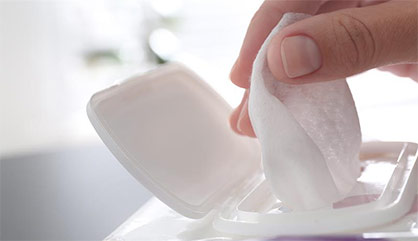
The industry supports government and stakeholder efforts to reduce pollution and sewer blockages, while ensuring that consumers, the NHS, social care, and businesses can continue to benefit from the fundamental uses and advantages that wet wipes provide.
It is extremely important to debunk some of the myths regarding wet wipes and our sewage systems.
- Contrary to some previous reports, our industry figures show that over 70% of consumer wet wipes on sale in the UK are already plastic free*.
- Non-flushable wet wipes are found in sewer blockages, but they are not the primary cause of them. Scientific research shows that the primary cause of sewer blockages is Fats Oil and Grease (FOG) being incorrectly poured down the drain by both businesses and consumers**. This results in a build-up of FOG causing fatbergs, which then catch other items that should not have been flushed and should never have ended up in the sewers – including wet wipes, menstrual health products, nappies, cotton buds, incontinence pads, tea towels, and more – which ultimately leads to sewer blockages. There is a need for educational campaigns that stop FOG being poured down the drain and to stop unflushable wet wipes being wrongly flushed by consumers.
- Plastic free wet wipes are not necessarily flushable, and wet wipes are not the primary cause of blockages. Therefore, taking plastic out of consumer wet wipes cannot alone solve the problem of sewer blockages.
Wet wipes are not the cause of sewer overflows – they are caught up in sewer overflows that are happening for entirely different reasons. Scientific research shows that sewer overflows from water companies occur when excess water reaches sewage infrastructure that cannot cope with it***. Water companies subsequently release wastewater into the environment to stop it from coming back up the drains and flooding homes. While wet wipes are not the cause of these overflows, they can be – along with a host of other items that were incorrectly flushed – released as part of the overflow.
Plastic can be vital in ensuring disinfectant, antiviral, and hygiene functions in certain B2B wet wipes. These properties are a requirement for wipes by the NHS as well as other medical, social, care, and other professional and industrial settings. These are B2B and institutional/industrial settings where waste regulations and guidance already exist and are followed by staff to ensure that these wipes are properly disposed of in appropriate bins and waste facilities. As such they are extremely unlikely to be incorrectly flushed.
EDANA convened a UK industry working group comprising wet wipes manufacturers to tackle this issue. The EDANA UK Working Group has recommended several measures to the UK and devolved governments, including the following to address the issues:
- Educational campaigns should be launched targeting Fat Oil and Grease (FOG), as well as the need to avoid flushing unflushable wipes – as tackling both will be essential to solve existing sewage problems. Scientific research clearly shows that the vast majority of wipes that get caught up in sewer blockages caused by FOG are unflushable wipes that should never have been flushed in the first place. The same research clearly shows that flushable wipes are only caught up in sewer blockages caused by FOG in tiny amounts and are not the cause of sewer problems because they are designed to be flushable.
- Mandatory Do Not Flush labelling for non-flushable wipes using one of the two existing widely recognized logos to make it very apparent to consumers that they must not flush such products.
- Mandatory use of a recognised specification for flushable wipes to ensure that all wipes marketed as flushable have passed the relevant scientific tests that ensure they are truly flushable.
- An exemption for B2B wet wipes used in medical, social, care, and industrial settings where waste regulations and guidance already exist ensuring wet wipes are correctly disposed of and where plastic can be vital for disinfectant, antiviral, and hygiene purposes.
- For consumers to be able to continue to benefit from plastic free wet wipes, natural polymers like viscose and lyocell, which are made from plants usually trees, must be able to continue to be used. Other than plastic, there are no other polymers that can be used to create wet wipes.
- Sufficient time for the industry to adapt to 100% plastic free alternatives for consumer wet wipes, as well as to sell existing wet wipes stocks to avoid the unnecessary waste and environmental impacts if unsold items need to be destroyed as they no longer comply with regulations. Moving too fast risks excessive costs for businesses, much higher imports, as well as challenges with continuity of supply, cost, and unnecessary waste if existing stocks must be destroyed.
- Other jurisdictions such as the EU have chosen to tackle the issues in a different way – e.g. through Extended Producer Responsibility (EPR) schemes. UK manufacturers should continue to be able to manufacture plastic containing consumer wipes solely for export to these markets to protect UK jobs and investment.
- Any proposed restrictions on plastic in consumer wet wipes must be introduced at the same time and in the same manner across the whole of the United Kingdom. An England only approach either to regulation or the timing of implementation would lead to a situation where English manufacturers cannot sell consumer plastic containing wet wipes in England, but Scottish and Welsh manufacturers can. It is perfectly possible to adopt a UK wide approach to both regulation and implementation and that is a far better approach for all stakeholders.
We look forward to working with the UK and devolved Governments to achieve these important objectives."