[pageLogInLogOut]

#Nonwovens / Technical Textiles

Garbage cleanup

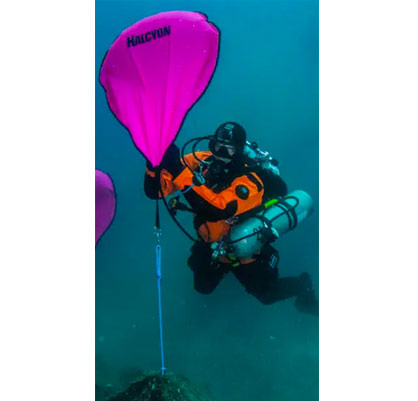
Distinctive pink lift bags made by Halcyon Dive Systems retrieve abandoned ghost nets and other plastic waste from the world’s oceans. The special fabric for the bags was developed by Trelleborg.

Trelleborg materials are renowned for their presence in a huge range of technologies and environments worldwide, but sometimes they can be found in the unlikeliest of places that surprise even Trelleborg itself.

© 2021 Trelleborg
© 2021 Trelleborg

Recently, while watching a television news report about removing plastic waste from the oceans, an employee within Trelleborg Industrial Solutions, noticed something familiar: the bright pink lift bags used for the task contained a polyurethane coated fabric that was produced by Trelleborg.

The bags, made by Trelleborg’s customer Halcyon Dive Systems, are used by Greenpeace and others to remove ‘ghost nets’, fishing nets that have been abandoned to drift in the world’s oceans, causing all manner of havoc to sea life.

“I was very surprised when I saw the bags. I had no idea our coated material was being used to help pull up ghost nets in the ocean,” says Steve Brockman, Vice President & Commercial Director for Trelleborg’s engineered coated fabrics, who is proud that Trelleborg can make a contribution to help address what is a growing problem.

In fact, ghost nets have become a bane of the seas. They are left behind after being caught on coral, dropped by fishermen, or just carelessly discarded because they are worn out. But out of sight does not mean they’re gone. The forgotten nets keep drifting in the water like specters in a haunting dance, continuing to do their job, but helping no one or anything. Fish, crabs, turtles and other sea creatures still become caught in these nets, slowly perishing due to starvation or strangulation.

The United Nations Environmental Program (unep) estimates that 640,000 ghost nets are left behind in the sea each year. That amounts to ten percent of the 14 billion pounds (6.3 billion kilograms) of waste that makes its way into the ocean annually, and it accounts for 85 percent of the plastic that makes up the Great Pacific Garbage Patch.

The Global Ocean Explorers Survey Foundation (goes) warns that the bits of plastic filling the seas are merging with toxic chemicals from sunscreens, fire retardants (pbdes), polychlorinated biphenyls, tin and mercury, bonding together and being mistaken for food by plankton and other inhabitants of the sea.

These poisonous cocktails have already wiped out an enormous amount of the plankton population on Earth, and goes says we have only ten years to correct this death spiral. Plankton eat a significant amount of carbon dioxide and produce an astounding 75 percent of the oxygen generated on Earth. That’s more than the Amazon rainforest.?If all the planet’s plankton are killed off, it spells doom for life on Earth.

“There’s an incredible amount of plastic out there — wherever you look, wherever you go, you’ll find plastic, even in the Arctic,” says Mark Messersmith, Chief Operating Officer of Halcyon Dive Systems. For many years, Halcyon has been providing equipment like the dive bags a Trelleborg employee spotted in the news report to Ghost Fishing teams, who work around the world to dredge discarded nylon nets from the sea.


The firm sponsors conservation efforts in Europe and Central America, providing lift bags and diving equipment. Divers attach the bags to debris, then inflate them with their air tanks to lift them off the ocean floor. Messersmith says it can be a tedious and risky business. “There are many small animals living on the nets and you don’t want to cause further damage. It can become dangerous and takes skill.”

The company is located in northern Florida in the us, in the heart of an underground paradise for technical divers, who are daring enough to explore the water-filled cave network that holds the freshwater supporting the surfside communities, including Florida’s famous Ginnie and Wakulla freshwater springs, which are respectively 75 and 300 feet deep. Halcyon evolved from the specialized needs of these divers. 
© 2021 Trelleborg
© 2021 Trelleborg


Nowadays, Halcyon distributes its diving gear around the world.

“We’ve built a good team and we have a great product. Our reach through the diving community is pretty much unparalleled,” says Messersmith.

As well as its supply of dive bags worldwide, Halcyon is committed to other conservation projects. It runs Global Underwater Explorers, a specialized dive training agency that is world-renowned, and Project Baseline, a non-profit organization. The latter is dedicated to documenting water bodies to build databases that will establish a baseline to allow for objective scientific evaluation in the future.

“Conservation has always been of interest to us; it’s who we are. Science and communities of people working together can change the trajectory,” says Messersmith.

He adds that Halcyon has streamlined its packaging and supply lines to utilize recycled, biodegradable, environmentally friendly materials as often as possible. The company even powers its facility with solar energy. “We’re not kidding when we say we’re making an impact.”
More News from TEXDATA International

#Texprocess 2026

Texprocess 2026: Automation, digitalisation and AI redefine textile processing

Making investment decisions in textile processing has become significantly more demanding. Increasing energy costs, a shortage of skilled labour and ongoing geopolitical uncertainties are compelling companies to focus on technologies that deliver clear gains in efficiency and process reliability. This applies equally to apparel manufacturing and to the processing of technical textiles and high-performance materials. As a result, modernisation initiatives are assessed more carefully – even as the need to upgrade production systems continues to intensify.

#Techtextil 2026

Techtextil 2026: Between innovation pressure & market reality

From 21 to 24 April 2026, Techtextil in Frankfurt am Main will once again become the central meeting point for the international technical textiles and nonwovens industry. Running in parallel, Texprocess will focus on the industrial implementation of textile processing technologies as the leading platform in this field. Together, the two trade fairs form a closely integrated presentation and working platform along the entire textile value chain – from material development to finished applications.

#Techtextil 2026

Between geopolitical pressure and industrial resilience

In this interview, Dr. Janpeter Horn (VDMA) discusses the current challenges facing textile machinery manufacturers, shaped by geopolitical tensions, regulatory developments and subdued investment. He also outlines why innovation strength, integrated solutions and strategic positioning remain key to global competitiveness.

#Texprocess 2026

Between investment restraint and modernization pressure

Texprocess 2026 takes place in a complex market environment shaped by uncertainty and innovation pressure. In this interview, Elgar Straub (VDMA) explains why the trade fair is particularly relevant this year and which technologies are driving efficiency and competitiveness.

More News on Nonwovens / Technical Textiles

#ITMA Asia + CITME Singapore 2025

ANDRITZ sets focus on textile recycling and durable nonwoven production technologies at ITMA Asia 2025

International technology Group ANDRITZ will be presenting its innovative nonwovens production and textile solutions at ITMA ASIA + CITME 2025 in Singapore, from October 28 to 31, 2025 (Hall 2, D106). ANDRITZ will showcase its MMCF production plants, textile sorting and recycling, bast fiber processing, needlepunch, airlay, and life-cycle service technologies, with a focus on sustainable solutions. Discover how these innovations can grow your business opportunities and support a greener future.

#ITMA Asia + CITME Singapore 2025

Dilo Group at ITMA ASIA Singapore 2025

At ITMA ASIA Singapore, the Dilo Group will exhibit at Booth No. H2 – D202. Together with Kansan Materials, Izmir, the company will present its latest developments and looks forward to welcoming visitors to exchange ideas and explore innovations in needling technology.

#Nonwovens

OUTLOOK™ 2025: Charting a sustainable and innovative future for the Nonwovens Industry

EDANA concluded its flagship event, OUTLOOK™ 2025, last week, marking it as a major success and addressing the biggest questions facing the industry. The three-day conference highlighted the urgent need for a unified approach to sustainability, regulation, and innovation in the absorbent hygiene and wipes sectors.

#Nonwovens

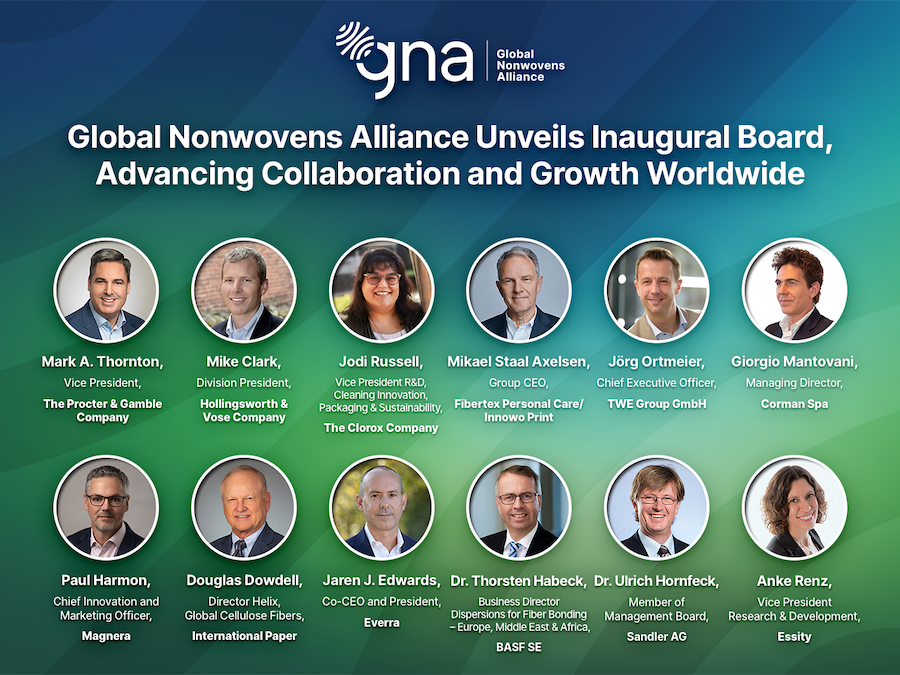
Global Nonwovens Alliance unveils Inaugural Board, advancing collaboration and growth worldwide

The Global Nonwovens Alliance (GNA), a tax-exempt federation jointly founded by INDA, the Association of the Nonwoven Fabrics Industry, and EDANA, the Voice of Nonwovens, announces the appointment of its founding Board of Directors. This group of leaders represents some of the most influential executives across the nonwovens value chain and reflects GNA’s mission to foster global collaboration, innovation, and growth in the industry.

Latest News

#Heimtextil 2027

Heimtextil celebrates Milan Design Week honoring partnerships with Patricia Urquiola and Alcova Milano

Heimtextil is represented at Milan Design Week with its strong design partners Patricia Urquiola and Alcova. At Villa Pestarini, the leading trade fair spotlighted its dynamic collaborations with acclaimed designer Patricia Urquiola and Alcova Milano.

#Texprocess 2026

Kornit Digital expands digital production into footwear and technical textiles with Presto MAX PLUS

Kornit Digital (NASDAQ: KRNT) (“Kornit” or the “Company”), a global pioneer in sustainable, on-demand digital fashion and textile production, today unveiled the Kornit Presto MAX PLUS, a new roll-to-roll system expanding digital manufacturing into footwear, automotive interiors, military camouflage, high-performance sportswear, and high-end furnishings. Debuting at Texprocess 2026 in Frankfurt, Presto MAX PLUS enables entirely new applications for on-demand textile production.

#Textile processing

NATULON® zipper series surpasses 50% of YKK’s global zipper sales

YKK Corporation (Headquarters: Chiyoda-ku, Tokyo; President: Koichi Matsushima; hereafter, YKK) announces that the global sales share of its NATULON® zipper series—zippers that incorporate recycled materials—has exceeded 50%.

#Smart Textiles

Covestro, FILK Freiberg, and OUT e.V. develop flexible, conductive polymer smart textile system

As the smart textiles market continues to grow across healthcare, personal protection, sportswear, and automotive applications, developers are seeking new ways to integrate electronic functionality directly into textiles, without the rigidity and complexity of conventional wiring. To address this challenge, FILK Freiberg Institute, an independent research institution with expertise in polymer coatings for textile applications, collaborated with Optotransmitter-Umweltschutz-Technologie (OUT) e.V. The joint project, funded under the German Industrielle Gemeinschaftsforschung (IGF) program of the Bundesministerium für Wirtschaft und Energie (BMWE), focused on developing flexible, conductive polymer surfaces for next-generation smart textiles.

TOP