[pageLogInLogOut]

#Knitting & Hosiery

Resilence down to smallest detail
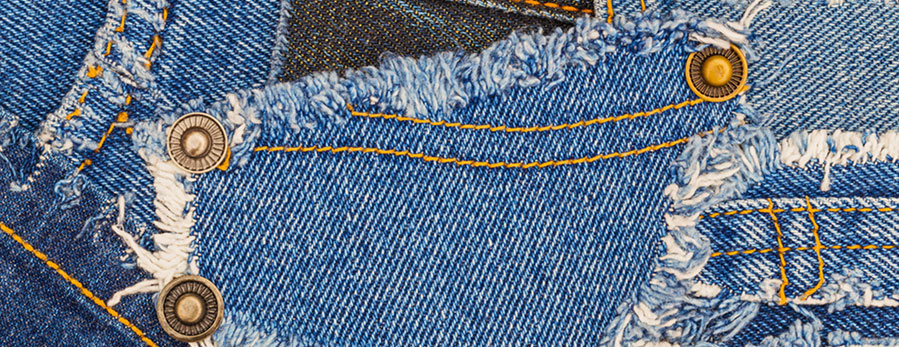
Jeans with rivets for recycling (c) 2020 Groz-Beckert
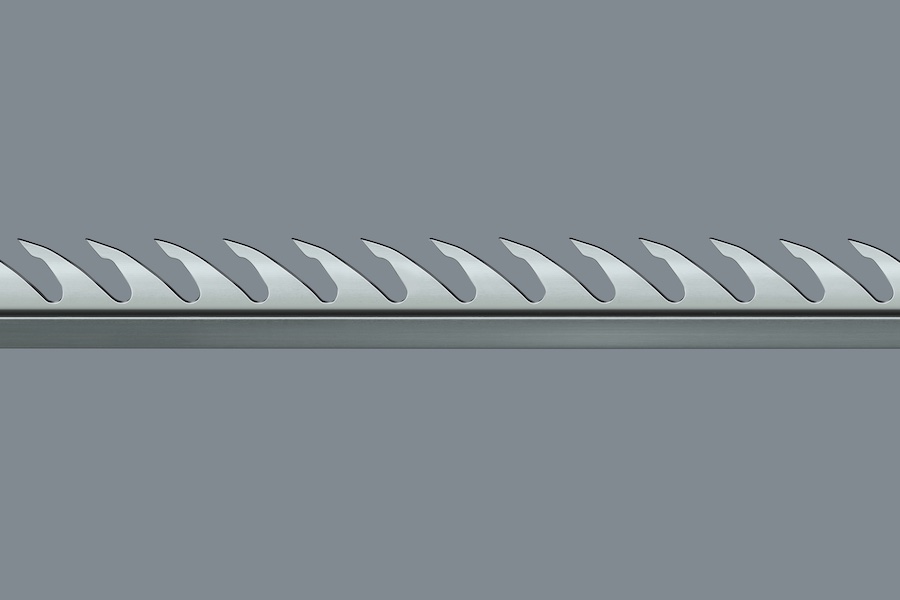
The coarsest metallic card clothing from Groz-Beckert, the interlocking 4 and 5 thread wires, cannot be compared with conventional card clothing. Their special feature is the large rib thickness of 5.08 mm (5 thread) and 6.35 mm (4 thread). This makes them the coarsest metallic card clothing in the Groz-Beckert product range and on the market as a whole. The thread number here shows how many rows the card clothing has per inch.

In the event of a crash caused by overloading, plain rib wires can cause major damage to the card. To avoid this where possible, the 4 and 5 thread card clothing is only available with an interlocking rib design. A plain rib wire could lead to further damage on the rollers of the card as a broken wire could unwind more easily. Interlocking wires have less tendency to spring open due to their rib design.

Interlocking and plain rib wires in case of a crash (c) 2020 Groz-Beckert


Special card clothing for specific scopes of application

The special properties of the 4 and 5 thread wires make them the perfect tool in the areas of the textile industry where durability is required. For this reason, they are frequently used in the field of textile recycling. Here, large quantities of textiles must be processed down to the single fiber. Durability at high speeds is not only required when recycling hard-wearing and cut-proof textiles such as jeans; but also foreign parts such as buttons, zippers and rivets must not lead to overloading of the card clothing. Conventional card clothing is not suitable for this application and would lead to production downtimes.

The same applies for manufacturing cellulose fiber (including viscose). In this special application, tightly pressed raw materials must be torn apart and chopped up for fiber production. For this process, the 4 thread wire can be mounted on crushing rollers and must have an extremely durable tooth and rib to withstand damage or breakages. These damages would bring the system to a stop and result in machine downtime at the customer.


In addition to the usage in recycling, and the manufacturing of cellulose fibers, the coarsest card clothing offered by Groz-Beckert is also used in the processing of natural fibers such as flax. The quantities and properties of the fiber processed here, require extremely resilient and robust wires to guarantee optimal processing.

The use of the interlocking 5 thread wire is also recommended on the feed rollers and licker-ins of the roller top card. With this card clothing, a relatively thick fiber web can be controlled and the roller card can be fed evenly. Whether at the opening or the feed roll, the interlocking 4 and 5 thread wires, when used optimally, provide the ideal conditions for downstream carding.

Interlocking 4 and 5 thread card clothing (c) 2020 Groz-Beckert


Optimal service for challenging card clothing

When mounting the interlocking 4 and 5 thread wires, due to their extreme resilience, both patience and a service technician with extensive experience in handling these wires is required. Groz-Beckert service technicians are also specially trained for this challenging work. In combination with the right working tools, Groz-Beckert offers reliable service quality and thus achieve a high level of customer satisfaction.
More News from Groz-Beckert KG

More News on Knitting & Hosiery

#Knitting & Hosiery

KARL MAYER's HKS 2-SE Expands Possibilities for Premium Stretch WARP KNITS

Warp knitted fabrics with a woven look are more in demand than ever in the fashion and apparel industries. Stretch WARP KNITS, in particular, impress with their freedom of movement, breathability, and virtually wrinkle-free wear – thereby opening up new style worlds such as smart casual or business casual. When it comes to the highly efficient production of premium-quality stretch WARP KNITS, the HKS 2-SE has long been the machine of choice. KARL MAYER’s best-selling tricot machine produces standard elastic fabrics characterized by high gauges, smooth, delicate surfaces, and a soft hand feel.

#Knitting & Hosiery

Footwear innovation enabled by warp knitting technology– insights from New Balance

The future of the athletic shoe is increasingly being shaped on warp knitting machines. For KARL MAYER, the footwear industry is one of the most important growth markets – and one of the sectors where innovative textiles can realize their full potential. In his keynote address at the opening of KARL MAYER’s TEXTILE INNOVATION CENTER in Obertshausen in April, Vishnu Prakash Muthusamy, Senior Textile and Materials Engineer at New Balance, explained the opportunities that warp knitting technology opens up for performance, sustainability, and faster development processes, and why textile manufacturers are transitioning from suppliers to development partners.

#ITM 2026

ITM 2026: Mayer & Cie. Global presents itself successfully at international industry trade fair

Mayer & Cie. Global has used ITM 2026 in Istanbul for its first major international appearance since the restart. Together with the Turkish representative Mayer Mümessillik, the company presented its premium circular knitting machines "Made in Germany", explained its future positioning within the group of companies and held talks with customers and representatives from numerous markets. The response to the restart was positive. The clear orientation of the company, the reliable worldwide network of representatives and the resumption of service and spare parts supply were welcomed by customers.

#ITM 2026

Positive market signals for KARL MAYER at ITM 2026

KARL MAYER is pleased with its participation as an exhibitor at ITM 2026. Faced with the challenges of rising domestic costs and fierce competition from low-priced Asian markets, the industry leader had traveled to Istanbul with mixed feelings – yet still draws a really positive conclusion.

Latest News

#Textile processing

Dedicated car seat model of SHIMA SEIKI’s P-CAM® R Cutting Machine unveiled

Leading Japanese textile solutions provider SHIMA SEIKI MFG., LTD. of Wakayama, Japan, showed a special version of its P-CAM® R multi-ply computerized cutting machine dedicated to the production of car seats for the first time, at a private exhibition held over two days on Thursday, July 2nd and Friday, July 3rd at the Kariya City Industrial Promotion Center in Aichi Prefecture.

#Research & Development

ALADIN paves the way for circular and demand-driven textile production in Europe

Textile production can be organized sustainably by utilizing short supply chains and preventing overproduction. This can already be achieved today by intelligently connecting and efficiently utilizing existing infrastructure. At the same time, production becomes circular when innovative technologies and materials are used that enable high-quality recycling. The ALADIN research project, launched in May 2026 and co-funded with five million euros under the EU Horizon Europe program, is creating the conditions for this.

#Nonwovens

Katharina Obergruber appointed to the Management Board of Sandler AG

The Supervisory Board of Sandler AG has appointed Katharina Obergruber to the company’s Management Board. Effective September 1, 2026, the Board will consist of Philipp Ebbinghaus (CEO), Dr. Ulrich Hornfeck (currently CCO, future COO), and Katharina Obergruber (CCO). Katharina Obergruber, currently Chief Sales Officer Hygiene and member of the Management Team of Sandler AG, will assume responsibility for all sales activities as Chief Commercial Officer. She will assume this role from Dr. Ulrich Hornfeck, who will focus primarily on production and supply chain topics.

#Recycling / Circular Economy

Ence and ShareTex begin initial testing of the ATENEA innovation project to promote textile recycling in Spain

Ence and ShareTex are making progress on the Atenea R&D project, which aims to develop a complete value chain for textile recycling in Spain. Specifically, the goal of the ATENEA project—which is funded by the Center for Technological Development and Innovation (CDTI)—is to connect all the necessary stages for the recovery of textile waste, from collection and management, through recycling and transformation into new raw materials, to their incorporation into new textile products.

TOP