[pageLogInLogOut]

#ITMA 2019

“Weave by Wire”: Why the digital age began much earlier for weaving machine manufacturers like DORNIER

Intelligent drive: In combination with the patented DORNIER SyncroDrive® drive concept, Jacquard weaving opens up new dimensions in weaving quality, functional reliability and cost ef ciency
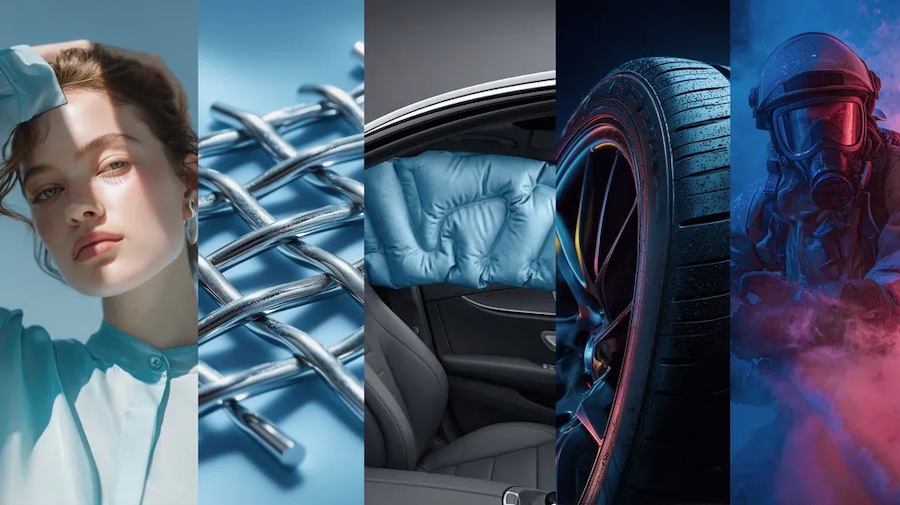
DORNIER Air-Jet Weaving Machine A1, Type AWS 6/J G with a nominal width of 240 cm Artikel: Outdoor clothing fabrics (OPW)
(Image: “Outdoor”; Source: DORNIER)
Everyone is talking about digitalization and Industry 4.0 at the moment. An important aspect of both of these major trends is automation, which is going to supersede analog approaches to production, technology and consumer behavior in practically every way. Under the banner “Weave by Wire” at the ITMA exhibition, weaving machine manufac- turer Lindauer DORNIER will demonstrate why the inexorable advance of ones and zeros is not new for the company.

For most industries, automation is a relatively new trend which presents them with enormous challenges. But for weaving machine manufacturers like DORNIER, the issue has been an ever-present consideration for many decades. A little historical context: Back in 1805 in Lyon, France, at that time the center of the world’s silk weaving industry, weaver’s son Joseph-Marie Jacquard took a piece of card and invented a weaving loom that was controlled by perforation patterns – and at a stroke he revolutionized fabric production. From that point on, perforated cards contained and communicated all the defining information for the patterns of fabrics for upholstery, tapestries and clothing.

And it was not just fabric manufacturing itself which underwent a complete transformation: The loom as “programmable” machine was a fundamental element for today’s automation. Well over a century later, the punched card spread was intro- duced into data processing, assisted by an American named Herman Hollerith. From there it made its way to binary computer programming. Finally, in 1924 the company founded by Hollerith paved the way for a business which in those days was called “International Business Machines Corporation”, but which is now known exclusively by its short form: IBM.
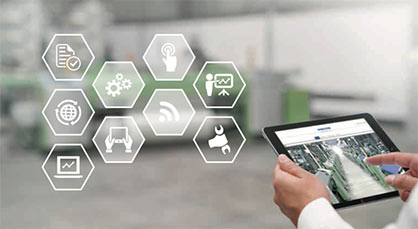
Smartphone, tablet, PC or operating panel: The new DORNIER myDoX® customer portal is the customer’s direct line 4.0 to top level fabric production from anywhere in the world and anytime<br />
(Image: “myDoX”; Source: DORNIER)
Smartphone, tablet, PC or operating panel: The new DORNIER myDoX® customer portal is the customer’s direct line 4.0 to top level fabric production from anywhere in the world and anytime (Image: “myDoX”; Source: DORNIER)


Future-oriented weaving: One-piece outdoor trousers

At the ITMA international textile and garment technology exhibition, the precursor to digital technology as invented by Jacquard will again play a forward-looking part. For example, the stand of machinebuilder Sta?ubli will feature an air-jet weaving machine from DORNIER which will be used to produce a pair of outdoor trousers from a single piece. Undoubtedly, weaving is a very familiar technique for users of outdoor apparel, because the two-thread system of weft and filling threads lends the requisite flexibility and tear resistance to equipment which is expected to withstand harsh weather conditions. But outdoor trousers as “One Piece Woven” (OPW) represents a world first. “The question is: How can the manufacture of outdoor clothing be trans- ferred from two to three dimensions?”, says Volker Janke, Product Applications Manager for air-jet weaving machines.

A large outdoor apparel provider approached a fabric manufacturer – one of DORNIER’s customers – with a request to develop a more sustainable, more flexible process for manufacturing outdoor products. It is not inconceivable that this was also prompted by emerging (online) purchasing patterns, because keywords such as Fashion on Demand and Pay per Piece show that consumers and their rapidly changing needs, demands and individual wishes are seen increasingly as the starting point for production. But this means that production must be adapted – that is to say it must become more agile. “The OPW outdoor trousers are an example of future-oriented fabric production”, says Janke. The objective is to be able to offer a product which is “tailored” precisely to the customer in terms of design, pattern and wearability, which is manufactures at the cost of less material, energy and waste. Janke has no doubt: “The road from two-dimensional to 3D weaving offers an entirely new dimension in manufacturing flexibility”.


Direct line 4.0: The new myDoX® customer portal

DORNIER will also present its new myDoX® customer portal publicly for the first time in Barcelona. It completes and expands our personal technical DORNIER service and the weaving machine panel ErgoWeave® with integrated Ethernet interface. “Log on and get to work immediately”, says Florian Stro?ßenreuther, Head of Training and Documentation. The system is based on HTML5 and ultramodern database technology (powered by SAP HANA). According to Stro?ßenreuther, it does not need any plug-ins or extra programs and can be operated with equal ease from a PC, smartphone, tablet or weaving machine control panel.

Besides serving as the 24/7 online shop (DoXPOS – Parts Order System) for original parts for all machine generations, an overview of orders (including display of processing progress), production and machine data and the enhanced DoXWeave software for the networking of weaving machines, myDoX® is also the direct line 4.0 to experts and information from the house of DORNIER. “It is the way for our customers all over the world to receive support they want at the highest possible technical level for their fabric production at all times”, Stro?ßenreuther concludes.

Optimum transitions from the pile to the border: The terry weaving machines from DORNIER deliver the highest precision and loop quality DORNIER Air-Jet Weaving Machine A1 ServoTerry, Type ATSF 8/J G with a nominal width of 340 cm<br />
Artikel: Terry fabrics<br />
(Image: „Terry weaving“; Source: DORNIER)<br />
Optimum transitions from the pile to the border: The terry weaving machines from DORNIER deliver the highest precision and loop quality DORNIER Air-Jet Weaving Machine A1 ServoTerry, Type ATSF 8/J G with a nominal width of 340 cm Artikel: Terry fabrics (Image: „Terry weaving“; Source: DORNIER)


Unsurpassed terry weaving with DORNIER

Visitors to the ITMA exhibition will also find a DORNIER weaving machine at the stand of machine builder Bonas, this time a terry weaving machine. Also combined with a Jacquard machine, it weaves three towels simultaneously over a width of 3.40 meters with supreme precision and loop quality. The typical DORNIER control system and flexible drives allow pile heights to be adjusted individually; and time-consuming manual adjustments are reduced thanks to automated speed changes, when changing from the pile to the border, for example. At the same time, electronic pressure control for the relay nozzles enables different pressures to be selected and programmed easily on the terry weaving machine according to design specifications. Other technology features on the terry air-jet weaving machine include the patented “Soft-Beat-up” for gentle terry beat-up to form the best possible pile, free access to warp stop motion positioning weight-reduced whip roll for even warp tension.
More News from Lindauer DORNIER GmbH

#Weaving

Lindauer DORNIER GmbH welcomes new apprentices and dual-study students

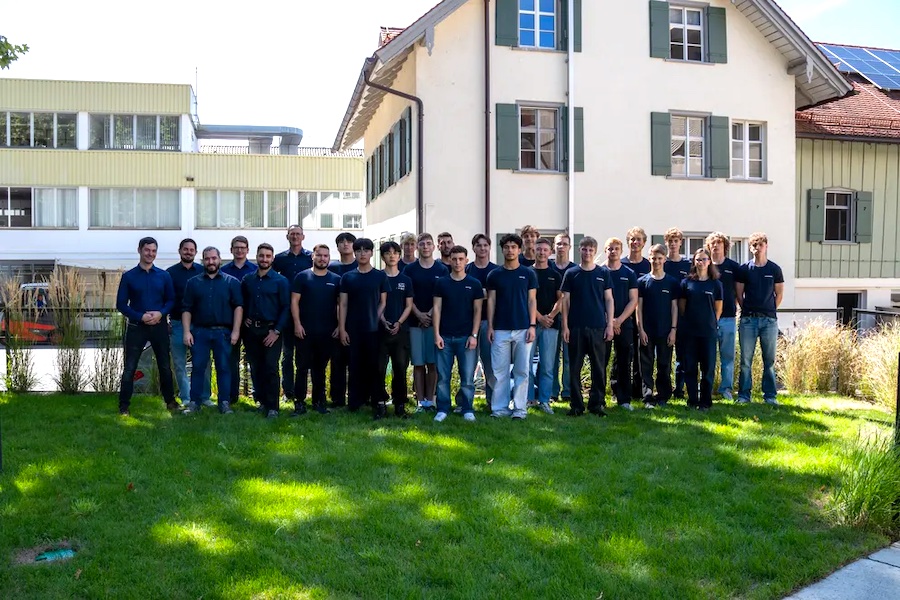
For 22 new “DORNIER Talents”, these days mark the beginning of a new chapter at Lindauer DORNIER. For the family-owned company, in-house training is a key pillar in developing skilled professionals and retaining them within the company for the long term.

#Weaving

"Dynamic markets do not only create uncertainty – they also create opportunities."

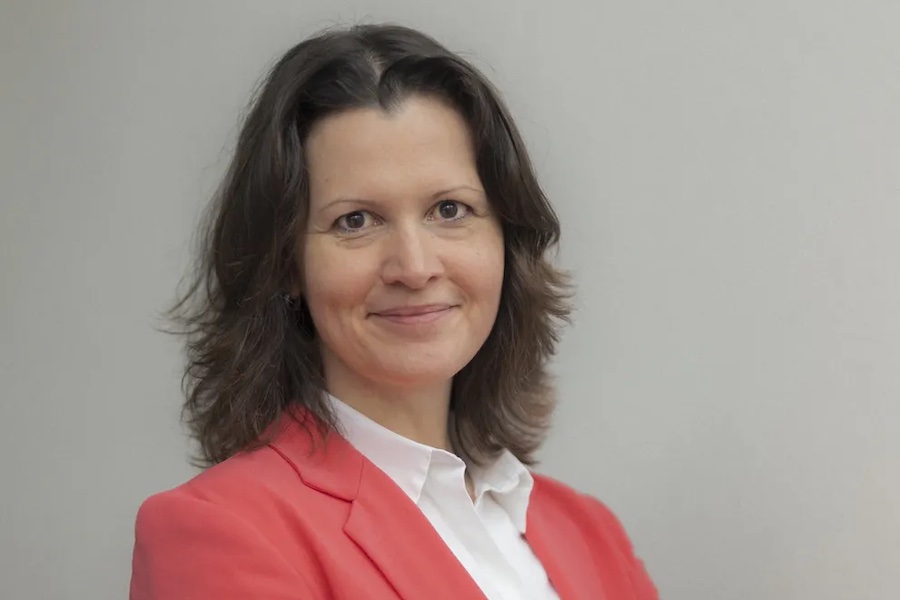
Volatile markets, increasingly complex materials and growing demands for flexibility are changing the weaving industry. At the same time, new opportunities are emerging in technical textiles, filtration, composites and many other specialised applications. Since taking over as Head of DORNIER's Weaving Machines Product Line at the beginning of 2026, Yvonne Schuberth has been helping to shape this development. In this interview with TexData, she explains why process stability and customer proximity remain the foundation of innovation, how digitalisation is transforming weaving mills, and why she believes the future belongs to technologically demanding applications.

#Composites

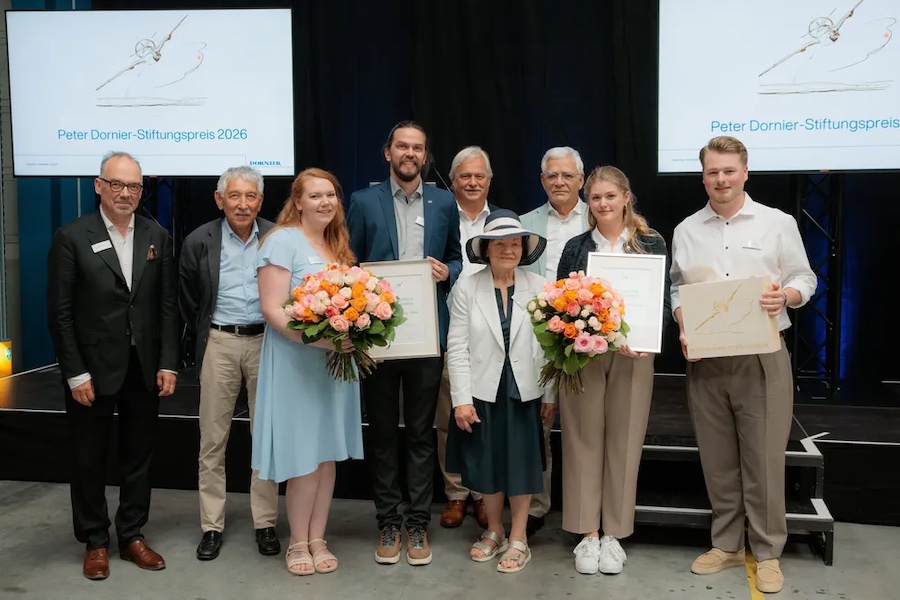
Fewer pores, greater impact tolerance: Peter Dornier Foundation Prize 2026 honours material research on fibre-reinforced composite components for aerospace industry

Microscopically small pores that form during manufacture, or barely visible impact damage, can severely impair the load-bearing capacity and service life of fibre-reinforced composite components. Two young researchers have presented groundbreaking work in this field and will both be awarded the 2026 Peter Dornier Foundation Prize: Dr.-Ing. Benedikt Neitzel from the Technical University of Ilmenau for his doctoral thesis on pore minimisation in the RTM process, and Johanna Buschmann, M.Sc., for her master’s thesis, completed at the German Aerospace Centre, on the improved impact tolerance of 3D fabrics compared to 2D laminates.

#Techtextil 2026

From carbon to canvas: DORNIER presents flexible and reliable weaving technologies for 3D weaving and dynamic markets at Techtextil

At Techtextil from 21 to 24 April 2026 in Frankfurt am Main (Hall 12.0, Stand D95), Lindauer DORNIER will be showcasing reliable and flexible weaving technologies for ever-changing market requirements. The machine and plant manufacturer will present retrofits for existing machines, the new TRITOS® FLEX 3D weaving technology, intuitive automation concepts and software solutions for data-sovereign networking of the weaving machine fleet.

More News on ITMA 2019

Latest News

#Associations

ITMF names five winners of the Start-up Award 2026

Five start-ups from Switzerland, Brazil, the United States and China have been selected as winners of the ITMF Start-up Award 2026. Their concepts range from new polymer chemistry and natural-fiber biocomposites to zero-waste design, 3D weaving and enzymatic PET recycling.

#Associations

HeiQ & Archroma and Lenzing & Armedangels win ITMF International Collaboration Awards 2026

The International Textile Manufacturers Federation (ITMF) has named two industry partnerships as winners of the ITMF International Collaboration Awards 2026. The awards go to collaborations between HeiQ and Archroma as well as Lenzing and Armedangels, highlighting joint approaches to innovation and sustainability across different parts of the textile value chain.

#Research & Development

180 years of TESTEX: From Zurich silk testing to global certification

For 180 years, TESTEX has developed alongside the textile industry while maintaining the same underlying purpose: creating trust through independent and reliable measurement. Founded in Zurich in 1846 as the Zurich Silk Conditioning Institute, TESTEX has grown from a local institution serving the silk trade into an international Swiss testing and certification institute for textiles and leather.

#Recycling / Circular Economy

Moving Advanced Recycling from Innovation to Implementation

The Advanced Recycling Conference 2026 explores technologies, markets, financing and scale-up of innovative recycling solutions for waste streams including mixed plastic waste, textiles and PVC. Europe’s chemical and materials sector faces growing pressure to close carbon loops, strengthen raw-material safety and resilience and meet increasingly ambitious EU recycling targets. Against this backdrop, the Advanced Recycling Conference (ARC) will bring together industry leaders, technology providers, researchers, innovators and policy-makers on 17–18 November 2026 in Cologne, Germany.

TOP