[pageLogInLogOut]

#ITMA 2015

Lower Energy Costs for BCF Yarn Production
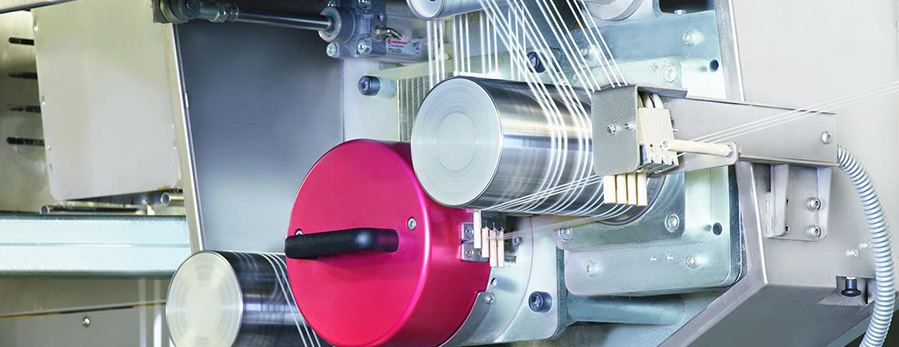
RoTac3 the rotating tangle unit from Oerlikon Neumag
RoTac3 the rotating tangle unit from Oerlikon Neumag, global market and technology leader for turnkey plants for the production of BCF carpet yarn, is a highlight on booth A105 in hall 4 at ITMA 2015. Its successful launch is a further signal that energy saving and yarn quality are playing a growing role in the production of BCF carpet yarn.

50 per cent less compressed air consumption

For RoTac3 makes high energy savings possible thanks to its innovative technology. In comparison to conventional tangle units, the RoTac3 technology forms the tangle knots with a pulsating instead of a continuous air current. This means that compressed air is only consumed if a tangle knot is to be formed. This is achieved with a special tangle nozzle that rotates with the yarn. Several holes are incorporated around the nozzle cover, according to the number of desired knots and the distance between them. If a hole is now positioned over the compressed air opening, an air blast is released and tangles the yarn.

Therefore tangle knots can not only be produced at defined distances and strengths. The discontinuous compressed air impulse also considerably reduces the required volume flow and compressed air consumption – by up to 50 per cent compared to conventional tangle units, depending on the yarn type. Since energy consumption is reduced as a result, RoTac3 bears the e-save label from Oerlikon Manmade Fibers for particularly energy efficient, environmentally friendly technologies.

Customers confirm improved processing quality

Given increasing process speeds and air pressures to enhance productivity in BCF production, this energy saving is a major advantage, but not the only one. The RoTac technology also eliminates tangle dropouts, which can occur repeatedly at a high process speed with conventional tangling. Last but not least, it ensures very gentle yarn guiding and reduced yarn tension as well as better process stability. This particularly supports future trends such as fine titer and sophisticated polymers.

“Many of our customers also confirm that the yarn quality for the downstream processes has improved and the corresponding process steps have been made easier“, says Martin Rademacher. At ITMA 2015, the company is thus expecting further encouragement for the successful product, which is available as a component with the three-end BCF plant S+ or can be retrofitted.


More News from Oerlikon Neumag, Zweigniederlassung der Oerlikon Textile GmbH & Co. KG

More News on ITMA 2015

Latest News

#Heimtextil 2026

Eastman Naia™ expands All-Night Comfort at Heimtextil 2026

New fill solutions and the debut of sleepwear highlight the versatility and performance of Naia™ Renew, its circular fiber, for home textile applications.

#Heimtextil 2026

Stability in volatile markets: Heimtextil 2026 launches with 3,000 exhibitors and design expertise from Patricia Urquiola

Heimtextil opens the new season with 3,000 exhibitors from 66 countries – maintaining stability while becoming even more international. The new hall layout increases visibility and connects supply and demand even more efficiently. At the opening, architect and designer Patricia Urquiola and Rosa Bertoli, Global Design Director of Wallpaper magazine, talk about AI, innovative materials and future-oriented design for modern living environments.

#Research & Development

Innovation center for textile circular economy inaugurated

Just over eight months after the foundation stone was laid, the new Innovation Center for Textile Circular Economy was officially inaugurated today at TITK Rudolstadt. Thuringia's Minister President Mario Voigt, TITK Director Benjamin Redlingshöfer, and other guests of honor cut the ribbon to the modern building complex and viewed the premises, which are now ready for occupancy. The “DICE – Demonstration and Innovation Center for Textile Circular Economy” is TITK's largest single investment to date. The Free State of Thuringia supported the total cost of €11.5 million with €8 million in GRW and FTI funding.

#Research & Development

Sustainable design of Geosynthetics and roof underlayments made from recyclates

Is it possible to recover plastic recyclates from previously unused waste streams in order to produce high-quality fibers and films? How can bio-based polymer fibers be manufactured so as to allow adjustable biodegradability? These are the questions being addressed by researchers from the Fraunhofer Cluster of Excellence Circular Plastics Economy CCPE in the Zirk-Tex project.

TOP

