[pageLogInLogOut]

#IDEA 2022

Debut for Milliken at IDEA 2022

Milliken & Company will make its debut at the forthcoming IDEA nonwovens show in Miami Beach, Florida, from March 28-31, to showcase an extensive range of engineered products for the automotive and bedding industries and discuss the potential of its proprietary technologies in many other end-use applications.

Specifically for the automotive sector, the company has developed a patent-pending new rigid underbody shield, based on a new construction of polyester nonwovens.

“Underbodies reduce the road noise coming from the tyres as well as optimising the aerodynamics of the region under the car,” explained Milliken’s VP of Nonwovens, Jeff Stafford.

Many of these trim parts, he added, are moulded into three-dimensional shapes to follow the geometry of the body section they cover, and are often made of a core layer of glass fibres bound by a thermoplastic binder.

“Glass fibres essentially provide the required stiffness but exposure to the fibres during the production of the parts and car assembly, can pose a health issue for those handling the material,” Stafford said. “Other underbodies are injection moulded plastic parts but both of these solutions are heavier than the industry wants them to be. Our new underbody is significantly lighter, while retaining the stiffness and other functional properties required for this exterior vehicle component.”
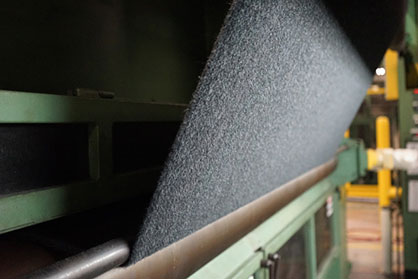
Nonwovens production at the Simpsonville plant. © Milliken


Milliken’s entry into the nonwovens sector began with the opening of a first plant in Simpsonville, South Carolina, in 1989, and it now manufactures its nonwoven portfolio at two plants in the USA and a third in Mexico.

Strong relationships with automotive OEMs already established over Milliken & Company’s long history, and the accumulated know-how of 5,000+ patents worldwide, has seen Milliken’s nonwovens business develop a range of successful automotive trim materials based on proprietary fibre blends and composite layers, with tunable NVH performance and a weight reduction of up to 30% compared to competing products.

For interior surfaces, interfacial chemistries and engineered matrix properties have also delivered a variety of wear-resistant, longer lasting products, while a technology for dramatically reducing moisture absorption by up to six times has resulted in noticeably tougher products.


Seperately, a range of enhanced flame retardant nonwovens forms part of the company’s Innovarest range of materials for the mattress industry, in addition to knits and laminates.

Milliken’s nonwoven solutions are employed in a wide range of automotive applications. © Milliken


Flame resistance is a core competency of the company. All of its mattress products can be tuned and customized to make 16 CFR 1632 and 16 CFR 1633 compliance simple and straightforward.

“There are a lot of options we can offer the market when it comes to engineered materials for many different applications, and we’re looking forward to fruitful discussions with customers old and new in Miami,” Stafford concluded.



More News from TEXDATA International

#Techtextil 2026

Performance Apparels: Functional textiles drive innovation at Techtextil 2026

From high-performance fibres and advanced membranes to smart textiles and sustainable material concepts – functional apparel is becoming one of the most dynamic innovation fields in technical textiles. At Techtextil 2026, exhibitors demonstrate how new materials, finishing technologies and digital functions are shaping the next generation of protective, workwear and outdoor systems.

#Texprocess 2026

Texprocess 2026: Automation, digitalisation and AI reshape textile processing

Investment decisions in textile processing have become increasingly complex. Rising energy prices, labour shortages and geopolitical uncertainties are forcing companies to prioritise technologies that deliver measurable improvements in efficiency and process stability. This applies not only to apparel production, but also to the processing of technical textiles and high-performance materials. Modernisation projects are therefore being evaluated more selectively – but the pressure to upgrade production systems continues to grow. Texprocess 2026 reflects this tension between cautious investment behaviour and increasing technological demand.

#Techtextil 2026

Textile Chemicals & Dyes: Innovation in Textile Chemistry moves into focus at Techtextil 2026

From PFAS-free finishes and water-saving dyeing technologies to advanced coatings and recycling-compatible formulations, innovation in textile chemistry is accelerating across the industry. Reflecting this development, Techtextil 2026 introduces Textile Chemicals & Dyes as a dedicated product segment, highlighting the growing role of chemical solutions in shaping the next generation of technical textiles.

#Recycling / Circular Economy

textile.4U publishes special edition “Top 100 Textile Recycling Companies 2025”

With a comprehensive 176-page special edition, textile.4U is dedicating its latest issue entirely to one of the most dynamic and influential topics in today’s textile industry: textile recycling. The new issue, published exclusively in high-quality print, presents the Top 100 textile recycling companies researched and selected by TexData – organizations that already play a key role in the transition to circular textiles or are expected to have a significant impact in the near future.

More News on IDEA 2022

Latest News

#Raw Materials

New study shows low environmental impact by Cotton made in Africa Organic Cotton from Tanzania

Today, the Aid by Trade Foundation (AbTF) is announcing the results of a comprehensive life-cycle analysis (LCA) for cotton produced in Tanzania under the Cotton made in Africa Organic (CmiA Organic) standard. The study emphasises the small ecological footprint of CmiA Organic verified cotton. This can largely be traced back to the absence of synthetic pesticides, artificial fertilisers, and artificial irrigation. Consequently, CmiA Organic cotton can help the textile industry meet regulatory requirements as well as science-based targets. The results also show that the consequences of climate change threaten the livelihoods of these cotton farmers, even though the type of agriculture they practise barely contributes to climate change.

#Raw Materials

Better Cotton Initiative strengthens regenerative focus in standard update

The Better Cotton Initiative (BCI) has strengthened the regenerative focus of its field-level standard with the launch of a new version of its Principles & Criteria (P&C), which marks the next step in the organisation’s journey to becoming a regenerative standards system.

#Man-Made Fibers

Selenis and Kintra Fibers partner to scale 100% bio-based synthetic fiber technology

Selenis, a leading global specialty polyester manufacturer, today announced a strategic manufacturing partnership with materials science company Kintra Fibers to scale Kintra’s patented fiber-grade PBS resin - a 100% bio-based and biodegradable material designed for textile applications.

#Functional Fabrics

PERFORMANCE DAYS proves its relevance as the industry’s key meeting point

Held on March 18–19, 2026, PERFORMANCE DAYS once again confirmed its position as a leading international platform for functional textiles. A total of 3.366 trade visitors and around 560 exhibitors gathered in Munich, with the event already kicking off successfully on DAY 0, which received highly positive feedback for its interactive format. Despite challenging conditions caused by the public transport strike in Munich, the event saw strong attendance and a consistently high level of activity across both exhibition days.

TOP




