[pageLogInLogOut]

#Digital Printing

The second collaboration between the inkjet textile printer “FOREARTH” and the fashion brand “ANREALAGE” was presented at Paris Fashion Week® Spring/Summer 2025

Kyocera Document Solutions Inc. (President: Hironori Ando) is pleased to announce a collaborative work designed and produced by Kunihiko Morinaga, the founder and designer of the Japanese fashion brand “ANREALAGE,” using fabrics printed on our inkjet textile printer “FOREARTH”. The collaborative work was presented at the women's collection of Paris Fashion Week for Spring/Summer 2025. This is the second collaboration following the previous Paris Fashion Week® for Fall/Winter 2024-2025.

The collaborative work was unveiled on Tuesday, September 24 at 17:00 local Paris time. In this collaboration which was based on the concept of “WIND,” FOREARTH printed on very light weight fabrics such as high-density polyester taffeta, which expects to keep soft hand feel and light weight with sustainability. FOREARTH contributes not only flexible printing but also dramatically reduces environmental impact.

ANREALAGE is a fashion brand that has participated in Paris Fashion Week more than 20 times in 10 years. This collaboration is implemented by Mr. Morinaga, who shares affinity with the concepts of the environmentally friendly inkjet textile printer “FOREARTH,” which uses 99.98% less water.
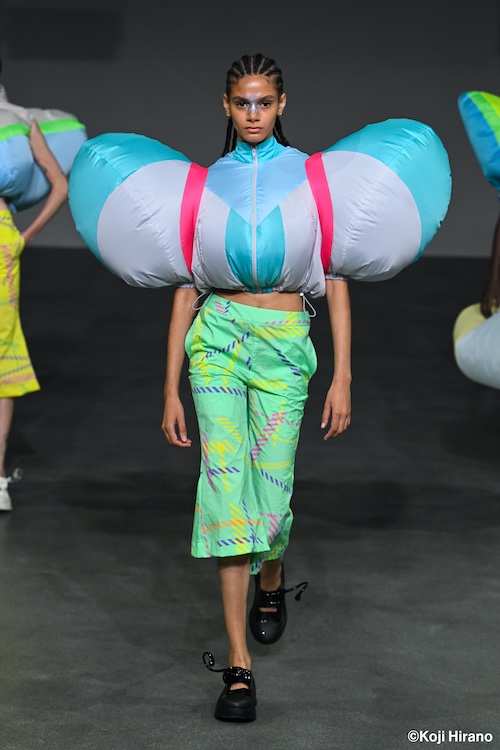
ANREALAGE 0007 0710 at Paris Fashion Week © 2024 Anrealage


Comment from Mr. Kunihiko Morinaga:

"The concept of this collection is "WIND". We visualized the invisible force of the wind. The clothes are transformed from ordinary form into an extraordinary form by wind inside. When the wind stops, the form of the clothes changes again to draped daily wear due to gravity. I also thought that the wind could be visualized through graphic design, which is essential for fashion. Normally, graphic prints are arranged regularly without the concept of gravity, but I thought that if the wind were to blow there, the graphic pattern itself would be released from the gravity on the earth and would float freely in the sky. I created graphic designs that allow petals to dance in floral patterns, and even polka dots, checkered patterns, houndstooth patterns, and tartan checks to dance freely in spaces. The wind, which is the theme of the collection, is expressed in the form of the clothes and the visuals by sending the wind into the textile space surrounded by the graphic. 

The reason we adopted "FOREARTH’s" printing technology is because wind and water are closely related. Originally, when the wind blows, waves are generated on the surface of the sea, and those waves become ocean currents, which evaporate to form clouds. By creating clouds, rain falls on the ground and creates a water cycle on the earth. We believe that wind and water are inseparable for the environment. I felt affinity with the characteristics of "FOREARTH," which uses as little water as possible, and adopted it as a printing technology.

What was also noteworthy about the clothes this time was the part where the textile expands lightly as if it were flying in the air when wind is fed into the clothes. For this reason, we used thin and light textiles that weigh only 23 grams per square meter, but we needed a technology that would not affect the weight and lightness of the textiles by placing prints on them. Ordinary pigment inkjet prints tend to be heavy and hard, but with "FOREARTH" we have been able to reproduce the light, flexible, and supple texture without losing its originality."
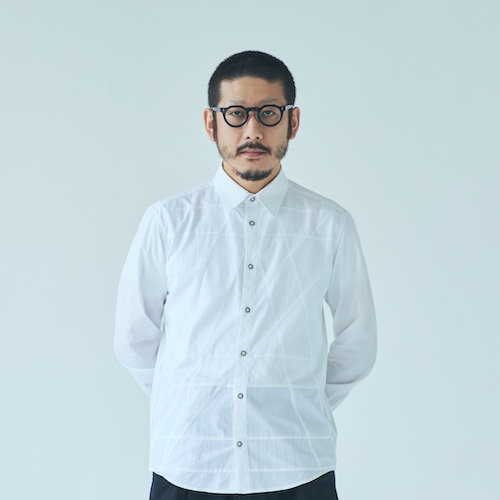
Mr. Kunihiko Morinaga © 2024 Mr. Kunihiko Morinaga


Features of the inkjet textile printer "FOREARTH"

  • Water Free Concept

Dramatically reduces water usage in textile printing.* 

  • Creative Free

Proprietary water-based pigment ink realizes both soft hand-feel prints and high fastness in a wide range of fabrics. 

  • Location Free

Textile printing does not rely on water resources, so it supports optimized production volumes and optimized manufacturing location setting and contributes to the reduction of logistic costs, time, and excess inventories.

As "FOREARTH" dramatically reduces water usage in textile printing next to zero, it does not require separate facilities such as for steaming and washing needed in pre- and post-treatment processes of conventional textile printing. This will also contribute to a significant reduction in energy consumption and CO2 emissions.

Furthermore, it achieves a soft texture maintaining softness of the fabric that are important in the textile and apparel industries, and enables high-definition printing on a wide range of fabrics such as cotton, silk, polyester, nylon, and blended fabrics.
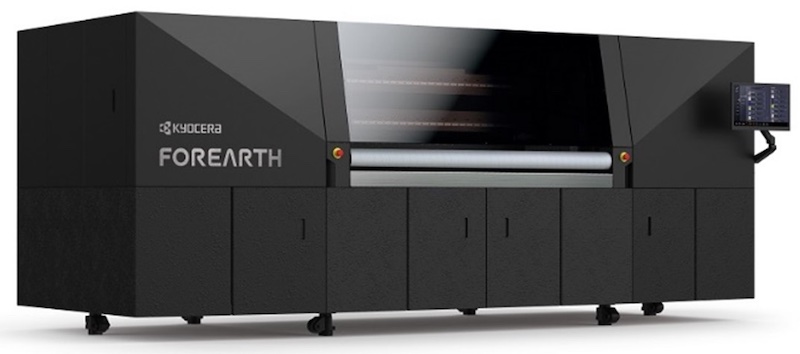
Inkjet textile printer
Inkjet textile printer "FOREARTH" © 2024 Kyocera


*FOREARTH has a two-step printing and drying process. No water is used in the printing process based on the concept of "WATER FREE". Kyocera focuses on reducing water usage not only for the printing process but also for the maintenance process. FOREARTH also recycles cleaning water used for the conveyor belt with filters resulting in water consumption per 1kg of fabric reduced to 0.02L (Based on Kyocera research, in 2022).
More News from Kyocera

More News on Digital Printing

#Digital Printing

FESPA confirms participation from leading exhibiting suppliers and brands for inaugural textile event

FESPA has confirmed a strong exhibitor line-up for its inaugural Textile show, a dedicated new event that will run as part of FESPA 2026, alongside co-located events: Global Print Expo, Personalisation Experience, European Sign Expo, WrapFest and the brand-new Corrugated.

#Digital Printing

UK Manufacturer Basic Prints commits to digital-first production model with dual investment in Kornit Digital’s Apollo

Kornit Digital, a global leader in sustainable, on-demand digital fashion and textile production technologies, today announced that UK clothing manufacturer Basic Prints has expanded its digital production capacity with a second Kornit Apollo Direct-to-Garment (DTG) system. This marks a strategic shift supporting Basic Prints’ digital-first manufacturing model.

#Digital Printing

Keeping print inclusive: Empowering women in the print industry

Across all industries, cultivating a diverse and inclusive workplace is increasingly recognised as valuable and essential to long-term success. However, despite the print industry’s significant advancements in technology and innovation, visible representation of women remains limited. As the sector grapples with low recruitment, it’s important to challenge outdated perceptions. Creating real change, however, requires collective effort - no single company can do it alone.

#Digital Printing

Express Print boosts production using an expanded fleet of Mimaki technologies

Express Print, a fast-growing Bulgarian provider of visual communication and soft signage solutions, has significantly enhanced its production workflow with a comprehensive portfolio of Mimaki digital printing systems. Based in Varna and active for more than 10 years, the company maintains a strong focus on the advertising sector. Over the years, it has steadily expanded its operations, driven by a clear vision to bring the full spectrum of large-format printing services in-house, avoiding outsourcing and ensuring complete control over production quality.

Latest News

#Techtextil 2026

Gebr. Otto highlights versatility at Techtextil with regional supply chains, yarn innovations and new hygiene segment

At this year’s Techtextil, Gebr. Otto places its versatility at the center of its presentation. In addition to spinning, twisting and dyeing – traditionally focused on fine cotton – textile processors will also find a competent development partner for technical specialty solutions. The Dietenheim-based spinning mill has now built up a decade of experience in the production of technical yarns, particularly from aramids. A new hygiene segment has also been established, where yarns for medical and hygiene products are currently being produced. In the future, this department could also develop textile products for the food sector. Gebr. Otto will once again be present at the BW-i joint stand, booth D81, hall 12.1. What is wound onto the spool is determined by the customer: Gebr. Otto develops according to specific customer requirements and transforms its own ideas into yarn innovations.

#Europe

Commission presents proposal for EU Inc. - unlocking the full potential of the Single Market for Europe's entrepreneurs

Today, the European Commission presented its proposal for EU Inc., a new single set of corporate rules, building the cornerstone and starting point for the EU's 28th regime. EU Inc. is an optional, digital-by-default European corporate framework. It will make it easier for businesses to start, operate and grow across the EU – incentivising them to stay in Europe, and encourage those who once looked elsewhere to return.

#Man-Made Fibers

OnceMore® from Södra brings end-to-end traceability for circular Man-made Cellulosic Fibers (MMCF) using TextileGenesis

OnceMore® from Södra, the world’s first large-scale process for recycling blended fabrics into high‐quality dissolving pulp, will begin using TextileGenesis, a Lectra company, to strengthen traceability from raw material to retail across the value chain. OnceMore® produces dissolving pulp made from blended textile waste and wood sourced from responsibly managed Swedish forests. By integrating TextileGenesis, OnceMore® supports the growing need for verified data and secure, transparent tracking throughout increasingly complex supply chain.

#Sustainability

Experts publish APAC policy priorities

Cascale today announced the publication of its APAC Policy Priorities Paper, developed by the Asia-Pacific (APAC) Policy Member Expert Team (MET) to identify key regional sustainability challenges and provide practical, aligned recommendations for policymakers and industry stakeholders across Asia-Pacific.

TOP