[pageLogInLogOut]

#Digital Printing

Kyocera "FOREARTH" prints fabric for Paris Fashion Week

Kyocera has announced that a collaboration work designed and created by Mr. Kunihiko Morinaga, a designer and founder of the Japanese fashion brand "ANREALAGE," using the fabric printed by Kyocera’s inkjet textile printer "FOREARTH", has been announced at the 2024-25 Fall/Winter womenswear collection in Paris Fashion Week. This collection was held in Paris, France from Monday, February 26 to Tuesday, March 5, 2024. The collaboration work with Kyocera was announced on Tuesday, February 27.

Background of this collaboration

Mr. Kunihiko Morinaga sympathized with the concept of "FOREARTH", an inkjet textile printer that dramatically reduced water usage contributing to solve long-standing issues in the textile and apparel industries, such as printing-related water pollution and waste resulting from the mass disposal of overstocked fabric and clothing. That's how this collaboration realized.

Features of the inkjet textile printer "FOREARTH"

1) Water Free Concept 

Dramatically reduces water usage in textile printing.

2) Creative Free

Proprietary pigment ink realizes both soft hand-feel prints and high fastness in a wide range of fabrics.

3) Location Free

Textile printing does not rely on water resources, so it supports optimized production volumes and optimized manufacturing location setting and contributes to the reduction of logistic costs, time, and excess inventories.
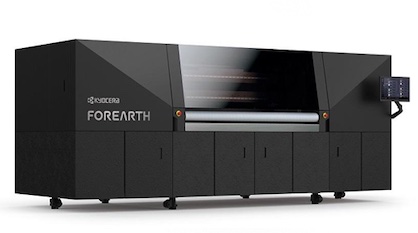
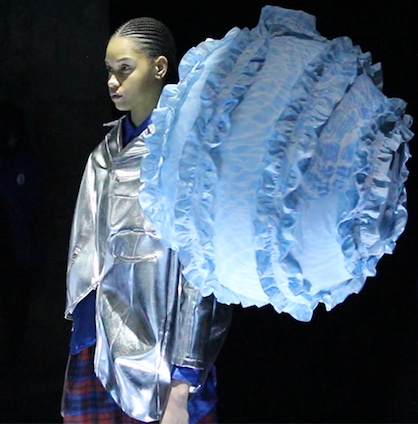
Kyocera FOREARTH © 2024 Kyocera


The fabric printed by the sustainable inkjet textile printer FOREARTH (Photo: Business Wire)


Mr. Kunihiko Morinaga made the following comment: "The theme of this collection is “OBJECT”. I pursued the way of clothes for inanimate objects, not humans. The show has taken on the world 100 years from now, in the 22nd century. 

In this show, I tried to express the concept of FOREARTH to reduce water usage in the form of clothes and showed a dress like a drop of water. I was very impressed that the fabric printed with FOREARTH achieves the vibrant and high-definition expression even with little water, and that the softness of the fabric was maintained. 

FOREARTH enables us to express what we have not been able to achieve before, and it is very important for our own creation leading to the future, the 22nd century."!



More News from TEXDATA International

#ITM 2026

ITM 2026: The new geography of textile production

New production hubs are emerging across North Africa and Central Asia, while Türkiye is accelerating its transformation toward higher-value, technology-driven and more sustainable textile manufacturing.

#Research & Development

“Production is a product”

From technical textiles and AI-driven robotics to the limitations of textile circularity: Professor Dr Thomas Gries looks back on more than two decades of development at ITA Aachen. In the interview, he explains why production technology remains a decisive success factor, discusses international collaborations and innovation ecosystems, and shares his views on the transformation of production landscapes and the challenges facing an increasingly regulated industry.

#Knitting & Hosiery

“We need to move away from the price trap and return to a value-driven mindset.”

With its new Textile Innovation Center, KARL MAYER is sending a strong signal for innovation, collaboration, and the future of textile applications. In this interview, Karl Josef Mayer discusses new opportunities in warp knitting, the processing of staple fibres, recycling, the changing role of machinery manufacturers, and why the textile industry must once again focus more strongly on the value of textiles. by Oliver Schmidt

#Associations

“Innovation, resilience and international experience remain the great strengths of the Swiss textile machinery industry”

Geopolitical uncertainty, growing competitive pressure from China, new free trade agreements and the shift towards a circular economy are currently reshaping the global textile industry. In this interview, Cornelia Buchwalder discusses the current mood within the Swiss textile machinery sector, the industry’s distinctive innovative strength, new market opportunities in India and Asia, and the technological trends that could shape the upcoming trade fair cycle leading up to ITMA 2027.

More News on Digital Printing

#Digital Printing

Where every detail counts: Experiential applications of DTF and UV-DTF printing

Personalisation has moved far beyond the traditional logo on a t-shirt. Today, brands want to create complete experiences, where every detail – from clothing and accessories to décor and packaging – feels distinctive and reflective of their identity.

#Dyeing, Drying, Finishing

EFI Reggiani and Danitech Group announce strategic multi-year agreement for Mezzera textile finishing machinery

Electronics For Imaging, Inc. (EFI), through its subsidiary EFI Reggiani (Reggiani Macchine S.p.A.), together with Danitech Engineering and Solutions Srl (Italy) and Suzhou Danitech Intelligent Technology Co. Ltd (China), announces a multi-year license and manufacturing agreement covering the Mezzera and Jaeggli textile finishing machinery portfolio.

#Digital Printing

USColorworks expands digital platform with Kornit Atlas MATRIX and Atlas MAX PLUS solutions

Kornit Digital Ltd. (NASDAQ: KRNT), a global pioneer in sustainable, on-demand digital fashion and textile production, today announced that USColorworks, a North Carolina-based apparel decoration and fulfillment company specializing in custom and on-demand printing for retail and promotional markets, has expanded its Kornit digital production platform with the addition of Atlas MATRIX and Atlas MAX PLUS systems to deliver high-quality, on-demand apparel across cotton, blended fabrics and polyester.

#Digital Printing

DTF vs DTG Printing - The technologies shaping today’s custom merchandise market

From sportswear to branded tote bags, custom merchandise continues to grow in popularity across sectors, driving print shops to cater to short runs, personalisation, and rapid turnaround. As print providers look to this market, two printing technologies often stand out: Direct‑to‑Film (DTF) and Direct‑to‑Garment (DTG). Each offers its own benefits, and understanding these differences helps determine the most suitable production method for print service providers.

Latest News

#Functional Fabrics

PERFORMANCE DAYS announces new focus topic & forums for October 2026

With its upcoming October 13–14, 2026 edition, PERFORMANCE DAYS is placing the spotlight on one of the textile industry’s most important transformations: “Bio-Based Materials – From Fiber to Fabric”, a two-part Focus Topic exploring the future of bio-based innovation across the textile value chain. Part 1, presented in October 2026, will focus on fibers and next-generation material developments, while Part 2 at the March 2027 edition will shift the perspective toward dyeing, finishing, additives, and processing technologies.

#Nonwoven machines

MENANG rapidly resumes production with new ANDRITZ airlay line after major fire

MENANG, a Malaysian manufacturer of nonwoven automotive components, has resumed production after a major fire severely damaged its airlay line in mid-March 2026. A new airlay line supplied by ANDRITZ enabled production to restart within only four months.

#Exhibitions & Events

Febratex 2026 to be the largest edition of the leading textile trade fair in the Americas with 10 exhibition halls

Febratex 2026 will be the largest edition in the history of the leading textile trade fair in the Americas. Dedicated to the textile and apparel manufacturing industries, the event will take place from August 18–21, 2026, in Blumenau, Santa Catarina, Brazil, with a strong focus on technology, sustainability, and business generation.

#Raw Materials

Cotton Brazil Dialogues field trip brings international stakeholders closer to Brazil’s cotton production chain

How do you build trust across the global textile value chain? By opening the farm gates. This is the principle behind the Cotton Brazil Dialogues. At the end of July, the programme welcomed its first group of international participants for a five-day immersion into Brazilian cotton production, combining field visits with technical workshops to showcase the quality, sustainability, innovation and traceability behind one of the world’s leading cotton origins.

TOP