[pageLogInLogOut]

#Digital Printing

Durst grows and expands
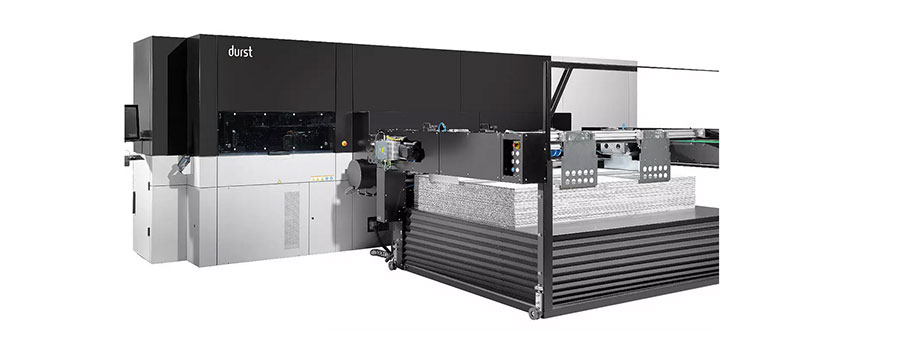
The Rho 2500 series © 2022 Durst
Durst, the industrial printer manufacturer based in Brixen, is again growing strongly and expanding its production.

The South Tyrolean headquarters is currently being expanded by 5000 square meters of production space. At the site in Lienz, the second production plant of the Durst Group, the number of employees in development and production is to be increased by around ten percent. The East Tyrolean plant has recently seen intensive investment in the software sector. And in Kufstein, the competence center for textile printing based there will be strengthened. This was announced by Durst CEO Christoph Gamper in an interview with TT.

Durst employs a total of around 880 people worldwide, 248 of them in Lienz and Kufstein and 341 in Brixen. The company produces printers for industrial companies, which use them to print large-format advertising media, textiles, tiles or packaging, among other things. The portfolio includes printer systems, inks, software and services. A growing area of business is 3D printing for the aviation and automotive industries, among others.

In the previous year, Durst grew strongly after the pandemic put a damper on the company in 2020. At that time, consolidated sales shrank to 204 million euros (in 2019, they were still 240 million euros). In 2021, group sales rose to around 260 million euros, according to preliminary figures.

This was achieved by adjusting the strategy and investments as well as further product developments, Gamper explained. However, supply chain problems, travel restrictions and quarantines also caused difficulties at Durst. Gamper's plans for the next few years are ambitious: "We've got our sights set on 2022 - we want to grow by over 20 percent once again on a consolidated basis." After that, things are to continue at a similar pace. In 2025, more than 400 million euros in sales are targeted.

Last year, Durst expanded in its key U.S. market, acquiring a majority stake in Vanguard Digital Printing Systems. The company builds printers for companies that use them to print signs and interior decorations, among other things. Vanguard will also launch in Europe in the spring. Manufacturing, marketing and distribution will be based at the company's expanded headquarters in Bressanone, Italy. Two other new Durst companies and the in-house 3D printing service provider will also move there.


The pandemic has also reorganized things in the printing world. Textiles are once again increasingly being printed in those markets where they are also sold. As a result, there is increasing demand not only for giant printers for Pakistan or India, but also for smaller and environmentally friendly devices, Gamper said. Such new ink systems for the textile sector are being developed in the Lienz and Brixen laboratories, with the machines and process development coming from Kufstein. Production will begin in Bressanone in the middle of the year, with supplier parts from Lienz. Sales are planned worldwide and will be handled to a large extent by the company's own subsidiaries.

Durst has 24 subsidiaries in Europe, Australia, America and Asia. For digital packaging systems, the company operates a joint venture with the German printing press manufacturer Koenig & Bauer. The latter has a Customer Excellence Center in Lienz and will also set up its own GmbH there.

Durst also conducts a great deal of research into sustainability. It has already succeeded in developing inks that no longer contain any harmful substances. Sustainable growth is the group's declared goal. However, Gamper admits, "We also have a lot of room for improvement here." The over-packaging of goods remains an important issue.




More News from TEXDATA International

#Texprocess 2026

Texprocess 2026: Automation, digitalisation and AI reshape textile processing

Investment decisions in textile processing have become increasingly complex. Rising energy prices, labour shortages and geopolitical uncertainties are forcing companies to prioritise technologies that deliver measurable improvements in efficiency and process stability. This applies not only to apparel production, but also to the processing of technical textiles and high-performance materials. Modernisation projects are therefore being evaluated more selectively – but the pressure to upgrade production systems continues to grow. Texprocess 2026 reflects this tension between cautious investment behaviour and increasing technological demand.

#Techtextil 2026

Textile Chemicals & Dyes: Innovation in Textile Chemistry moves into focus at Techtextil 2026

From PFAS-free finishes and water-saving dyeing technologies to advanced coatings and recycling-compatible formulations, innovation in textile chemistry is accelerating across the industry. Reflecting this development, Techtextil 2026 introduces Textile Chemicals & Dyes as a dedicated product segment, highlighting the growing role of chemical solutions in shaping the next generation of technical textiles.

#Recycling / Circular Economy

textile.4U publishes special edition “Top 100 Textile Recycling Companies 2025”

With a comprehensive 176-page special edition, textile.4U is dedicating its latest issue entirely to one of the most dynamic and influential topics in today’s textile industry: textile recycling. The new issue, published exclusively in high-quality print, presents the Top 100 textile recycling companies researched and selected by TexData – organizations that already play a key role in the transition to circular textiles or are expected to have a significant impact in the near future.

#Recycling / Circular Economy

Responsible Textile Recovery Act of 2024 signed by Governor

Senator Josh Newman (D-Fullerton) is proud to announce that Senate Bill 707 (SB 707), the Responsible Textile Recovery Act of 2024, has been signed into law by the Governor of California, Gavin Newsom. This groundbreaking legislation establishes the country’s first Extended Producer Responsibility (EPR) textile recycling program, marking a significant step forward in the state’s efforts to combat waste and promote sustainability.

More News on Digital Printing

#Digital Printing

Former ASOS CEO Nick Beighton joins Kornit Digital to help shape the future of on-demand fashion

Kornit Digital LTD. (NASDAQ: KRNT) ("Kornit" or the "Company"), a global leader in sustainable, on-demand digital fashion and textile production technologies, today announced it has appointed Nick Beighton, former Chief Executive Officer of ASOS, as a strategic advisor to the Company and its Board of Directors. His appointment reflects Kornit’s continued focus on strengthening its connection to global brands, retailers, and digital commerce platforms as the industry transitions toward on-demand production. The Company plans to nominate Mr. Beighton for election to the Board at Kornit’s 2026 Annual Shareholder Meeting.

#Digital Printing

FESPA confirms participation from leading exhibiting suppliers and brands for inaugural textile event

FESPA has confirmed a strong exhibitor line-up for its inaugural Textile show, a dedicated new event that will run as part of FESPA 2026, alongside co-located events: Global Print Expo, Personalisation Experience, European Sign Expo, WrapFest and the brand-new Corrugated.

#Digital Printing

UK Manufacturer Basic Prints commits to digital-first production model with dual investment in Kornit Digital’s Apollo

Kornit Digital, a global leader in sustainable, on-demand digital fashion and textile production technologies, today announced that UK clothing manufacturer Basic Prints has expanded its digital production capacity with a second Kornit Apollo Direct-to-Garment (DTG) system. This marks a strategic shift supporting Basic Prints’ digital-first manufacturing model.

#Digital Printing

Keeping print inclusive: Empowering women in the print industry

Across all industries, cultivating a diverse and inclusive workplace is increasingly recognised as valuable and essential to long-term success. However, despite the print industry’s significant advancements in technology and innovation, visible representation of women remains limited. As the sector grapples with low recruitment, it’s important to challenge outdated perceptions. Creating real change, however, requires collective effort - no single company can do it alone.

Latest News

#Research & Development

Textilfabrik 7.0 launched: Mönchengladbach becomes a real-world lab for sustainable textile production

With the official kick-off event of the Textilfabrik 7.0 (T7), a major transformation project for the German textile and apparel industry has been launched in the Monforts Quarter in Mönchengladbach. At the “Textile Roundtable,” an event format organized by the Zukunftsagentur Rheinisches Revier, representatives from industry, research, politics, and the regional economy came together to jointly lay the foundation for CO₂-neutral, circular, and economically viable textile production in Germany.

#Techtextil 2026

Future ready nonwovens and fiber processing solutions – Meet Trützschler at Techtextil 2026

From April 21 to 24, 2026, the Trützschler Group will present its future‑ready solutions at Techtextil in Frankfurt, Germany. At Booth C61 in Hall 12.0, Trützschler Nonwovens will showcase its latest developments for efficient nonwovens production, including comprehensive service and consulting solutions. Highlights include the fully upgraded X‑Series nonwoven cards suitable for spunlace, needle‑punching and air‑through bonding (ATB) processes, as well as the T‑ONE digital working environment enhanced with new features. Trützschler Card Clothing will complement the presentation with a new card wire designed with a specially engineered surface for high‑performance nonwoven applications. Visitors can also take a closer look at Trützschler’s complete solution for the recycling of textile waste, TRUECYCLED.

#Recycling / Circular Economy

Europe needs tipping point to scale textile-to-textile recycling, BCG and ReHubs say

A new report from Boston Consulting Group (BCG) and ReHubs, titled “Advancing Textile Circularity – Europe’s textile waste challenge: Scaling Textile-to-Textile requires enabling mechanisms”, highlights the urgent need for systemic action to tackle Europe’s growing textile waste and scale a circular textile economy.

#Techtextil 2026

Gebr. Otto highlights versatility at Techtextil with regional supply chains, yarn innovations and new hygiene segment

At this year’s Techtextil, Gebr. Otto places its versatility at the center of its presentation. In addition to spinning, twisting and dyeing – traditionally focused on fine cotton – textile processors will also find a competent development partner for technical specialty solutions. The Dietenheim-based spinning mill has now built up a decade of experience in the production of technical yarns, particularly from aramids. A new hygiene segment has also been established, where yarns for medical and hygiene products are currently being produced. In the future, this department could also develop textile products for the food sector. Gebr. Otto will once again be present at the BW-i joint stand, booth D81, hall 12.1. What is wound onto the spool is determined by the customer: Gebr. Otto develops according to specific customer requirements and transforms its own ideas into yarn innovations.

TOP