[pageLogInLogOut]
TRÜTZSCHLER SPINNING - THE NEW CARD

#Industry 4.0 / Digitalization

Jeanologia and BCome connect factory data with Life Cycle Assessment and Digital Product Passports

A new white paper by EIM by Jeanologia and BCome demonstrates how primary environmental data from denim finishing processes can be integrated into a garment's Life Cycle Assessment (LCA) and prepared for use in a Digital Product Passport (DPP). A comparative case study highlights significant improvements at the production stage while also showing how these translate into the environmental performance of the finished garment.

The fashion industry can invest in technologies that cut water, energy and chemical use in its factories. But how does that information reach the brand? And how does it become reliable data on a garment's impact?

EIM by Jeanologia and BCome tackle these questions in The Denim Passport, a new white paper demonstrating how primary data collected during production can be connected to a garment's Life Cycle Assessment and its Digital Product Passport.

The initiative addresses one of the textile industry's outstanding challenges: while factories are making progress in measuring and reducing their impacts, much of that information remains siloed within their facilities. Without access to supplier-specific data, brands may be forced to rely on industry averages that don't necessarily reflect actual manufacturing conditions.

“We need to understand what lies behind the product, connect the different stages and get the whole chain speaking the same language. Measure to understand, compare and improve”, says Begoña García, Director of EIM.

From industry averages to real production data

The white paper presents a case study of a 100% cotton denim garment that connects two complementary levels of information.

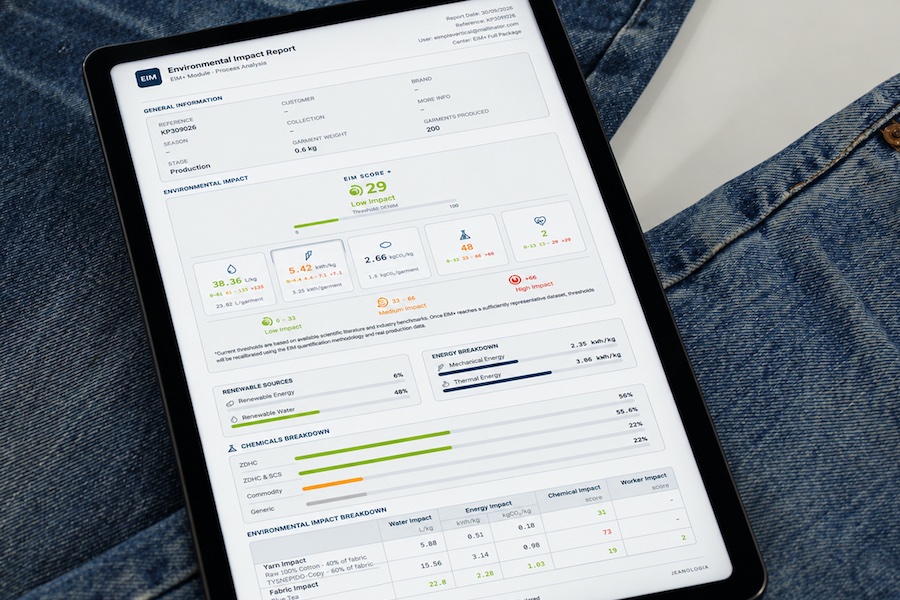
EIM by Jeanologia measures the impact of finishing processes directly on the factory floor, including water and energy consumption, chemical use and worker health. BCome integrates this specific data into the garment's Life Cycle Assessment, also accounting for the impacts of earlier stages in the supply chain.

The case study uses real data to compare a conventional finish, using stone wash and potassium permanganate spray, with Jeanologia's ATMOS technology. Factory measurements show reductions of 96.3% in water consumption, 20.8% in energy consumption and 38.2% in process-related emissions. Chemical impact also falls by 77%, and the worker health indicator improves by 93%. These improvements are reflected in the EIM Score, which drops from 78 points (high impact) for the conventional process to 17 points (low impact) with ATMOS.

By incorporating this data into the Life Cycle Assessment, the study evaluates the improvements in the context of the whole product. The results show reductions of 1.99% in global warming impact, 1.18% in the water scarcity indicator and 9.88% in marine eutrophication.

Beyond the figures, the exercise illustrates why it matters to connect factory-specific measurements with the rest of the product information. This view helps brands better understand where their impacts come from, assess production alternatives and base their decisions on more representative information.
© 2026 Jeanologia
© 2026 Jeanologia


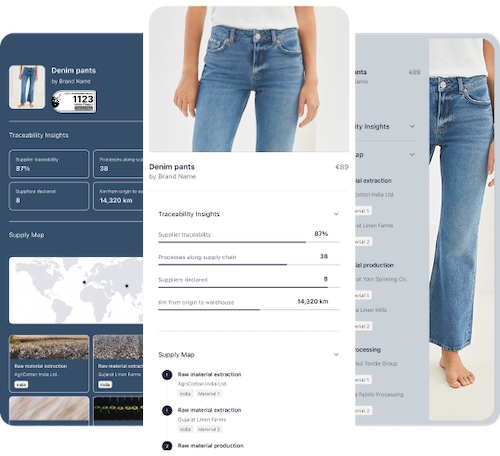
The Digital Product Passport starts long before the QR code

The upcoming EU Digital Product Passport requirements for textiles have made collecting, structuring and sharing product information one of the sector's priorities.

However, having a QR code or a digital product sheet does not, on its own, guarantee the quality of the information behind it. For the : to be useful, the data must be linked to the product, structured and backed by reliable sources.

The collaboration between EIM by Jeanologia and BCome shows how to move in that direction. EIM captures and standardizes primary data from finishing processes, while BCome integrates it into the Life Cycle Assessment, following the EU Product Environmental Footprint (PEF) framework, and structures the results for inclusion in the Digital Product Passport.

The model connects information that has traditionally remained separate and carries it from the production floor to the brand's information systems. Environmental data thus stops being just an operational metric and becomes useful information for traceability, product assessment and readiness for upcoming regulatory requirements.

“The quality of a : depends on the quality of the data that feeds it. That's why collecting primary data from the supply chain is an essential part of the process”, say Alba García and Anna Cañadell, co-founders of BCome.

From transparency to data-backed decisions

The Denim Passport shows that connecting factories and brands is not just a technological matter. It is also a prerequisite for improving the quality of environmental information, substantiating product claims and reducing reliance on generic estimates.

For brands, the challenge now is to connect the data that already exists across their supply chain and turn it into coherent, traceable information ready for different uses, from internal decision-making to product communication and the :.

The white paper offers a practical example of how industrial measurement and Life Cycle Assessment can be combined to work towards that goal in one of the fashion industry's most representative categories: denim.

Further information: Download the

White paper – The Denim Passport


More News from JEANOLOGIA S.L.

#Industry 4.0 / Digitalization

Jeanologia presents expanded EIM platform and COMMON GROUND collection at Kingpins Amsterdam

Jeanologia is presenting two approaches to textile product development at Kingpins Amsterdam on October 14–15: measuring the environmental impact of textile production and exploring new creative possibilities through garment finishing technologies.

#Industry 4.0 / Digitalization

EIM evolves into a new Environmental Intelligence to measure the impact of textile production

¿Do we really know the environmental impact behind a garment? Answering this question remains one of the textile industry’s major challenges. Garment production involves multiple stages, from yarn and fabric to final finishing, carried out by different players across the supply chain. Accesing reliable data from each process, connecting it and establishing a common language are essential to understanding a product’s true impact.

#Sustainability

Jeanologia Sustainability Report highlights environmental impact of textile technologies

Jeanologia has published its Sustainability Report 2025, reporting a 13.64% reduction in its own carbon footprint and quantifying the environmental impact associated with the use of its technologies across the global textile industry. According to the company’s calculations, their use avoided the pollution of 21.52 million m³ of water and emissions of approximately 103,530 tonnes of CO₂ compared with conventional textile finishing processes.

#Recycling / Circular Economy

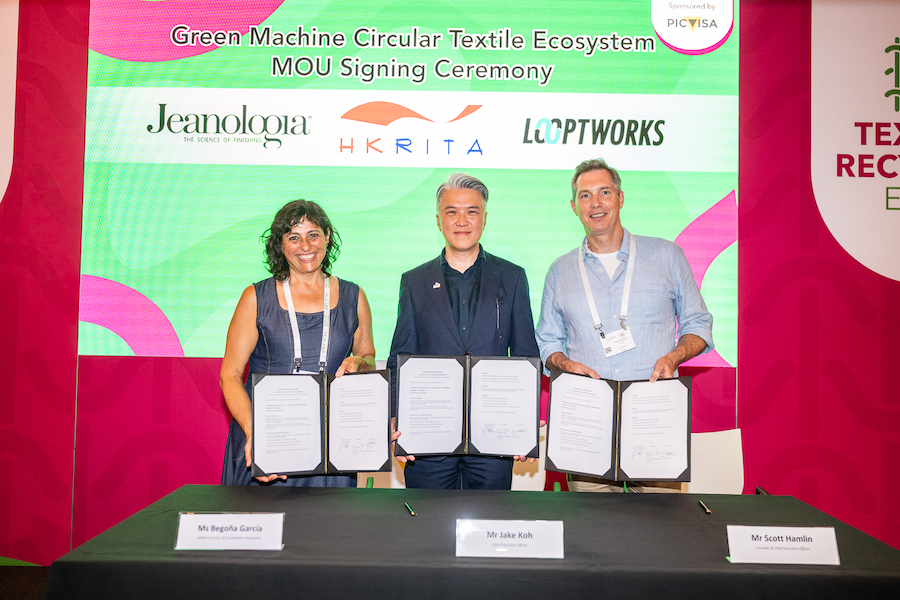
HKRITA signs MoU with Jeanologia and Looptworks to establish the Green Machine Circular Textile Ecosystem

The Hong Kong Research Institute of Textiles and Apparel (HKRITA) yesterday officially signed a landmark Memorandum of Understanding (MoU) with two key global partners, Jeanologia and Looptworks, to establish the Green Machine Circular Textile Ecosystem – a first-of-its-kind collaboration to accelerate the large-scale recycling of blended textiles.

More News on Industry 4.0 / Digitalization

#Industry 4.0 / Digitalization

White House reduces production planning time by up to 80% with Coats Digital’s FastReactPlan

Indian garment manufacturer White House has reduced its production planning cycle by 60–80% following the implementation of Coats Digital’s FastReactPlan software. The integrated planning solution provides greater visibility across production, capacity and material requirements while supporting faster decision-making and improved delivery performance.

#Software

UNIFEQ Europe adopts Coats Digital’s GSDCost and AI-powered GSDQuest to support rapid growth

Coats Digital is pleased to announce that rapidly growing Polish defence and uniform manufacturer UNIFEQ Europe Sp. z o.o. has invested in its award-winning GSDCost solution together with its AI-powered GSDQuest platform to establish a consistent approach to garment costing, improve sewing-floor productivity and accelerate labour costing for tenders and new products.

#Industry 4.0 / Digitalization

Orient Rongheng connects production planning across China and Bangladesh with FastReactPlan

Chinese apparel manufacturer Orient Rongheng is implementing Coats Digital’s FastReactPlan to digitalize production planning across its manufacturing operations in China and Bangladesh. The project aims to connect capacity, materials and order planning across multiple factories while integrating these processes with the company’s existing ERP and Manufacturing Execution System (MES).

#Industry 4.0 / Digitalization

Lectra launches Apogy with agentic AI for fashion product development

Lectra has launched Apogy, a new cloud-based solution for fashion product development that combines product data, collaborative workflows and agentic artificial intelligence. The platform is designed to connect the different stakeholders and processes between initial design and production while using AI agents to automate tasks and support decision-making throughout the development cycle.

Latest News

#Spinning

Georg Stausberg, a veteran of the textile machinery industry, takes over as Rieter Group CEO

Georg Stausberg, one of the most experienced executives in the international textile machinery industry, has been appointed Chief Executive Officer of the Rieter Group with immediate effect from 4 November 2026. With more than three decades of industry experience and a long-standing leadership career at Barmag, Stausberg brings extensive technological expertise, international market knowledge and an established network across the global textile industry to his new position.

#Denim

Inside the Making connects denim and sportswear supply chains at Ecomondo 2026

Six European companies are joining forces at Ecomondo 2026 in Rimini to demonstrate how different stages of denim and sportswear production are interconnected. The new initiative, Inside the Making, highlights the importance of cooperation across the textile supply chain in addressing sustainability challenges, from reducing resource consumption to improving transparency and the reliability of environmental claims.

#Nonwovens

EDANA welcomes definitive EU anti-dumping measures on Chinese PET spunbond

EDANA, the international association serving the nonwovens and related industries, has welcomed the European Commission's decision to impose definitive anti-dumping duties on imports of PET spunbond originating in China. The association considers the measures an important step towards restoring fair competition and safeguarding European industrial capacity.

#Nonwovens

EU imposes definitive anti-dumping duties on Chinese PET spunbond imports

The European Commission has introduced definitive anti-dumping duties ranging from 39.8% to 48.1% on imports of PET spunbond from China. The measures, which entered into force on 31 October 2026, will remain in place for five years and are intended to address unfairly priced imports that have caused injury to European manufacturers. The EU market for these nonwoven materials is valued at approximately €200 million.

TOP