[pageLogInLogOut]

#Denim

The atmosphere washing revolution hits Denim PV

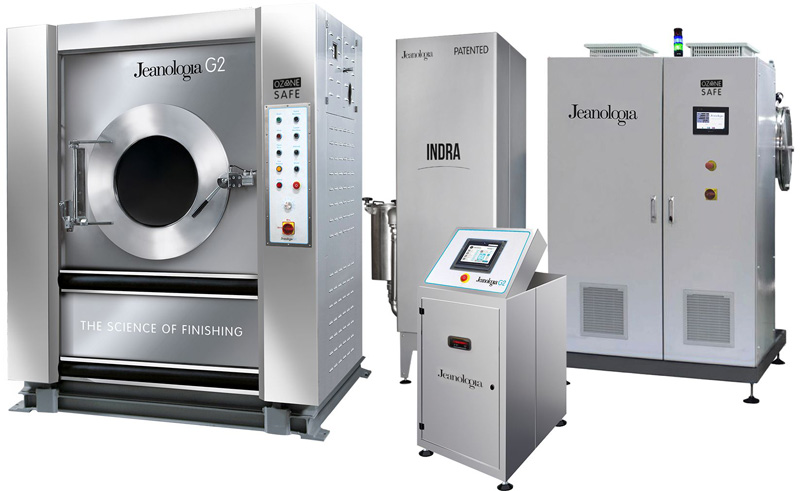
Jeanologia transforms the denim sector with ATMOS, the eco-efficient process alternative to traditional stone washing. With G2 technology and the innovative INDRA system it is possible to eliminate the use of water and pumice stone in aging jeans, ensuring their quality, authenticity, and adaptability to industry trends.

Jeanologia is showcasing in Milan the potential of its sustainableprocess for finishing and aging denim garments

Jeanologia makes its presence felt at the Denim PV Milan edition on June 5 to 6 in the heart of Italian fashion. At this landmark event, the Spanish company, a global leader in sustainable textile technology, will present its groundbreaking atmospheric washing process ATMOS, promising to revolutionize the denim industry by offering an eco-efficient alternative to traditional stone washing. The unveiling of ATMOS in Milan holds particular significance amidst the resurgence of Italian denim, with the country's textile industry redefining its standards towards sustainability and luxury.
(c) 2024 Jeanologia
(c) 2024 Jeanologia


The ATMOS process, fueled by the innovative INDRA system and G2 technology, marks a true breakthrough in denim garment finishing by leveraging only atmospheric elements, dispensing with water and pumice stone. This pioneering technical approach not only ensures a drastic reduction in the consumption of natural resources, with up to 96% less water usage, but also eliminates the use of abrasive materials associated with negative environmental impacts, ensuring the quality and durability of garments.

Traditional stone washing entails significant water consumption during the washing, wearing, rinsing, and cleaning stages, using between 80 and 100 liters of water per 200 kg of garments and requiring additional detergents and chemicals to remove pumice stone residues. In contrast, Jeanologia has successfully reduce water usage to only 1 liter per garment, by leveraging a combination of the ATMOS process and other proprietary technologies, including, eFlow technologies, which utilizes nanobubbles to apply performance chemicals and the revolutionary H2 Zero a water recuperation system, guarantee a perfect close loop. This approach not only eliminates the need for extensive rinsing and chemical use but also reduces resource consumption and facilitates wastewater management, thereby promoting a cleaner and more efficient water treatment cycle.

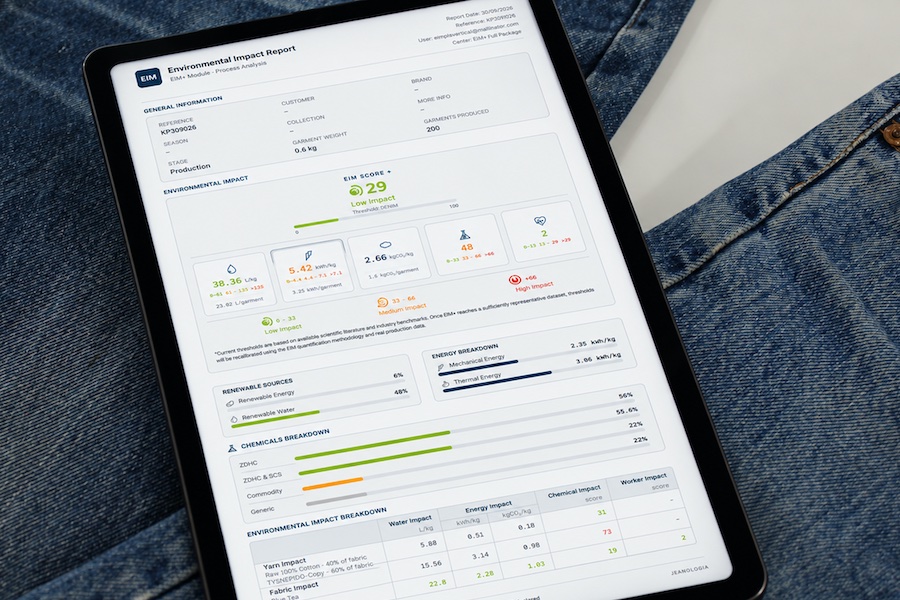
These attributes enable to garner a high rating on the EIM assessment scale. Jeanologia's environmental impact measurement software in textile garment production, widely adopted by leading brands and retailers worldwide. Denim garments aged through G2 Ozone & INDRA attain 'green EIM score', ensuring compliance with global sustainability standards throughout the production chain, classifying processes based on water, energy, chemicals consumption, and worker health.
(c) 2024 Jeanologia
(c) 2024 Jeanologia


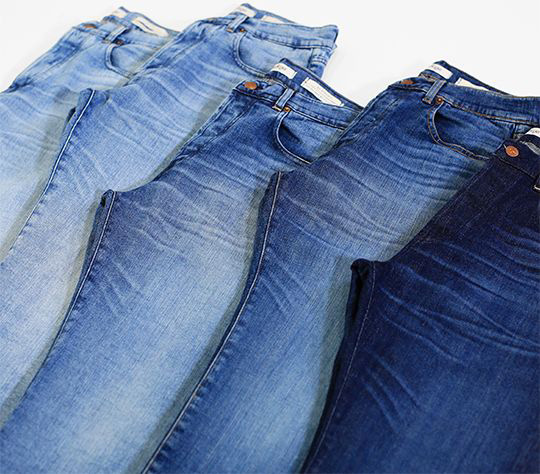
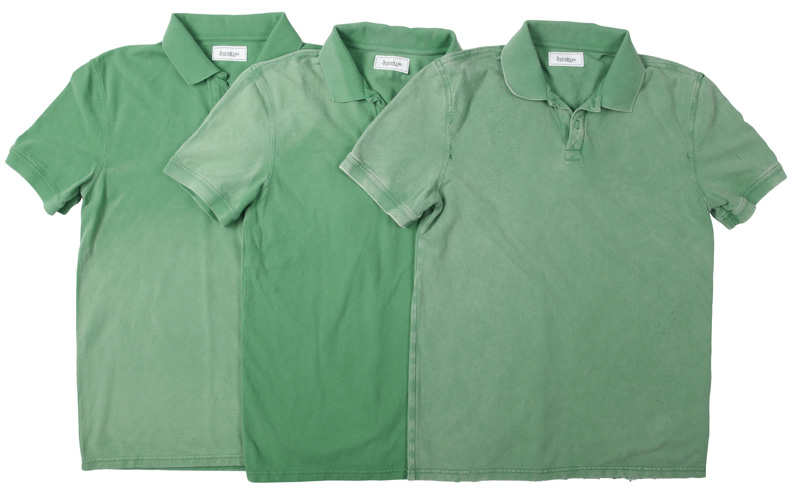
Jeanologia is set to present the 'Atmos Vintage' collection at Denim PV, featuring a 'stone wash' inspired looks created using the ATMOS process. This capsule collection is designed to inspire all European brands and garment manufacturers with its cutting-edge approach. By showcasing it in Milan, Jeanologia seeks to engage the Italian market in responsible textile production, significantly reducing water usage and eliminating the need for stones and chemicals, all while preserving the authenticity and beauty of the garments.

Propelling Italy into a new era of sustainable luxury denim

The Italian textile industry, renowned globally for its quality and design, has undergone significant transformation in recent years, especially in the denim sector, which has evolved into a benchmark for the luxury market. Italian factories have adapted their processes to meet the demand for high-end denim products, incorporating new designs and applications of these fabrics not only in garments, but also in footwear, and accessories.

Mindful of this evolution, Jeanologia has bolstered its presence in Italy, forging close collaborations with the country's leading fashion brands. The company has emerged as a key ally in implementing technologies that enhance the quality of the final product and production efficiency, while markedly reducing the environmental impact of textile processes.
(c) 2024 Jeanologia
(c) 2024 Jeanologia


"Italy has always been a beacon in fashion and sustainability, and its denim industry has repositioned itself in recent years towards the luxury market," notes Stefano Tessarolo, Jeanologia’s Sales Manager in Italy. "ATMOS not only aligns with this new positioning but also propels Italy towards a new era of sustainable and responsible denim fashion."

Committed to leading the charge towards more sustainable practices in the fashion industry, Jeanologia views ATMOS as a tangible manifestation of this commitment. Through Denim PV Milan as a platform, the Spanish company seeks to inspire other entities in the industry to embrace eco-efficient technologies and collaborate towards building a more sustainable future for fashion.

With a current capacity to process up to 50 million jeans, Jeanologia anticipates an exponential uptake of this technological process in the coming years, catalyzing a fundamental shift towards responsible fashion.


More News from JEANOLOGIA S.L.

#Textile processing

Jeanologia showcases the future of product development

Jeanologia is showcasing how software is transforming product development in the fashion industry at PI Apparel Europe: The Fashion Technology Show, taking place on March 30–31 in London.

#Denim

Jeanologia launches Billy

The new AI extracts precise laser designs from a garment image in minutes, transforming how vintage denim is recreated for production. If Jeanologia’s laser changed the way jeans were made at the end of the last century, its AI now takes the next step: moving from reproducing wear to designing it. / archive photo © 2026 Jeanologia

#Textile chemistry

Jeanologia urges industry to accelerate PP Spray phase-out following ZDHC Watchlist update

Potassium permanganate has officially entered the Chemical Watchlist of the ZDHC Foundation, signaling increased scrutiny and potential phase-out of one of the most hazardous chemicals still used in denim finishing. The inclusion confirms an industry shift that Jeanologia anticipated more than a decade ago.

#Denim

Jeanologia celebrates its 30th anniversary transforming how jeans are produced worldwide

Jeanologia celebrates its 30th anniversary reaffirming the mission it was born with in 1994, to transform the textile industry into a more sustainable, efficient, and human-centered sector. Three decades later, that vision has become a global reality. Today, more than 40 percent of all jeans produced worldwide are made using technologies developed by the Valencia-based company.

More News on Denim

#Denim

Eastman Naia™ debuts at Kingpins Amsterdam, transforming Denim from the inside out

At Kingpins Amsterdam (April 15–16, 2026), Naia™ by Eastman Chemical Company makes its debut, presenting its approach to circularity and comfort in denim at Stand 1, Ground Level (Blue Area). The brand also highlights its growing global ecosystem, connecting mill partners, designers and brands working to expand denim possibilities through fiber innovation.

#Denim

ISKO introduces a new chapter of denim innovation at Kingpins Amsterdam with FW 27/28

At Kingpins Amsterdam, ISKO presents its latest FW27/28 collection, a forward-looking exploration of denim that merges advanced color technologies, innovative fabric engineering, and contemporary finishing techniques. Designed to meet the evolving demands of the industry, the collection reflects ISKO’s commitment to pushing the boundaries of authenticity, performance, and responsible innovation, while also embracing a strong lifestyle perspective.

#Denim

TENCEL™ Lyocell - HV100 achieves global denim availability in six months; Vol. 2 debuts at Kingpins Amsterdam

When TENCEL™ Lyocell - HV100 debuted at last year’s Kingpins Amsterdam in October, 17 mill partners across five countries presented fabrics featuring the new fiber. Just six months on, participation has more than doubled, evolving into a global network that spans nine countries and four continents, signaling both strong industry momentum and growing demand.

#Recycled Fibers

Recover™ and Prosperity Textile announce strategic denim partnership

Recover™, a global producer of low-impact, high-quality recycled cotton fiber at scale, has announced a strategic partnership with Prosperity Textile, a vertically integrated denim fabric manufacturer operating at industrial scale.

Latest News

#Heimtextil 2027

Heimtextil celebrates Milan Design Week honoring partnerships with Patricia Urquiola and Alcova Milano

Heimtextil is represented at Milan Design Week with its strong design partners Patricia Urquiola and Alcova. At Villa Pestarini, the leading trade fair spotlighted its dynamic collaborations with acclaimed designer Patricia Urquiola and Alcova Milano.

#Texprocess 2026

Kornit Digital expands digital production into footwear and technical textiles with Presto MAX PLUS

Kornit Digital (NASDAQ: KRNT) (“Kornit” or the “Company”), a global pioneer in sustainable, on-demand digital fashion and textile production, today unveiled the Kornit Presto MAX PLUS, a new roll-to-roll system expanding digital manufacturing into footwear, automotive interiors, military camouflage, high-performance sportswear, and high-end furnishings. Debuting at Texprocess 2026 in Frankfurt, Presto MAX PLUS enables entirely new applications for on-demand textile production.

#Textile processing

NATULON® zipper series surpasses 50% of YKK’s global zipper sales

YKK Corporation (Headquarters: Chiyoda-ku, Tokyo; President: Koichi Matsushima; hereafter, YKK) announces that the global sales share of its NATULON® zipper series—zippers that incorporate recycled materials—has exceeded 50%.

#Smart Textiles

Covestro, FILK Freiberg, and OUT e.V. develop flexible, conductive polymer smart textile system

As the smart textiles market continues to grow across healthcare, personal protection, sportswear, and automotive applications, developers are seeking new ways to integrate electronic functionality directly into textiles, without the rigidity and complexity of conventional wiring. To address this challenge, FILK Freiberg Institute, an independent research institution with expertise in polymer coatings for textile applications, collaborated with Optotransmitter-Umweltschutz-Technologie (OUT) e.V. The joint project, funded under the German Industrielle Gemeinschaftsforschung (IGF) program of the Bundesministerium für Wirtschaft und Energie (BMWE), focused on developing flexible, conductive polymer surfaces for next-generation smart textiles.

TOP