[pageLogInLogOut]

#Denim

Lotustex Textile invests in KARL MAYER's first LINK-MATIC® system for automatic batch change on PRODYE®-S slasher indigo dye range

The fully automatic knotting unit on the LINK-MATIC® system © 2022 KARL MAYER
KARL MAYER has placed its first LINK-MATIC® system on the market. The sophisticated automation solution considerably simplifies the batch change on indigo and sizing machines, thus increasing productivity. An increase of up to 30 % is possible, depending on the number of batch changes per day.

Sales success of a solution for more efficiency in warp preparation

In addition, less yarn waste is produced. Up to 600 m, on indigo dyeing range, of unusable yarn material can be saved with each batch – while at the same time requiring less manpower. During batch changes, only one operator is required to prepare the warper beams for entry into the machine. A fully automatic knotting unit couples the warp yarns of the new batch to the yarns of the batch just finished.

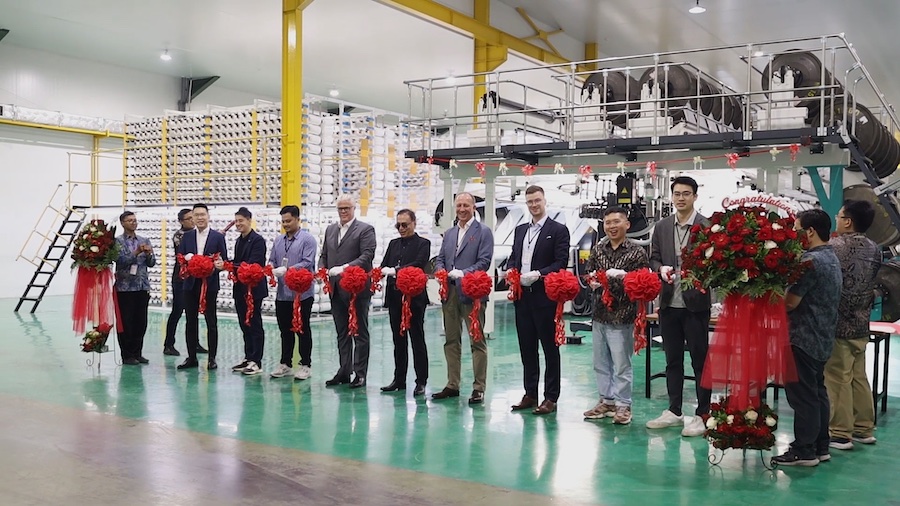
Lotustex Textile has recognized all these advantages for itself. The Egypt-based denim manufacturer, which was only founded in 2019, was the first company to invest in the innovative LINK-MATIC® system in recent months in order to optimize the performance of its PRODYE®-S sizing machine. Especially for its activities in the fashion sector, Lotustex Textile expects a significantly higher flexibility and cost reduction. The delivery date for the new acquisition is November 2022.

Continuous processes with LINK-MATIC®

LINK-MATIC® makes it possible to automate the batch change on the PRODYE®-S and PROSIZE® with two subsystems. The first subsystem focuses on feeding the yarn sheets of the new batch from the warper beams to the infeed of the machine. The yarn material is guided to its destination in the lower section of the warper beam frame. Previously, it had to be threaded by hand, usually by two skilled workers, under the bottom cover. The lengthy, complicated process resulted in a batch of waste and numerous sources of error.


With the new solution, only one operator fixes the warp yarns of a warper beam in homogeneous distribution by a clamp in beam length. He then guides the clamp downward and hooks it into a transport chain on each side. The circulating chains take care of the transport to the machine. The time savings are immense. What's more, the quality is right. The yarns are guided to the machine with uniform, constant tension. Here, the second dividing system cuts the warp yarns of the finished batch at the infeed and knots on the warp yarns of the new batch - each with high precision and fully automatically. The actual batch change can thus be reduced to 90 seconds. What appears to be so simple is the result of the precise interaction of well thought-out components such as the clamping device for string formation before knotting and the pneumatic solution for sucking in the yarn ends.

The new LINK-MATIC® system can develop its full potential in conjunction with an moveable creel.

More News from KARL MAYER Textilmaschinenfabrik GmbH

#ITMA Asia + CITME 2026

KARL MAYER expands TM WEFT capabilities for fashion fabrics at ITMA ASIA 2026

A new E 36 gauge, an EL pattern drive and improved yarn tension regulation extend the application possibilities of KARL MAYER's TM WEFT warp knitting machine. At ITMA ASIA 2026, the company will demonstrate the developments alongside a collection of woven-like warp knitted fabrics for fashion and apparel.

#India ITME 2026

KARL MAYER highlights new technologies and growth opportunities at INDIA ITME 2026

India‘s textile industry is undergoing a profound transformation: What was previously a production hub driven primarily by cost and volume is increasingly evolving into a market focused on technology, exports, and value creation. KARL MAYER supports this change with high-performance machinery solutions and innovative textile concepts, and is therefore looking forward to INDIA ITME 2026 with great anticipation.

#Knitting & Hosiery

Long John puts KARL MAYER's RDJ 7/3 into operation and strengthens its position as a market leader

KARL MAYER has just unveiled its new RDJ 7/3 Jacquard Double Needle Bar Raschel Machine in the international trade press, and the innovation is already causing a stir in the market: The Long John Group, a leading manufacturer of performance footwear fabrics and a long-standing partner of renowned brands, was the first customer to invest in the new machine and celebrated its official launch at its Indonesian plant on August 20.

#Knitting & Hosiery

KARL MAYER invites the Global Textile Industry to celebrate its 90th anniversary at its German Headquarters in 2027

KARL MAYER is turning its anniversary year 2027 into a milestone for the textile sector. To mark its 90th anniversary, the industry leader is inviting customers, partners, and experts from around the world to a unique event series in September aimed at pushing boundaries, unlocking new opportunities, and jointly setting the course for a new era in textiles – just as KARL MAYER has done throughout its history. The company’s headquarters in Obertshausen, near Frankfurt, is the place to be.

More News on Denim

#Recycling / Circular Economy

Blue Jeans Go Green celebrates 20 years of denim recycling with more than six million items collected

Cotton Incorporated is celebrating the 20th anniversary of its Blue Jeans Go Green™ denim recycling program. Since its launch in 2006, the initiative has collected more than six million denim items, diverted over 3,000 tons of textile waste from landfills and enabled the production of more than 12 million square feet of denim-based insulation. What began as a college campus collection drive has developed into a nationwide recycling initiative involving consumers, retailers, schools and community organisations across the United States.

#Industry 4.0 / Digitalization

Jeanologia and BCome connect factory data with Life Cycle Assessment and Digital Product Passports

A new white paper by EIM by Jeanologia and BCome demonstrates how primary environmental data from denim finishing processes can be integrated into a garment's Life Cycle Assessment (LCA) and prepared for use in a Digital Product Passport (DPP). A comparative case study highlights significant improvements at the production stage while also showing how these translate into the environmental performance of the finished garment.

#Denim

Inside the Making connects denim and sportswear supply chains at Ecomondo 2026

Six European companies are joining forces at Ecomondo 2026 in Rimini to demonstrate how different stages of denim and sportswear production are interconnected. The new initiative, Inside the Making, highlights the importance of cooperation across the textile supply chain in addressing sustainability challenges, from reducing resource consumption to improving transparency and the reliability of environmental claims.

#Denim

Catalyst Club connects fashion industry leaders and emerging talent at Kingpins Amsterdam

Following its debut in Florence, Catalyst Club hosted its second networking event during the Kingpins Show in Amsterdam, bringing together international fashion and denim industry representatives to exchange ideas, share experiences and explore new opportunities for collaboration.

Latest News

#India ITME 2026

Stäubli to introduce new S3292 dobby for high-speed weaving at ITME India 2026

Stäubli will introduce its new S3292 dobby at ITME India 2026, taking place from December 4 to 9 at the India Expo Centre & Mart in Greater Noida, Uttar Pradesh. Designed for high-speed air-jet weaving, the new machine will be among the highlights of the company's presentation, which also includes warp preparation systems, cam motions, Jacquard technologies and digital services.

#Research & Development

DITF develops bio-based binding fibers for wood-fiber insulation materials

As part of the CelluWoodFlex project, the German Institutes of Textile- and Fiber-Research in Denkendorf (DITF) are developing bio-based cellulose ester fibers as alternative binding fibers for flexible wood fiber insulation materials. In addition to the spinning process and the production of suitable staple fibers, the institute is also investigating how wood and cellulose fibers can be separated and recycled at the end of their useful life.

#Recycled Fibers

Reju expands textile-to-textile recycling network with six international fabric manufacturers

Reju, a textile-to-textile regeneration company, is expanding its industrial network through collaborations with six fabric manufacturers in Europe and the Americas. The initiative aims to accelerate the integration of regenerated polyester into textile manufacturing and support the development of finished fabrics for commercial applications.

#Nonwovens

Magnera highlights HighPleat™ filtration media technology at FiltXPO 2026

At FiltXPO 2026, held on October 28–29 at the Minneapolis Convention Center in Minneapolis, Minnesota, Magnera highlighted advances in air filtration media architecture, with a particular focus on its HighPleat™ platform for MERV 8–10 applications. The technology combines a lofted fiber structure with optimized pore architecture to address the challenge of balancing filtration efficiency, airflow resistance and contaminant-holding capacity.

TOP