[pageLogInLogOut]

#Composites

Grand Largue Composites and Sicomin enable first flax-fibre-built Class40

© 2022 Grand Largue Composites / Sicomin
Fibres, fabrics, epoxy resins and adhesives from Sicomin have been used by Grand Largue Composites (GLC) to construct the first Class40 racing yacht to feature a significant quantity of flax-fibre reinforcements.

The yacht, called Crosscall, won the Class40 World Championships in June 2022 and is a prototype of the new Lift V2 design by Marc Lombard, one of the leading naval architects in this field.

Class40 is one of the most competitive fleets in yacht racing. The hulls of Class40 yachts must be light in weight, strong and stiff, and durable in the most extreme of conditions. Furthermore, to keep costs down, they cannot be reinforced with carbon fibres. The quality and reliability of the resins used for the infusion and lamination of the hulls are therefore of paramount importance.

© 2022 Grand Largue Composites / Sicomin


Owner of Crosscall, Aurelien Ducroz, was keen to use as much flax as possible in the construction of the yacht, but Lombard – who had to certify and warranty the structure of the boat in ocean racing use – was more cautious. A compromise therefore had to be reached.

Crosscall's cockpit was designed to be effectively non-structural, with the mainsheet, which can generate huge shock loads, supported separately. This would allow the cockpit to be made from a hybrid biaxial fabric comprising 50% flax fibres. Other parts of the boat that incorporate flax fibre include the tunnel, the engine cover, the ballast tanks and the cap. The rest of the boat is reinforced with 100% glass-fibre fabrics.

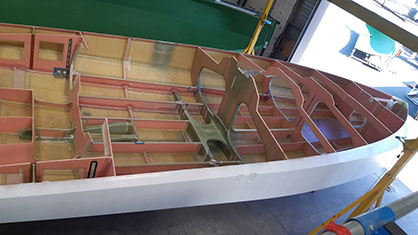
To help it realise this ambitious design, GLC, a highly skilled infusion specialist, turned to its long-time material supplier, Sicomin. The hull was moulded and infused in one piece and the deck – including the hybrid flax-fibre cockpit – was also infused as a single part. The internal structure was then laminated into the hull by hand before the hull and deck were finally bonded together.


The infusion resin selected was Sicomin’s SR 1710, a high-modulus structural epoxy. Designed specifically for use in infusion and injection processes, it has exceptionally low viscosity and its low-reactivity hardener makes it suitable for the production of large parts. Composites components made from SR 1710 possess high interlaminar shear-strength and the resin retains its mechanical properties in wet environments. 
© 2022 Grand Largue Composites / Sicomin


Sicomin’s low-toxicity SR 8200 was used to laminate the internal structures onto the skin of the hull. Ideal for hand laminating, this system includes a choice of hardeners with a wide range of reactivities, which makes it equally suitable for making large or small parts. The hull and deck were joined together with Sicomin’s Isobond SR 7100, which demonstrates extremely high fatigue strength and is very resistant to microcracking.

An epoxy bonding primer – called Undercoat EP 215 HB+ and supplied by Sicomin’s sister company, Map Yachting – was applied to the moulds first to make demoulding easier. It also serves as an undercoat in the polyurethane exterior paint system that is used instead of gelcoat to protect the epoxy hull from UV damage.

Since the launch of Crosscall, GLC has started building a second Lift V2 Class40 and a third one is now planned, both for which Sicomin will supply the materials. Managing Director, GLC, Xavier Gosselin, concludes: "We have been using Sicomin’s products since the beginning, we have never had a problem and I would not want to risk trying a different supplier."




More News from TEXDATA International

#Texprocess 2026

Texprocess 2026: Automation, digitalisation and AI reshape textile processing

Investment decisions in textile processing have become increasingly complex. Rising energy prices, labour shortages and geopolitical uncertainties are forcing companies to prioritise technologies that deliver measurable improvements in efficiency and process stability. This applies not only to apparel production, but also to the processing of technical textiles and high-performance materials. Modernisation projects are therefore being evaluated more selectively – but the pressure to upgrade production systems continues to grow. Texprocess 2026 reflects this tension between cautious investment behaviour and increasing technological demand.

#Techtextil 2026

Textile Chemicals & Dyes: Innovation in Textile Chemistry moves into focus at Techtextil 2026

From PFAS-free finishes and water-saving dyeing technologies to advanced coatings and recycling-compatible formulations, innovation in textile chemistry is accelerating across the industry. Reflecting this development, Techtextil 2026 introduces Textile Chemicals & Dyes as a dedicated product segment, highlighting the growing role of chemical solutions in shaping the next generation of technical textiles.

#Recycling / Circular Economy

textile.4U publishes special edition “Top 100 Textile Recycling Companies 2025”

With a comprehensive 176-page special edition, textile.4U is dedicating its latest issue entirely to one of the most dynamic and influential topics in today’s textile industry: textile recycling. The new issue, published exclusively in high-quality print, presents the Top 100 textile recycling companies researched and selected by TexData – organizations that already play a key role in the transition to circular textiles or are expected to have a significant impact in the near future.

#Recycling / Circular Economy

Responsible Textile Recovery Act of 2024 signed by Governor

Senator Josh Newman (D-Fullerton) is proud to announce that Senate Bill 707 (SB 707), the Responsible Textile Recovery Act of 2024, has been signed into law by the Governor of California, Gavin Newsom. This groundbreaking legislation establishes the country’s first Extended Producer Responsibility (EPR) textile recycling program, marking a significant step forward in the state’s efforts to combat waste and promote sustainability.

More News on Composites

#Composites

Kordsa showcases its global expertise in material technologies at JEC World 2026

Kordsa, a subsidiary of Sabancı Holding, shared its global expertise in material technologies with participants at JEC World 2026, held in Paris. The company’s solutions developed for a wide range of industries—particularly aviation, energy, and automotive—stood out among its key innovations at the exhibition. Throughout the event, Kordsa also presented its vision for sustainable growth and its strategic transformation in composite technologies to international stakeholders.

#Composites

JEC Composites Startup Booster: 2026 winners announced

The leading global startup competition for composites and advanced materials has crowned its 2026 champions, ahead of a landmark 10th anniversary edition next year. The winners of the JEC Composites Startup Booster 2026 were announced on Wednesday, 11 March, at JEC World, recognizing the most promising emerging companies reshaping the future of composites and advanced materials.

#Yarn & Fiber

Teijin Carbon strengthens high‑end sports offering with advanced prepreg and resin technologies for next‑generation bicycle performance

High‑end bicycle manufacturers are entering a new era in which modern frames and components must be lighter, stiffer, tougher and more sustainable – all while enabling fast, repeatable and cost‑efficient production. To support this shift, Teijin Carbon is expanding its portfolio of advanced prepreg systems developed specifically for premium road, gravel and mountain bike applications.

#Composites

JEC WORLD 2026 opens: Paris becomes the World Capital of composites

JEC World 2026 opens tomorrow, March 10, at Paris Nord Villepinte, bringing together the entire composites ecosystem for three days of exhibitions, conferences, technical sessions, strategic industry gatherings, and business meetings. As the “festival of composites”, JEC World is also a destination for a broad spectrum of other professional visitors, eager to discover how these advanced materials can offer sustainable solutions to their industries.

Latest News

#Techtextil 2026

Gebr. Otto highlights versatility at Techtextil with regional supply chains, yarn innovations and new hygiene segment

At this year’s Techtextil, Gebr. Otto places its versatility at the center of its presentation. In addition to spinning, twisting and dyeing – traditionally focused on fine cotton – textile processors will also find a competent development partner for technical specialty solutions. The Dietenheim-based spinning mill has now built up a decade of experience in the production of technical yarns, particularly from aramids. A new hygiene segment has also been established, where yarns for medical and hygiene products are currently being produced. In the future, this department could also develop textile products for the food sector. Gebr. Otto will once again be present at the BW-i joint stand, booth D81, hall 12.1. What is wound onto the spool is determined by the customer: Gebr. Otto develops according to specific customer requirements and transforms its own ideas into yarn innovations.

#Europe

Commission presents proposal for EU Inc. - unlocking the full potential of the Single Market for Europe's entrepreneurs

Today, the European Commission presented its proposal for EU Inc., a new single set of corporate rules, building the cornerstone and starting point for the EU's 28th regime. EU Inc. is an optional, digital-by-default European corporate framework. It will make it easier for businesses to start, operate and grow across the EU – incentivising them to stay in Europe, and encourage those who once looked elsewhere to return.

#Man-Made Fibers

OnceMore® from Södra brings end-to-end traceability for circular Man-made Cellulosic Fibers (MMCF) using TextileGenesis

OnceMore® from Södra, the world’s first large-scale process for recycling blended fabrics into high‐quality dissolving pulp, will begin using TextileGenesis, a Lectra company, to strengthen traceability from raw material to retail across the value chain. OnceMore® produces dissolving pulp made from blended textile waste and wood sourced from responsibly managed Swedish forests. By integrating TextileGenesis, OnceMore® supports the growing need for verified data and secure, transparent tracking throughout increasingly complex supply chain.

#Sustainability

Experts publish APAC policy priorities

Cascale today announced the publication of its APAC Policy Priorities Paper, developed by the Asia-Pacific (APAC) Policy Member Expert Team (MET) to identify key regional sustainability challenges and provide practical, aligned recommendations for policymakers and industry stakeholders across Asia-Pacific.

TOP