[pageLogInLogOut]

#Business

Canopy introduces a first-of-its-kind $2 billion USD investment blueprint to decarbonize global materials supply chains
Today, the global, solutions-driven not-for-profit Canopy joined partners at Davos to introduce a new finance model designed to accelerate the growth of low-carbon materials and transform the paper, packaging, and textile supply chains. The event was anchored by a keynote speech from Sri A Revanth Reddy, Hon’ble Chief Minister of Telangana, with India set to host the first iteration of the new investment blueprint.

Co-hosted by Canopy alongside the NO.17 Foundation and Tsao Pao Chee (TPC) Group, the forum convened leading investors, philanthropists, and industry experts to explore the mobilization of $2 billion USD in investment, including a blended finance platform to unlock India’s rapid scale-up of Next Gen materials as an alternative to high-carbon wood-dependent products. Next Gen alternatives are lower impact and made from inputs like agricultural residues (that are otherwise burned) and recycled textiles (otherwise landfilled). The initial investment program is being designed for deployment in India and built for global replication. The initial infusion of $2 billion will enable the first 1.5 million tonnes of Next Gen paper, packaging, and textile production capacity in India and is part of a broader global initiative to mobilize $78 billion into the global Next Gen infrastructure transition by 2033.

The Davos event introduced the finance architecture behind Canopy’s first-of-its-kind blended finance blueprint: a model to de-risk early investments, attract institutional capital, and catalyze the large-scale production of Next Gen fibre for paper, packaging, and textiles. Next Gen solutions are essential to shifting global supply chains away from high-carbon wood fibre to more resilient, low-carbon alternatives.

Shifting global supply chains is one of the most effective levers that the world has to combat the climate crisis and deliver on critical climate and nature goals ahead of 2030. Current finance flows to nature-based solutions are $200 billion USD, only a third of levels needed to reach climate, biodiversity, and land degradation targets by 2030.

The blended finance model introduced today is designed to help correct this imbalance by mobilizing capital into India’s rapidly advancing Next Gen materials industry, enabling the commercial-scale production of low-carbon fibre made from agricultural residues and recycled textiles. Over the next decade, scaling this industrial shift in India is expected to require roughly $13–15 billion in investment — and the $2B investment program is designed to help establish market confidence, crowd in private capital alongside catalytic investors and public finance, and accelerate impactful project pipelines. For India, this transition can strengthen industrial competitiveness, reduce input volatility, improve air quality, and open new income pathways for rural communities — while positioning producers to serve rising global demand for traceable, lower-impact inputs.

“This is the moment to reimagine how capital flows to climate solutions at scale. The blended finance model that we’re unveiling today will lay the foundation for replacing high-carbon forest- fibre in global paper, packaging, and textile supply chains, while establishing a finance blueprint that can be replicated in other key markets,” said Nicole Rycroft, Founder and Executive Director of Canopy. “If we want to transform high-impact global commodity sectors at the pace required, we need finance models that share both risk and reward with the market — and that can scale across borders. Investors and brands here today are helping build exactly that.”

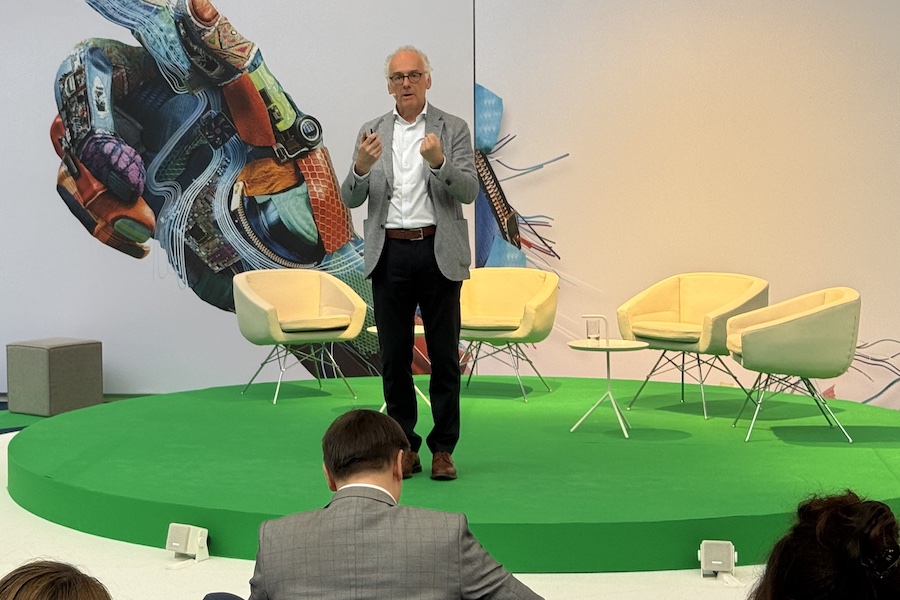
During the session, Canopy was joined by large brand partners as well as strategic and institutional investors and philanthropic leaders to discuss the design and early development of the model. Over the coming year, Canopy aims to secure partners interested in exploring anchor capital or future offtake agreements as the structure is finalized. More than 950 brands, representing over $2.1 trillion in combined annual revenue, are already working with Canopy — strengthening the offtake signal that investors look for when underwriting new capacity.

“With these targeted structures in place, we can drive the investment needed to turn waste into high-value and circular everyday commodities,” said Zoë Caron, Canopy’s Strategic Lead, Global Investments for Canopy. “Many agricultural residues are still being burned on the fields, when we know they can be used more sustainably, cutting air pollution and scaling a sustainable supply chain for paper, packaging, and textiles.”

Following the session, Canopy and its partners will deepen engagement with interested investors, refine the platform architecture, and advance the model toward establishment in India. In India, air pollution from crop residue burning contributes to an average of 150 premature deaths daily. Diverting agricultural waste would cut Delhi’s seasonal air pollution while supporting rural income and mill modernization. Additionally, global businesses benefit from reduced wood-dependent supply chain volatility and access to regulation-compliant and low-impact paper, packaging, and textiles.


1 https://penniur.upenn.edu/publications/state-of-finance-for-nature-in-cities-2023-time-to-assess-summary-for-local
More News from Canopy

More News on Business

#Nonwovens

Sandler turns financial stability into a catalyst for shaping the future

The Sandler Group has presented its financial figures for the past fiscal year (01/01/2025-12/31/2025). Like previous years, the year 2025 was also marked by industry-wide structural challenges and geopolitical uncertainties. Turnover was virtually stable at EUR 321 million (2024: EUR 326 million). High energy costs continue to weigh heavily on profitability. The number of employees was 975 (2024: 980). The family-owned company, which was founded in 1879 and has been run by the fifth generation since August 2025, continues to invest millions in its Schwarzenbach site despite the high production costs in Germany. As part of the long-term corporate strategy, the management team is focusing on strict cost management, further development of the product portfolio, and greater efficiency in production and administrative processes. The company does not expect a market recovery in 2026 and 2027.

#Spinning

Rieter advances strategic repositioning amid market volatility

Rieter successfully completed the acquisition of Barmag on February 2, 2026, and reached an important milestone in the company’s repositioning. Barmag will be integrated into the Rieter Group as the “Man-Made Fiber” Division. With this strategically transformative acquisition, Rieter is expanding its core business beyond the short-staple fiber business in a targeted way. This positions Rieter as the global market leader along the entire value chain for natural and man-made fibers. In addition, as a complete systems supplier, Rieter is further strengthening its technological leadership in the areas of automation and digitization.

#Knitting & Hosiery

Huixing acquires insolvent Mayer & Cie.

Insolvency proceedings for the circular knitting and braiding machine manufacturer Mayer & Cie. were opened on December 1, 2025. Immediately following the opening of proceedings, the complete cessation of business operations was initiated. Most employees were subsequently given notice effective the end of February 2026. The production of the remaining orders in the circular knitting segment is expected to be completed by the end of the month. As early as December 2025, Mayer & Cie.’s braiding machine division was sold to an Italian investor.

#Spinning

Rieter completes acquisition of Barmag

Rieter has successfully completed the acquisition of Barmag as of February 2, 2026. This strategically important acquisition makes Rieter the world’s leading system provider for natural and synthetic fibers.

Latest News

#Techtextil 2026

Shima Seiki showcases WHOLEGARMENT® and 3D knitting solutions for technical textiles at Techtextil 2026

Leading textile technology solutions provider SHIMA SEIKI MFG., LTD. of Wakayama, Japan, along with its Italian subsidiary SHIMA SEIKI ITALIA S.p.A., will be participating in the Techtextil 2026 exhibition in Frankfurt, Germany next month. On display will be WHOLEGARMENT® and other advanced three-dimensional knitting applications across a wide range of industries besides fashion apparel that are not typically associated with knitting, such as technical textiles using industrial materials and advanced three-dimensional knitting.

#Research & Development

Textilfabrik 7.0 launched: Mönchengladbach becomes a real-world lab for sustainable textile production

With the official kick-off event of the Textilfabrik 7.0 (T7), a major transformation project for the German textile and apparel industry has been launched in the Monforts Quarter in Mönchengladbach. At the “Textile Roundtable,” an event format organized by the Zukunftsagentur Rheinisches Revier, representatives from industry, research, politics, and the regional economy came together to jointly lay the foundation for CO₂-neutral, circular, and economically viable textile production in Germany.

#Techtextil 2026

Future ready nonwovens and fiber processing solutions – Meet Trützschler at Techtextil 2026

From April 21 to 24, 2026, the Trützschler Group will present its future‑ready solutions at Techtextil in Frankfurt, Germany. At Booth C61 in Hall 12.0, Trützschler Nonwovens will showcase its latest developments for efficient nonwovens production, including comprehensive service and consulting solutions. Highlights include the fully upgraded X‑Series nonwoven cards suitable for spunlace, needle‑punching and air‑through bonding (ATB) processes, as well as the T‑ONE digital working environment enhanced with new features. Trützschler Card Clothing will complement the presentation with a new card wire designed with a specially engineered surface for high‑performance nonwoven applications. Visitors can also take a closer look at Trützschler’s complete solution for the recycling of textile waste, TRUECYCLED.

#Recycling / Circular Economy

Europe needs tipping point to scale textile-to-textile recycling, BCG and ReHubs say

A new report from Boston Consulting Group (BCG) and ReHubs, titled “Advancing Textile Circularity – Europe’s textile waste challenge: Scaling Textile-to-Textile requires enabling mechanisms”, highlights the urgent need for systemic action to tackle Europe’s growing textile waste and scale a circular textile economy.

TOP