[pageLogInLogOut]

#Yarn & Fiber

Lenzing solid in a significantly more challenging market environment
(c) 2019 Lenzing
The Lenzing Group continued its solid business development in the first half of 2019. Despite a significantly more challenging market environment with historically low prices for standard viscose, Lenzing recorded a slight increase in revenue. The disciplined implementation of the sCore TEN strategy and the focus on specialty fibers continue to have a positive impact. Thanks to ongoing high demand for sustainably produced specialty fibers and positive currency effects, the impact of low standard viscose prices was largely offset in earnings.
  • Continued positive development of specialties business with revenue share of already more than 48 percent
  • Commitment to long-term growth plan – investment in new 100,000 tons plant in Thailand approved
  • Significantly more challenging market environment for standard viscose with historically low prices
  • Outlook for 2019 confirmed

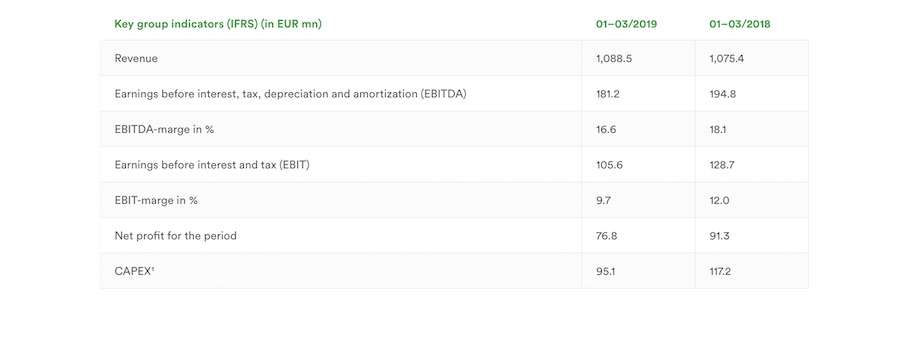
Revenue of the Lenzing Group increased by 1.2 percent in the first half of 2019 and amounted to EUR 1.09 bn. In addition to more favorable currency relations, this was primarily attributable to a further product mix optimization and higher prices for specialty fibers. The share of specialty fibers in revenue, at 48.4 percent, significantly exceeded the prior-year value of 44.1 percent. EBITDA (earnings before interest, tax, depreciation and amortization) dropped by 7 percent to EUR 181.2 mn. This decline primarily resulted from higher production volumes and currency effects which led to an increase in pulp costs, from an increase in personnel expenses and the market environment for standard viscose. The EBITDA margin declined from 18.1 percent in the first half of 2018 to 16.6 percent in the reporting period. EBIT (earnings before interest and tax) fell by 17.9 percent to EUR 105.6 mn, resulting in a lower EBIT margin of 9.7 percent (H1 2018: 12 percent). Net profit for the period decreased by 15.9 percent from EUR 91.3 mn to EUR 76.8 mn. Earnings per share amounted to EUR 2.97 (H1 2018: EUR 3.44).

“Fully in line with our sCore TEN strategy, our specialty fiber business is developing very positively, which has made us significantly more resilient today than a few years back. The investment in new production capacities for lyocell fibers and the focus on our TENCEL™ and VEOCEL™ product brands will make us even more resistant to market fluctuations and strengthen our position as a leading supplier of specialty fibers. The first phase of this ambitious growth plan is the construction of a state-of-the-art lyocell plant in Thailand”, says Stefan Doboczky, Chief Executive Officer of the Lenzing Group. “The escalating trade conflict between the largest economies confirm our decision to temporarily mothball the Mobile, Alabama project. Lenzing will continue to monitor these developments closely and review this decision on a regular basis”, says Doboczky.

Capital expenditures dropped by 18.9 percent to EUR 95.1 mn in the first half of 2019. This decline is temporary, primarily attributable to the completion of the expansion project in Heiligenkreuz (Austria) in 2018. Going forward, the planning for major projects in Brazil and Thailand will have a significant effect on the investment volume in the coming quarters.


Expansion of specialty fiber capacities

The Lenzing Group is substantially increasing its production of lyocell fibers to meet the strong demand for these products. Lenzing puts the focus on stable and profitable growth as well as an improvement of the ecological footprint of the textile and nonwovens industries by expanding the production of specialty fibers. The first expansion phase of this ambitious growth plan, the construction of a state-of-the-art production plant for lyocell fibers in Prachinburi (Thailand), was approved in the second quarter of 2019. The investment volume for the new plant, which has a capacity of 100,000 tons, totals approximately EUR 400 mn.

The conversion of production capacities from standard viscose to LENZING™ ECOVERO™ fibers in China was also completed during the reporting period.

Expansion of pulp capacities

An increased backward integration into dissolving wood pulp is another important step in the implementation of the sCore TEN strategy. Lenzing and its Brazilian partner Duratex continue to advance the planned construction of a dissolving wood pulp plant in the state of Minas Gerais (Brazil). The basic engineering, site preparation and the applications for the required permits are proceeding according to plan. The final investment decision is expected for the end of 2019.

The expansion and modernization of the production capacities for dissolving wood pulp at the Lenzing site was successfully completed in the first half of 2019.

Transparency from wood to garment

Lenzing will use blockchain technology to support its TENCEL™ branded fiber business, ensuring complete transparency and traceability for brands and consumers of its fibers in the finished garment. In the second quarter of 2019 Lenzing announced a cooperation with the Hong Kong based technology company TextileGenesis™ to accomplish this ambition. Lenzing will carry out several pilot tests involving partners along the entire value chain and expects the platform to be operational as of 2020.

Ambitious climate targets

The Lenzing Group aims to strengthen its position as a sustainability front runner in the fiber industry, by investing over EUR 100 mn in energy-saving measures, in the continued conversion to renewable energies and in new technologies. In the planning of new pulp and lyocell facilities such as the plant in Thailand, Lenzing also puts a strong focus on low-carbon energy sources and production processes. The goal of its climate strategy is to reduce net emissions of greenhouse gases to zero by 2050. An important milestone on the way to becoming climate-neutral is set for the year 2030. By then, Lenzing commits to reduce emissions per ton of fibers and pulp by 50 percent compared with 2017.

Outlook

The International Monetary Fund expects a slowdown of global economic growth to 3.2 percent in 2019, mainly driven by increasing protectionist tendencies and growing geopolitical tensions. The currency environment in the regions relevant to Lenzing will remain volatile.

Global fiber demand remains strong. According to preliminary calculations, cotton inventory levels should nevertheless increase in the 2019/20 season. Towards the end of the second quarter 2019, the polyester market recovered from slower growth in the preceding months. The price levels for cotton and polyester are expected to decline slightly. Despite continued strong demand, capacity expansions for standard viscose caused higher pressure on prices, which fell to a historic low in the first half of 2019. In specialty fibers, the Lenzing Group expects the positive development of its business to continue.

Driven by the challenging situation in standard viscose, prices for dissolving wood pulp show a downward trend. Caustic soda prices in Asia have already declined significantly over the past months; this development has now become noticeable also in Europe.

In a challenging market environment for standard viscose with prices at historic lows, the Lenzing Group continues to expect its results for 2019 to reach a similar level as in 2018 based on the current exchange rates. Above developments reassure the Lenzing Group in its chosen strategy sCore TEN. Lenzing is very well positioned in this market environment and will continue to focus growth with specialty fibers.

More News from Lenzing

#Nonwovens

Lenzing Group highlights scalable, bio-based nonwovens solutions at leading global industry fairs

From CIDPEX in China to Techtextil in Frankfurt and INDEX in Geneva, the Lenzing Group showcases ready-for-market, bio-based nonwoven solutions and receives industry recognition for LENZING™ Nonwoven Technology.

#Yarn & Fiber

Lenzing AG appoints Georg Kasperkovitz as Chief Executive Officer

The Supervisory Board of Lenzing AG has appointed Georg Kasperkovitz, Member of the Management Board and Chief Operations Officer, as Chief Executive Officer (CEO) of Lenzing AG with effect from June 1, 2026.

#Denim

TENCEL™ Lyocell - HV100 achieves global denim availability in six months; Vol. 2 debuts at Kingpins Amsterdam

When TENCEL™ Lyocell - HV100 debuted at last year’s Kingpins Amsterdam in October, 17 mill partners across five countries presented fabrics featuring the new fiber. Just six months on, participation has more than doubled, evolving into a global network that spans nine countries and four continents, signaling both strong industry momentum and growing demand.

#Techtextil 2026

Lenzing unveils three-tier cellulosic fiber portfolio for next generation protective wear

The Lenzing Group, a leading supplier of regenerated cellulosic fibers for the textile and nonwovens industries, today introduces Lenzing Solutions for Protective Wear. This integrated three-tier portfolio is anchored by LENZING™ FR fibers at the highest protection tier for inherent flame resistance and brings together complementary solutions including TENCEL™ Lyocell fibers, both EU Ecolabel-certified² and derived from certified or controlled wood sources³, within a unified protective wear architecture for the first time. The launch marks the most significant expansion of Lenzing’s protective wear business since the company pioneered inherently flame-resistant cellulosic fiber in 1977, and comes as the global personal protective equipment (PPE) market accelerates toward an estimated USD 130 billion by 2033⁴.

More News on Yarn & Fiber

#Yarns

Yarn Expo Shenzhen 2026 closes doors, advancing sustainable and innovative sourcing in South China

Yarn Expo Shenzhen 2026 served as a strategically positioned mid-year sourcing platform for the Greater Bay Area, highlighting Shenzhen’s role in connecting regional demand, supply and innovation exchange across the textile value chain. During the three-day fair, over 20,000 visits were drawn from 74 countries and regions[1], as exhibitors and buyers engaged with new developments in greener, performance-led, and value-added yarn and fibre solutions. Held in conjunction with Intertextile Shenzhen Apparel Fabrics and PH Value, the fair underscored the benefits of closer synergy and new materials across yarn, fabric and apparel platforms for the South China market.

#Yarns

Yarns and technologies in symbiosis: Biella Yarn presents Fall/Winter 2027/2028 collection “New Romance_”

Biella Yarn, the flat knitting brand of Suedwolle Group, launches new Fall/Winter 2027/2028 collection, inspired by the symbiosis of yarns and technologies – elements that blend, adapt and evolve together, forming something new without losing their origin. The name “Neu Romance_” reflects the emotional and neurological dimension of the yarns: a connection that engages the senses, experienced through material, touch and interaction. The collection is further brought to life through design collaborations, featuring selected yarns used in different design approaches.

#Recycling / Circular Economy

The textile industry in transition

Recycling, traceability, eco-design and digitalisation are among the key future challenges facing the European textile industry. The Erasmus+ project Skills4Circularity, involving 21 partners from twelve countries, is investigating the skills required to address these challenges. As the German industry partner, the Industry Association for Finishing – Yarns – Fabrics – Technical Textiles (IVGT) is bringing the industry’s perspective to the project.

#Research & Development

GenuTrace client advisory: Is your cotton supply chain UFLPA ready?

U.S. Customs and Border Protection has released updated operational guidance (CBP Publication No. 5560-0526) expanding its forced labor enforcement framework. The guidance supersedes the original 2022 UFLPA Operational Guidance and now covers all forced labor enforcement authorities — UFLPA, CAATSA, and WROs/Findings — in a single unified document. For cotton importers, the enforcement posture has not softened. It has become more structured, more documented, and more demanding. Learn more about UFLPA.

Latest News

#Dyeing, Drying, Finishing

Ferraro S.p.A. acquires the “Finishing” business unit of Cibitex S.r.l.

Ferraro S.p.A. and Cibitex S.r.l. are pleased to announce the completion of the agreement pursuant to which Ferraro S.p.A. has acquired the “Finishing” business unit of Cibitex S.r.l., specialized in the development and manufacturing of technological solutions for textile finishing.

#Recycling / Circular Economy

Reju opens its first R&D Center in the U.S. in Conshohocken, Pennsylvania

Reju, the company specializing in textile regeneration, today announced the opening of a Research and Development (R&D) Center in Conshohocken, Pennsylvania, the company's first proprietary research center in North America. Located within Technip Energies' existing Advanced Materials and Catalysts research center, the lab will allow Reju to accelerate the rollout of its recycling technologies and develop its next-generation circular solutions.

#Weaving

Itema reaffirms its commitment to the Syrian textile industry at NasTex 2026

From July 18th to 21st, Itema will exhibit at NasTex at the Damascus Fairground (Hall 11 – Stand C02), marking its return to one of the Middle East’s historically significant textile markets. Itema will showcase advanced weaving technology designed to support the competitiveness and technological evolution of Syrian manufacturers and announces a new partnership with Growfast Agency as the sole agent of Itema in Syria.

#Knitting & Hosiery

KARL MAYER's HKS 2-SE Expands Possibilities for Premium Stretch WARP KNITS

Warp knitted fabrics with a woven look are more in demand than ever in the fashion and apparel industries. Stretch WARP KNITS, in particular, impress with their freedom of movement, breathability, and virtually wrinkle-free wear – thereby opening up new style worlds such as smart casual or business casual. When it comes to the highly efficient production of premium-quality stretch WARP KNITS, the HKS 2-SE has long been the machine of choice. KARL MAYER’s best-selling tricot machine produces standard elastic fabrics characterized by high gauges, smooth, delicate surfaces, and a soft hand feel.

TOP