[pageLogInLogOut]

#Associations

Fifth transnational ADDTEX meeting in Prato
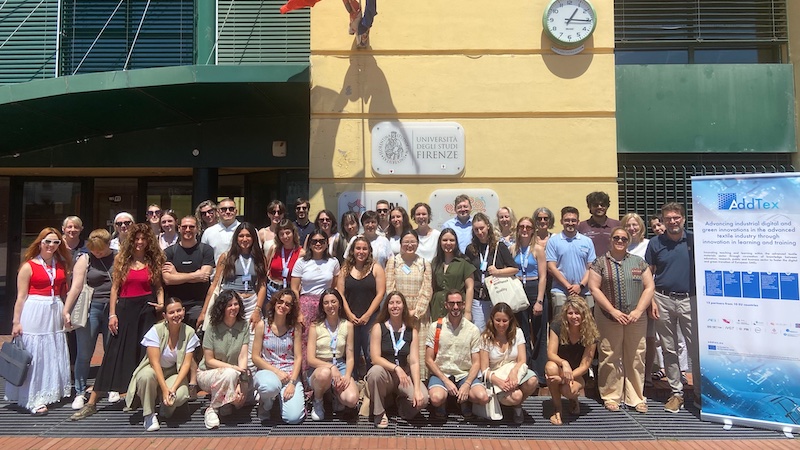
From 1 to 5 July 2024, the fifth member meeting of ADDTEX took place in Prato at PIN s.c.r.l. Educational and Scientific Services for the University of Florence. Parallel to the meeting of the project partners and in the same building in Piazza Giovanni Ciardi, 25, PIN organised a textile innovation boot camp with students from Sweden, Spain, Romania, Ireland, Italy and Portugal.
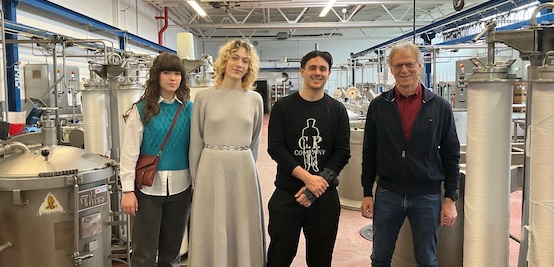
Joint photo of the ADDTEX partners and the summer school students in front of the entrance to the PIN in Prato. Photo: ADDTEX, Alessandro de Rosa


Preparations for workshops and webinars are in full swing

The meeting of the ADDTEX project partners served to find out about the current results of the individual partners of the EU Erasmus+ project and to discuss further activities. Following the meetings in Terrassa, Spain, Vila Nova de Famalicão, Portugal, Limerick, Ireland and Athens, Greece, the fifth meeting took place in the Italian textile centre of Prato in Tuscany. The IVGT e.V. is one of the 12 ADDTEX partners as a major textile trade association in Germany and was once again present in Prato. 

Summer school for students

The textile innovation bootcamp in the form of a summer school was organised by PIN and involved the participation of 25 students and 5 trainers from the universities of Boras (Sweden), UPC (Spain), PIN (Italy) and TUS (Ireland) and was offered as an in-depth supplement to the hackathons organised in May 2024.

The aim of the bootcamp was to foster innovation and collaboration and equip students with knowledge and skills to promote green, digital and smart transformation in the textile industry. The methodology used included face-to-face teaching, group work, company visits and field reports and was inspired by design thinking. Social moments were also incorporated to promote team spirit. This resulted in demonstrators made from materials such as sensor fabrics, e-textiles, knitwear and membranes, which were presented at the end together with exemplary business plans and marketing plans. In line with ADDTEX's focus, attention was paid to sustainability across the entire product life cycle through to recycling concepts. The students had acquired the necessary basic information in advance using the 45 training videos and training units from the free and public Smart, Digital and Green Skills Academy at https://addtex.eu.

Design Thinking

Design thinking is an interactive process that uses empathy to understand the users at the centre of the product or solution being developed. It is a solution-focused approach that allows people to develop a variety of ideas that can be quickly prototyped, tested and improved. For these reasons, it is often used by teams that want to innovate and solve complex challenges. 

In the first phase of the bootcamp, students had the opportunity to familiarise themselves with the design thinking process and learn about smart textiles, eco-design principles and digitalisation in manufacturing. They also had the opportunity to get in touch with real-life examples (Knitronix and Sensing Tex) and visit the companies Comistra and Rifinizione Nuove Fibre SpA, which are based in the Prato area. 
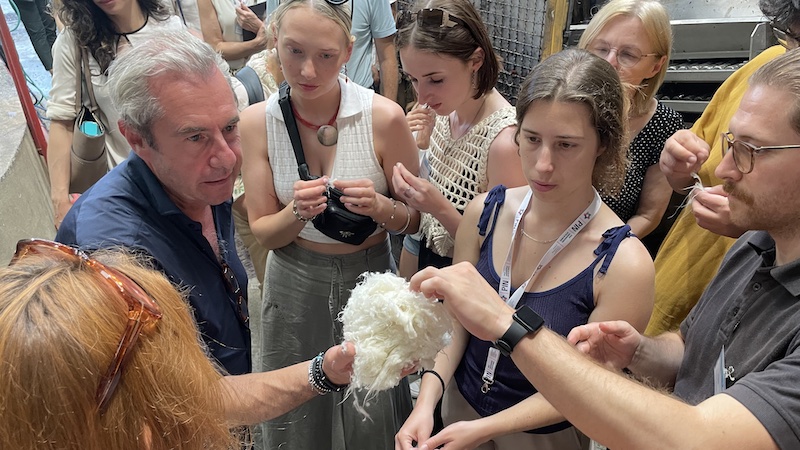
Fabrizio Tesi from Comistra shows the Summer Scholl students recycled wool fibres. Photo: ADDTEX, Katja Brencic


In the second phase of the process, the students began the creation process of their product, also familiarising themselves with the Lego® Serious Play® method. In the third phase of the boot camp, ideas were developed and prototypes were built. Finally, the students were instructed on how to prepare their pitch, which was then delivered on the last day of the bootcamp. The pitches started with a short introduction about the team and the product and ended with the presentation of the business model. The different teams showed a high level of motivation at work and several brilliant ideas emerged. Overall, the bootcamp was a great success for the AddTex project.
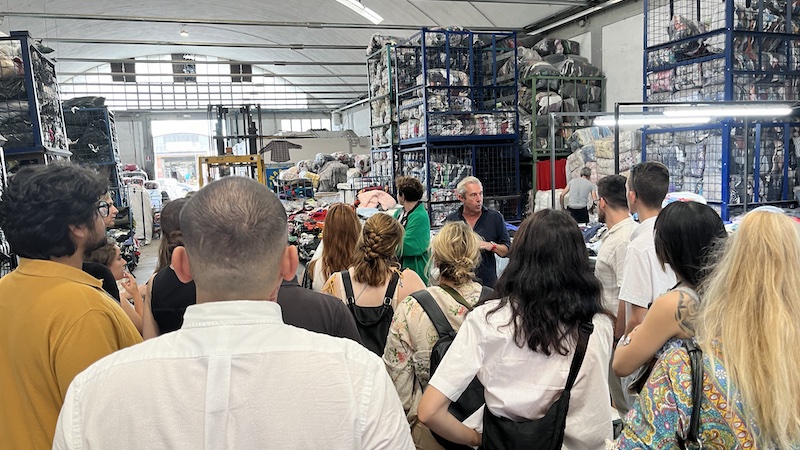
Comistra is a recycling company that produces high-quality mechanical wool from textile waste. Photo: ADDTEX, Iris Schlomski


Among other things, a webinar is planned for September 2024 to present the results of the hackathons and the bootcamp.

www.ivgt.de


More News from ADDTEX

More News on Associations

#Associations

Engineering depth and diversity for composites

Airbond is the latest member of the British Textile Machinery Association (BTMA) to receive recognition for contributions to the composites industry. The engineering firm based in Pontypool, South Wales, has just received the Make UK Energy and Sustainability Award for its Lattice 3D Printing project.

#Composites

Alliance for European Flax-Linen & Hemp expands bio-materials presence at JEC World 2026

The Alliance for European Flax-Linen & Hemp is pleased to announce its participation at JEC World 2026, featuring a significantly expanded presence and an enhanced offering for the global composites industry.

#Europe

FITA, ABIT and EURATEX underline strategic importance of Mercosur – EU Partnership Agreement for the textile and apparel industry

The Argentine Textile Industry Federation (FITA), the Brazilian Textile and Apparel Industry Association (ABIT), and the European Apparel and Textile Confederation (EURATEX) continue to monitor the process of internalizing the Mercosur-European Union Partnership Agreement. This agreement is essential for the competitiveness of our industries, on both sides of the Atlantic.

#Associations

Industry associations warn against state-run EPR models in the EU

European industry associations, led by Euratex, have raised concerns over a growing trend in several EU Member States to introduce state-run Producer Responsibility Organisations (PROs) within Extended Producer Responsibility (EPR) schemes.

Latest News

#Recycling / Circular Economy

Circulose restarts commercial-scale production at Ortviken plant in Sundsvall

Circulose today announced the restart of its commercial-scale production plant at Ortviken in Sundsvall, Sweden, marking a significant step in scaling next-generation materials for the global fashion industry. The company plans to resume production of CIRCULOSE®, a recycled pulp made entirely from discarded cotton textiles, in the fourth quarter of 2026.

#Textiles & Apparel / Garment

VIATT 2026 to debut German Pavilion, strengthening European participation alongside key Asian textile hubs

Vietnam’s textile and garment sector continues to be a major contributor to the country’s economic growth, with export revenues expected to reach USD 46 billion in 2025, a 5.6% increase from 2024 . From 26 – 28 February, the Vietnam International Trade Fair for Apparel, Textiles and Textile Technologies (VIATT) is set to contribute to economic growth opportunities by accelerating digital transformation and green transition across the entire textile value chain. The upcoming edition will respond to the rising demand for advanced technologies and sustainable materials with the introduction of the German Pavilion, alongside strong exhibitor participation from key Asian sectors, as well as several high-profile fringe events.

#Sustainability

Ying McGuire becomes new CEO of Cascale

Cascale today announced the appointment of Ying McGuire as Chief Executive Officer, effective June 1, 2026.

#Technical Textiles

Sustainable, lightweight, and sound absorbing: Polyester-based front trunk solution for BEVs

As car manufacturers look to further reduce their carbon footprint, Autoneum has developed an innovative front trunk solution for battery electric vehicles (BEVs), made entirely from polyester-based textile. The Ultra-Silent Frunk offers significant weight reduction, improved acoustic and thermal insulation, and uses up to 70 percent recycled material, supporting sustainable and efficient vehicle design. Autoneum, global technology leader in acoustic and thermal management for vehicles, has already received orders for the new frunk from three major OEMs in Asia and Europe to be built in three BEV models. Series production for two BEVs has been underway in China and Germany since last year.

TOP