[pageLogInLogOut]

#Associations

EURATEX & ATP Convention successfully concluded in Porto: European textile industry needs to prepare for a paradigm shift, and become global leader in sustainable textiles
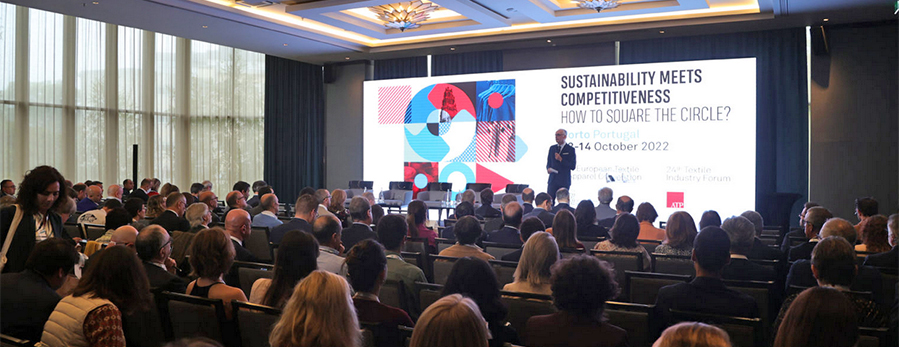
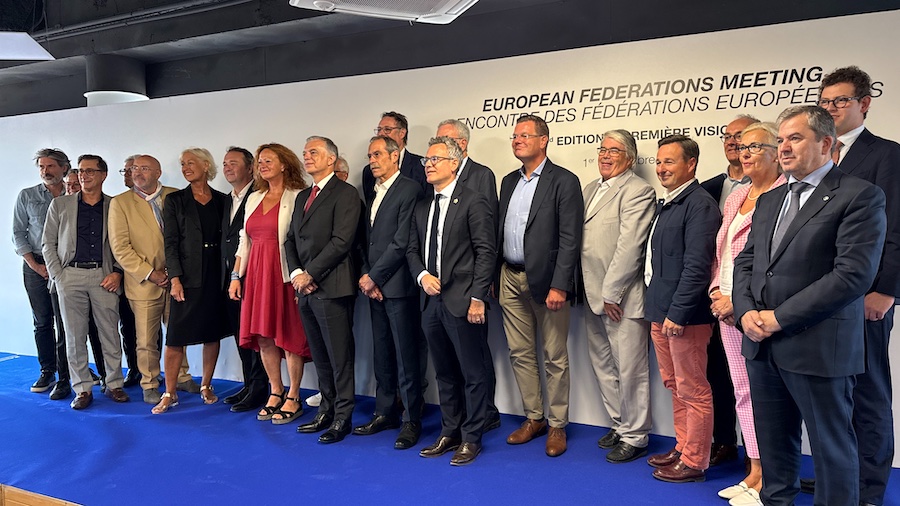
EURATEX Porto Convention © 2022 EURATEX
Organised by EURATEX in partnership with the Portuguese Textile Association (ATP), the Porto Convention – Sustainability meets Competitiveness: How to Square the Circle? – took place on 13-14 October in Porto, Portugal, with nearly 250 entrepreneurs attending from all over Europe. They discussed the current challenges of the European textile industry and set the grounds for a bright future, based on some strong foundations: innovation, creativity, quality and sustainability.

In his keynote speech, Mr. Pedro Siza Vieira, Former Minister for the Economy and Digital Transition of Portugal, assessed the geopolitical and macroeconomics changes, and how this will impact on the future of the textile industry: nearshoring and friend-shoring, independence from foreign gas through the use of European sustainable energy, as well as circular and automated production lines. While the current turbulence causes uncertainty, he sees a better future for our industry.

The first CEO Panel, addressing the theme of How to Measure and Communicate about Sustainability, focused on the challenges to translate “sustainability” towards the consumers. The panel addressed the issue of greenwashing and the role of brands in communicating about sustainability. It looked at how the new European Commission regulations on eco-label, digital product passport (:) and product environmental footprint (PEF) will create a new framework.

The second CEO Panel, discussing Financing Sustainability, looked at the cost of sustainable investments, and how this cost should be managed within the entire supply chain, including the brands and retailers.

Four workshops with industry experts followed in the afternoon, addressing the themes of Extended Producer Responsibility (EPR) in Textiles, Digital Product Passport (:), Recycling Textile Waste and Labelling Textiles (Product Environmental Footprint). As these initiatives will roll out in the coming years – as part of the EU Textile Strategy – participants got a better understanding of the future framework for our industry.

Dirk Vantyghem, Director General of EURATEX, commented on this: “to prepare for a brighter future requires a new regulatory framework, where quality and durability become the norm, where transparency and sustainability is rewarded, where free riders – who do not comply with rules and standards – are kept outside the market. The EU Textile Strategy aims at creating such a framework, which must be fair and balanced, and requires a close and constant dialogue between the regulator and the industry.”


During the 2nd day of the convention, participants had the opportunity to visit state of the art textile companies (Têxteis J.F. Almeida, RIOPELE, and TMG Automotive) and the Portuguese textile research centre CITEVE. They showcased how the Portuguese textile industry is making this transition, while remaining globally competitive.

Alberto Paccanelli, President of EURATEX, concluded: “We need to attract creative people in our companies, we need to produce top class quality products, and we need to become more sustainable. That is the recipe for our success in a globalised and highly competitive industry.” Paccanelli is positive about the future: “While we face very tough times, I am optimistic about the future of our European textile industry. The rest of the world is watching us, as we move forward with our strategy. We should become their benchmark and Europe should become a global leader in sustainable textiles.”

For further information and details about the speaker panels, you may consult the convention website – https://portoconvention.eu/ – or contact Cristina Gatti (cristina.gatti@euratex.eu).

More News from European Apparel and Textile Confederation (EURATEX)

#Associations

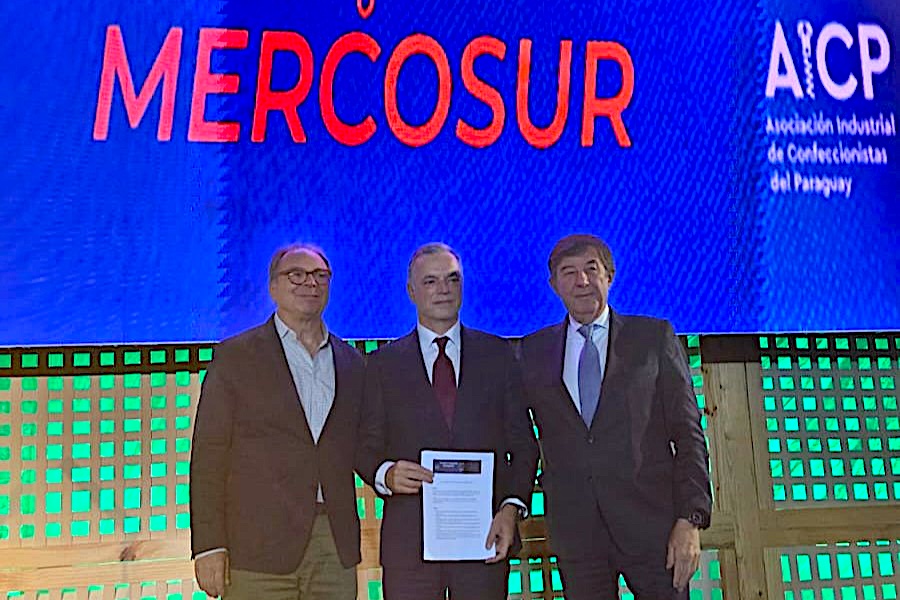
European Business Coalition welcomes provisional application of EU–Mercosur Agreement and calls for Swift and full implementation

With the European Commission’s decision to provisionally apply the EU–Mercosur Interim Trade Agreement, a process spanning more than 25 years now moves decisively into its implementation phase.

#Europe

Antwerp Declaration community urges EU leaders to deliver emergency measures as Europe’s competitiveness crisis deepens

EURATEX, representing the European textile and fashion industry, joins the Antwerp Declaration Community’s call on EU Heads of State and Government to adopt emergency measures that restore industrial competitiveness and deliver tangible results for Europe’s manufacturing base in 2026.

#Europe

FITA, ABIT and EURATEX underline strategic importance of Mercosur – EU Partnership Agreement for the textile and apparel industry

The Argentine Textile Industry Federation (FITA), the Brazilian Textile and Apparel Industry Association (ABIT), and the European Apparel and Textile Confederation (EURATEX) continue to monitor the process of internalizing the Mercosur-European Union Partnership Agreement. This agreement is essential for the competitiveness of our industries, on both sides of the Atlantic.

#Associations

Industry associations warn against state-run EPR models in the EU

European industry associations, led by Euratex, have raised concerns over a growing trend in several EU Member States to introduce state-run Producer Responsibility Organisations (PROs) within Extended Producer Responsibility (EPR) schemes.

More News on Associations

#Associations

EDANA joins industry coalition urging a strong internal market legal basis for the New Circular Economy Act

EDANA has joined 67 European industry associations in a joint industry statement calling on the European Commission and co-legislators to anchor the forthcoming New Circular Economy Act (CEA) in the Internal Market legal basis (Article 114 TFEU).

#Associations

EDANA warns of consequences of misclassification of PET spunbond imports

EDANA would like to remind its members and industry stakeholders of the legal requirement to comply with the EU rules on customs classification when importing nonwovens from third countries outside the EU. In this regard, it was recently discovered that there appears to be a high level of customs misclassification occurring in our industry. This could have dangerous and costly consequences for importers.

#Associations

Engineering depth and diversity for composites

Airbond is the latest member of the British Textile Machinery Association (BTMA) to receive recognition for contributions to the composites industry. The engineering firm based in Pontypool, South Wales, has just received the Make UK Energy and Sustainability Award for its Lattice 3D Printing project.

#Composites

Alliance for European Flax-Linen & Hemp expands bio-materials presence at JEC World 2026

The Alliance for European Flax-Linen & Hemp is pleased to announce its participation at JEC World 2026, featuring a significantly expanded presence and an enhanced offering for the global composites industry.

Latest News

#INDEX 2026

EDANA unveils nominees for INDEX™26 Awards: Highlighting the next generation of nonwoven excellence

EDANA is proud to unveil the highly anticipated nominees for the INDEX™26 Awards, the nonwoven industry’s highest accolade for technical and sustainable excellence. Out of a record-breaking field of entries, these finalists represent the cutting edge of material science—from bio-based hygiene fibers and PFAS-free protective textiles to revolutionary water-filtration machinery. Each nominee has been selected by a jury of industry experts for their ability to solve critical global challenges, including the transition to a circular economy and the pursuit of enhanced consumer performance.

#Raw Materials

Lenzing Group positions bio‑based materials as a strategic asset for Europe’s economic security

The Lenzing Group, a leading supplier of regenerated cellulose fibers for the textile and nonwovens industries, hosted a high‑level roundtable in Brussels to discuss how bio‑based materials can strengthen Europe’s economic security and support the shift toward a fossil‑free future. Organized in cooperation with Euractiv, the event brought together representatives of the European Commission, the UK Mission to the EU, academia, civil society, and industry.

#Natural Fibers

Beyond Cotton: Natural Fibres in the Spotlight at the Bremen Cotton Conference - Branded by DNFI

Climate targets, fragile supply chains, and rising regulatory requirements are fundamentally changing the perspective of the textile industry - the focus is increasingly shifting toward the base material. Not only cotton, but natural fibres are gaining significant importance: they stand out not only because of their outstanding functional properties, but also because they make a valuable contribution to the bioeconomy and responsible product development.

#Textiles & Apparel / Garment

Coats to showcase innovative reinforcement and filler materials for leather goods and accessories at APLF 2026

Coats, a world-class Tier 2 manufacturer and trusted partner for the apparel and footwear industries, will be promoting four advanced materials from its ‘Lifestyle Solutions’ portfolio at APLF 2026 in Hong Kong in March. Each innovation has been specifically engineered to help luxury and premium brands elevate the craft, durability, sustainability and creative expression required in the manufacturing of handbags, purses, and other high-end designer accessories.

TOP