#Raw Materials
Brazil sets new cotton export record and consolidates global leadership
Shipments reached 3.374 million tonnes in the 2025/26 commercial year, up 19%, with record revenue of US$5.3 billion
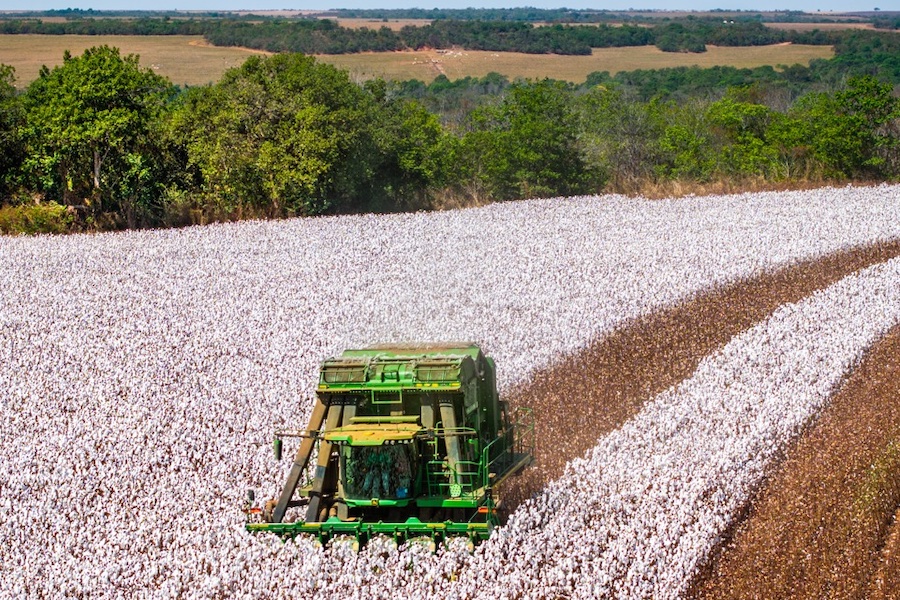
The increase represents approximately 538,500 additional tonnes of Brazilian cotton sold abroad. Export revenues reached a record US$5.3 billion, around 9% above the 2024/25 result, according to ComexStat data compiled by the Brazilian Association of Cotton Growers (Abrapa).
For Danyella Bonfim, Market Intelligence and Analysis Coordinator at Abrapa, the result is the consequence of a transformation built over several years, driven by increased production and advances in different attributes of Brazilian cotton.
“Brazil has expanded its production and gained scale, while also making progress in quality, traceability and sustainability. This combination has strengthened the competitiveness of Brazilian cotton and, above all, international buyers’ confidence in the country’s ability to supply the market on a regular and consistent basis,” she says.
Brazil widens its lead in the global market
The performance kept Brazil at the top of the global cotton export rankings. According to data from the United States Department of Agriculture (USDA) presented in Abrapa’s August report, the United States ranked second in 2025/26, with 2.656 million tonnes, followed by Australia, with 1.241 million tonnes.
Brazil exported approximately 718,000 tonnes more than the United States, its main competitor in the international market. According to Danyella, the country has assumed a strategic position for the global textile industry.
“Today, Brazil stands out not only for the volume it offers to the market, but also for its ability to position itself as a reliable, competitive and strategic supplier,” she emphasizes. According to the coordinator, this position is supported by four pillars: quality, sustainability, traceability and supply capacity.
“Brazil is able to bring these attributes together on a large scale, providing security to an industry that needs to plan its raw material supply throughout the year. This combination has been fundamental to strengthening the competitiveness of Brazilian cotton and building long-term commercial relationships,” she explains.
China and Bangladesh drive growth
China was the main destination for Brazilian cotton during the commercial year, importing 770,500 tonnes, equivalent to approximately 23% of the country’s total exports during the period.
Compared with 2024/25, shipments to the Chinese market increased by 309,200 tonnes. According to Danyella, the increase is largely related to trade disputes between China and the United States.
“U.S. cotton, our main competitor in this quality range, still faces an additional tariff in the Chinese market, which reduces its competitiveness. As a result, Brazilian cotton is gaining ground by offering a good combination of quality, available supply and price,” she says.
Bangladesh also played an important role in the result, with purchases increasing by 173,200 tonnes. In this market, the increase is explained by the expansion of the textile industry and the growing need to replace hand-picked cotton with fiber produced through mechanized systems, a segment in which Brazil offers scale, quality and competitiveness.
Not all major destinations, however, increased their imports. Vietnam and Pakistan recorded the largest declines, with reductions of 137,400 and 79,200 tonnes, respectively.
India emerges as a strategic market
Another highlight was India, which increased its imports of Brazilian cotton more than 40-fold in just two years. Although it is one of the world’s largest cotton producers, the country also has a large-scale textile industry and needs to turn to international markets when domestic production is insufficient to meet demand.
In 2025, the temporary suspension of India’s 11% tariff on cotton imports helped increase foreign purchases. Brazil was able to take advantage of this movement thanks to the availability of product, competitive prices and logistical capacity.
According to Danyella, however, the increase was not driven solely by a market circumstance. It was also the result of efforts to build closer ties with the Indian textile industry over recent years.
“When the need to import more emerged, Brazilian cotton was already known and had a presence among buyers. It is important to remember that this more-than-40-fold growth started from a small base. Even so, the speed of the expansion is remarkable and shows India’s potential to become increasingly relevant,” she says.
December recorded the highest volume of the cycle
Shipment volumes gained momentum particularly toward the end of 2025. After exporting 294,000 tonnes in October and 402,000 tonnes in November, Brazil reached its highest monthly result of the commercial year in December, with 452,000 tonnes.
Exports declined in January and February 2026, to 317,000 and 270,000 tonnes, respectively, but resumed growth in March, with 348,000 tonnes, and in April, with 370,000 tonnes. Despite being a historically slower month, July closed the cycle with 155,000 tonnes exported, an increase of 21.8% compared with July 2025 and the second-best result ever recorded for the month.
The commercial year’s performance also generated a US$5.293 billion surplus in Brazil’s cotton trade balance, 9% higher than the previous cycle.
Next cycle expected to see slight decline
For 2026/27, Abrapa estimates Brazilian production at approximately 3.9 million tonnes and exports at 3.1 million tonnes. The expected decline in shipments is mainly related to projections for a smaller crop, with reduced cotton availability for the international market.
Despite the possible decline, the outlook remains positive. For Danyella, the next step will be to transform leadership in volume into an increasingly diversified and lasting presence in consumer markets. “The challenge now is not simply to export more, but to increase market share, diversify destinations and consolidate long-term commercial relationships,” she concludes.