[pageLogInLogOut]

#Yarn & Fiber

European Toray unit obtains ISCC Certification for carbonfiber production plants
© 2023 Toray
Toray Industries, Inc. announced today that its French subsidiary, Toray Carbon Fibers Europe S.A., has obtained ISCC PLUS¹ certification for its Lacq and Abidos production plants in South-West France . This certification allows Toray Carbon Fibers Europe to allocate and use biomass or recycled materials through the mass balance approach² to produce and supply carbon fiber. Thus, Toray Carbon Fibers Europe now has the ability to reduce the Life Cycle Inventory³ (LCI) of its carbon fiber, prepreg, and other offerings and help its customers to enhance product Life Cycle Assessments? (LCA) while contributing to building a circular economy.

The ISCC PLUS, International Sustainability & Carbon Certification’s (ISCC) a voluntary certification program, guarantees that the raw materials used are sourced from biomass or recycled materials. It also ensures that there is complete traceability at all stages of the manufacturing process of a product. The mass balance approach tracks the amount and sustainability characteristics of circular and bio-based materials used in the value chain and it is based on verifiable record. This scheme is open to several sectors such as the food, feed, chemicals, plastics, packaging and textile industries.

Toray Carbon Fibers Europe will start manufacturing carbon fiber derived from biomass and recycled raw materials by the end of 2023?. In addition, Toray’s Ehime Plant in Japan aims to obtain ISCC PLUS certification by March 2024 and begin producing fiber by the close of that year. In the USA, the carbon fiber facility of Toray Composite Materials America, Inc. in Decatur, Alabama, also plans to obtain this certification in 2024. With these three locations obtaining certification, the Toray Group intends to manufacture carbon fiber using biomass or recycled raw materials at plants in Japan, the United States, and Europe, ensuring stable supplies to customers around the globe.

Toray has already received requests from customers similarly committed to carbon neutrality. From the end of 2023, Toray will offer this carbon fiber for industrial applications such as automobiles and handheld devices where demand for materials to create sustainable products is particularly high. At a later date, other applications, such as aviation and sports, will also be targeted.

This effort aligns with the Toray Group’s carbon fiber composites business roadmap to achieve carbon neutrality by 2050. Under Project AP-G 2025, its medium-term management program, Toray is actively contributing to the development of a more sustainable economy by quantifying the LCA improvements of customer products, reducing the LCIs of carbon fiber, prepreg, and other offerings, and using and recycling bio-based materials as part of its new materials ecosystem.

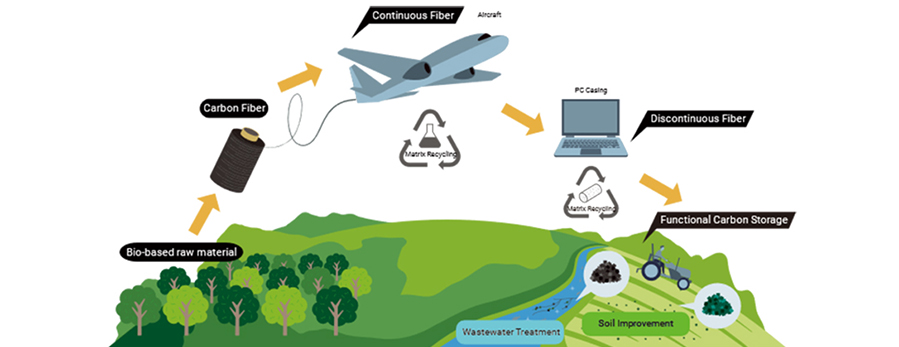
Toray aims to build a new materials ecosystem that harnesses natural raw materials and returns them to nature in an eco-friendly state. For carbon fiber, the ecosystem will be built using biomass and recycled raw materials to manufacture carbon fiber. This fiber will be made into a composite material and, finally, an end product. At the end of the product’s life cycle, continuous carbon fiber will be repurposed for the use as discontinuous fiber in other products. The last stage of the carbon fiber’s life cycle will be its recycling for water treatment or soil improvement.


Notes

1 ISCC PLUS certification allows us to declare that our products are made from biomass or recycled raw materials in a mass balance system. Such declaration is impossible without certification.

2 A mass balance approach is one in which raw materials with certain characteristics (an example being biomass-derived) are mixed with other raw materials (such as petroleum-derived ones) in the processing and distribution process, from raw materials through to finished products. Characteristics are assigned to part of a product in line with the input proportions of raw materials with those characteristics.

3 Life Cycle Inventory is an analytical technique to collect, verify, and compile input and output data on raw material usage, resource consumption, environmentally hazardous substance emissions, and waste at each stage of a life cycle.

4 Life Cycle Assessments quantitatively assess resource inputs, environmental impacts, and their effects on the planet and ecosystems across the life cycles of products.

5 The Lacq and Abidos plants of Toray Carbon Fibers Europe declared their compliance with ISCC PLUS requirements in line with prevailing ISCC rules.


Profiles

Toray Carbon Fibers Europe S.A.

(1) Businesses: Manufacturing and selling carbon fibers and composite molded products

(2) Head office: Lacq, Pyrénées-Atlantiques, France

(3) Establishment: December 1982

(4) Representative: Jean-Marc Guilhempey, Chairman and CEO


Toray Composite Materials America, Inc.

(1) Business: Manufacturing and distributing carbon fiber and prepreg materials

(2) Headquarters: Tacoma, Washington, United States of America

(3) Establishment: April 2017

(4) Representative: Dennis Frett, President and CEO


More News from Toray Engineering Co. Ltd.

#Man-Made Fibers

Toray develops AURLIST™ polyester filament fiber with luxurious luster and ultra-fine structure

Toray Industries has developed AURLIST™, a new polyester filament fiber designed to combine luxurious luster, soft loft and a subtle fibrillated surface texture. The company primarily targets applications in women’s apparel such as tops, bottoms and dresses.

#Recycling / Circular Economy

Toray develops recycling technology that retains carbon fiber strength and surface quality

Toray Industries, Inc., announced today that it has developed a recycling technology that can decompose diverse carbon fiber reinforced plastics (CFRP) made from thermosetting resins while retaining the strength and surface quality of those fibers. The company drew on this technology to create a nonwoven fabric employing recycled carbon fibers.

#Composites

HEAD launches more sustainable(1) BOOM RAW racquet on Earth Day by using Toray’s bio-circular carbon fibers

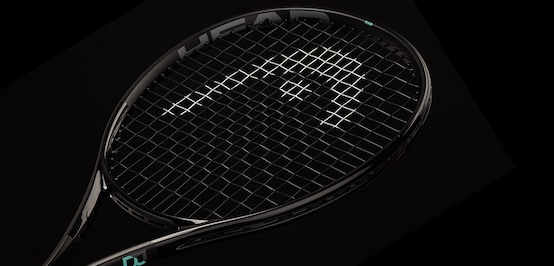
HEAD continues to innovate with the launch of the BOOM RAW tennis racquet, an encouraging development in the search for a more sustainable future for racquet sports. All of the carbon fibers are bio-circular carbon fibers in the limited-edition and highly innovative BOOM RAW racquet, which offers the same explosive power - along with the same fun, feel and easy playability - as the regular, in-line BOOM racquet. The bio-circular carbon fibers are manufactured by Toray and its subsidiary Toray Carbon Fibers Europe.

#Recycling / Circular Economy

Companies in Japan initiate demonstration to expand the automotive recycling process

DENSO CORPORATION and other partners have been chosen by an industry-government-academia collaborative project aiming to expand the recycle content for automobile in the fiscal year 2023 supported by Ministry of the Environment, Japan.

More News on Yarn & Fiber

#Man-Made Fibers

Lenzing advances its transformation: Higher EBITDA, stronger free cash flow and more than EUR 200 million in cost savings

The business performance of the Lenzing Group in 2025 was affected particularly in the second half of the year by external factors such as international tariff measures, subdued demand and declining market prices. As a result, revenue decreased slightly by 2.3 percent to EUR 2.6 billion, primarily due to lower fiber sales volumes and lower prices for fibers and pulp, which were further negatively impacted by currency developments. Nevertheless, thanks to the comprehensive Performance Program, Lenzing was able to improve its operating performance and key financial indicators compared with the previous year.

#Man-Made Fibers

“Lead Transformation – Generate Impact”: Lenzing presents its 2025 Annual and Sustainability Report

The Lenzing Group has published its 2025 Annual and Sustainability Report, entitled LEAD TRANSFORMATION – GENERATE IMPACT. The report shows how Lenzing is actively shaping change in the industry and making a lasting impact: economically, ecologically, and socially. Lenzing is consistently focused on the future: with targeted investments in premiumization, excellence, innovation, and sustainability, the company is strengthening its position as a leading provider of sustainable, cellulose-based premium fibers. The combined report is available in digital format.

#Raw Materials

Lenzing Group positions bio‑based materials as a strategic asset for Europe’s economic security

The Lenzing Group, a leading supplier of regenerated cellulose fibers for the textile and nonwovens industries, hosted a high‑level roundtable in Brussels to discuss how bio‑based materials can strengthen Europe’s economic security and support the shift toward a fossil‑free future. Organized in cooperation with Euractiv, the event brought together representatives of the European Commission, the UK Mission to the EU, academia, civil society, and industry.

#Yarn & Fiber

Teijin Carbon strengthens high‑end sports offering with advanced prepreg and resin technologies for next‑generation bicycle performance

High‑end bicycle manufacturers are entering a new era in which modern frames and components must be lighter, stiffer, tougher and more sustainable – all while enabling fast, repeatable and cost‑efficient production. To support this shift, Teijin Carbon is expanding its portfolio of advanced prepreg systems developed specifically for premium road, gravel and mountain bike applications.

Latest News

#Techtextil 2026

Gebr. Otto highlights versatility at Techtextil with regional supply chains, yarn innovations and new hygiene segment

At this year’s Techtextil, Gebr. Otto places its versatility at the center of its presentation. In addition to spinning, twisting and dyeing – traditionally focused on fine cotton – textile processors will also find a competent development partner for technical specialty solutions. The Dietenheim-based spinning mill has now built up a decade of experience in the production of technical yarns, particularly from aramids. A new hygiene segment has also been established, where yarns for medical and hygiene products are currently being produced. In the future, this department could also develop textile products for the food sector. Gebr. Otto will once again be present at the BW-i joint stand, booth D81, hall 12.1. What is wound onto the spool is determined by the customer: Gebr. Otto develops according to specific customer requirements and transforms its own ideas into yarn innovations.

#Europe

Commission presents proposal for EU Inc. - unlocking the full potential of the Single Market for Europe's entrepreneurs

Today, the European Commission presented its proposal for EU Inc., a new single set of corporate rules, building the cornerstone and starting point for the EU's 28th regime. EU Inc. is an optional, digital-by-default European corporate framework. It will make it easier for businesses to start, operate and grow across the EU – incentivising them to stay in Europe, and encourage those who once looked elsewhere to return.

#Man-Made Fibers

OnceMore® from Södra brings end-to-end traceability for circular Man-made Cellulosic Fibers (MMCF) using TextileGenesis

OnceMore® from Södra, the world’s first large-scale process for recycling blended fabrics into high‐quality dissolving pulp, will begin using TextileGenesis, a Lectra company, to strengthen traceability from raw material to retail across the value chain. OnceMore® produces dissolving pulp made from blended textile waste and wood sourced from responsibly managed Swedish forests. By integrating TextileGenesis, OnceMore® supports the growing need for verified data and secure, transparent tracking throughout increasingly complex supply chain.

#Sustainability

Experts publish APAC policy priorities

Cascale today announced the publication of its APAC Policy Priorities Paper, developed by the Asia-Pacific (APAC) Policy Member Expert Team (MET) to identify key regional sustainability challenges and provide practical, aligned recommendations for policymakers and industry stakeholders across Asia-Pacific.

TOP