#Yarn & Fiber
Lenzing Group’s 2022 financial year defined by challenging market conditions and outstanding strategic success
- Revenue rose to EUR 2.57 bn, while EBITDA declined to EUR 241.9 mn
- Implementation of EUR 70 mn cost reduction program proceeding according to plan
- Largest investment program in the company’s history including the lyocell plant in Thailand and the pulp mill in Brazil implemented on time and within budget
- Outlook: Lenzing expects EBITDA in 2023 to be in a range of EUR 320 mn to EUR 420 mn
In the year under review, revenue increased by 16.9 percent year-on-year to reach EUR 2.57 bn, primarily as a result of higher fiber prices. The quantity of fiber sold decreased, while the quantity of pulp sold rose. In addition to lower demand, the earnings trend particularly reflects the increase in energy and raw material costs. Earnings before interest, tax, depreciation and amortization (EBITDA) decreased by 33.3 percent year-on-year to EUR 241.9 mn in 2022. The net result for the year was minus EUR 37.2 mn (compared with EUR 127.7 mn in the 2021 financial year), while earnings per share stood at minus EUR 2.75 (compared with EUR 4.16 in the 2021 financial year).
Given the trend in earnings and the pronounced deterioration in market conditions, Lenzing launched a reorganization and cost reduction program in the third quarter of 2022. Implementation of the program is proceeding according to plan and is expected to save at least EUR 70 mn in costs per year once fully implemented.
At the same time, additional measures will be adopted to strengthen free cash flow, which stands at minus EUR 740.7 mn for the 2022 financial year. This is mainly attributable to the investments in Brazil and Thailand. Thus, in addition to the cost reduction program of EUR 70 mn, further steps will be taken in the months ahead to reduce working capital and reposition currency and energy price hedging. The temporary suspension of dividend payments is expected to boost free cash flow. All of these measures are being implemented against a backdrop of solid liquidity reserves amounting to EUR 686 mn.
“Lenzing faced extraordinary headwinds due to the multiple crises last year. Nevertheless, we can look forward with great confidence, as the need for sustainable innovations in the medium and long term is undiminished, while the demand for environmentally friendly fibers will continue to grow. We will make structural adjustments to our cost base and emerge stronger from this crisis”, says Stephan Sielaff, CEO of the Lenzing Group. “Having responded quickly and decisively to all these external challenges, we can also be very proud of our outstanding achievements including the implementation of our investment projects in Thailand and Brazil.”
Successful implementation of mega investment program
As the lyocell plant in Thailand is now fully operational, Lenzing has the capacity to increase its share of specialty fibers substantially and is even better equipped to meet structurally rising demand for environmentally friendly TENCEL™ and VEOCEL™ branded lyocell fibers. With a nominal capacity of 100,000 tonnes per year, the new production plant is the largest of its kind worldwide. The requisite dissolving wood pulp will also be provided by the new plant in Brazil in future. Despite multiple challenges, especially relating to the pandemic, Lenzing realized both projects on time and within the planned budget, and has successfully placed the volumes produced to date on the market.
In China and Indonesia, Lenzing is currently converting existing capacities for conventional viscose into those for environmentally friendly specialty fibers. In Nanjing, Lenzing is about to complete the conversion of a production line to TENCEL™ modal fibers. In Purwakarta, the company is creating additional capacities for LENZING™ ECOVERO™ branded fibers. The Indonesian site is set to become a pure specialty viscose provider in 2023.
Managing Board changes and strategy review
Significant changes to the Lenzing Managing Board were also approved in the year under review. As of April 1, 2022, Stephan Sielaff succeeded Cord Prinzhorn as CEO, who had taken over as interim CEO in the fourth quarter of 2021. At the same time, the Managing Board was reduced to four people. Nico Reiner was appointed as the new Chief Financial Officer as of January 1, 2023, succeeding Thomas Obendrauf. Meanwhile, the Managing Board mandate of Chief Pulp Officer Christian Skilich was extended early by a further three years until May 31, 2026.
In addition, a comprehensive review of the corporate strategy was conducted. As a consequence, Lenzing will continue to pursue its profitable growth path following the successful implementation of the two key projects in Thailand and Brazil, sharpen its focus on sustainable and high-quality premium fibers for textiles and nonwovens, and further advance the transition from a linear to a circular economy model.
“Sustainability champion”
Lenzing also enhanced its brands’ visibility in 2022 through targeted communication measures. The TENCEL™ brand remains the fastest growing ingredient brand in the textile and clothing industry, reaching second place in the global brand awareness ranking.
Lenzing also received awards for its achievements in sustainability and circularity from some of the world’s most respected organizations in 2022. Once again, Lenzing received top scores in three categories in the A List of the most environmentally friendly companies compiled by CDP, an organization that is now firmly established as a gold standard on the capital market. This was an achievement shared by only 11 other countries worldwide. MSCI also confirmed its AA rating for Lenzing in December. EcoVadis, an independent provider of corporate sustainability ratings, awarded its exclusive platinum status to Lenzing for the second time. As a result, Lenzing ranks among the top one percent of companies rated in its sector.
Lenzing’s top position in the prestigious Hot Button Ranking compiled by the Canadian non-profit organization Canopy confirmed its leading role in the fields of sustainability and the responsible procurement of wood and pulp. The key project in Brazil received a special commendation in the “Transformational Climate Change Solutions” category of the Transformational Business Awards 2022 issued by the Financial Times and the International Finance Corporation (IFC), a member of the World Bank Group.
Outlook
The war in Ukraine and the tighter monetary policy pursued by many central banks to combat inflation will continue to exert pressure on the global economy. The easing of China’s zero-Covid policy could lead to an unexpectedly rapid recovery. However, the IMF has warned that risks remain high overall and projects growth of 2.9 percent in 2023. Exchange rate volatility looks set to continue in regions that are important to Lenzing.
These challenging market conditions are also continuing to weigh on consumer confidence and sentiment in the sectors relevant to Lenzing. The outlook has improved slightly of late, with inventory levels returning to normal across the value chain. Nonetheless, subdued demand remains a source of concern for market players.
Inventories in the bellwether cotton market have diminished recently, although they remain above pre-pandemic levels. A decline in crops is foreseeable in the current 2022/2023 harvest season. The sharp rise in prices on the energy and raw material markets will continue to pose significant challenges for the market.
Overall, earnings visibility remains restricted.
In structural terms, Lenzing expects a continued rise in demand for environmentally friendly fibers in the textile and clothing industry, as well as in the hygiene and medical sectors. Thus, with its “Better Growth” strategy, Lenzing is very well positioned and will continue to drive growth in specialty products, while pursuing its sustainability targets including the transformation from a linear to a circular economy model.
In light of these factors and assuming a further market recovery in the current financial year, the Lenzing Group expects EBITDA in 2023 to be in a range of EUR 320 mn to EUR 420 mn.
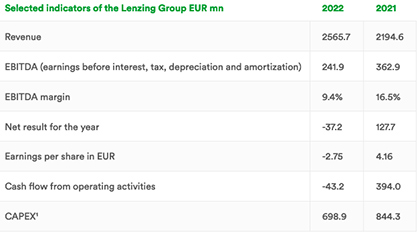
1) Capital expenditures: investments in intangible assets, property, plant and equipment and biological assets as per the consolidated statement of cash flows
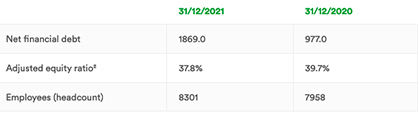
2) Ratio of adjusted equity to total assets in percent