[pageLogInLogOut]

#Weaving

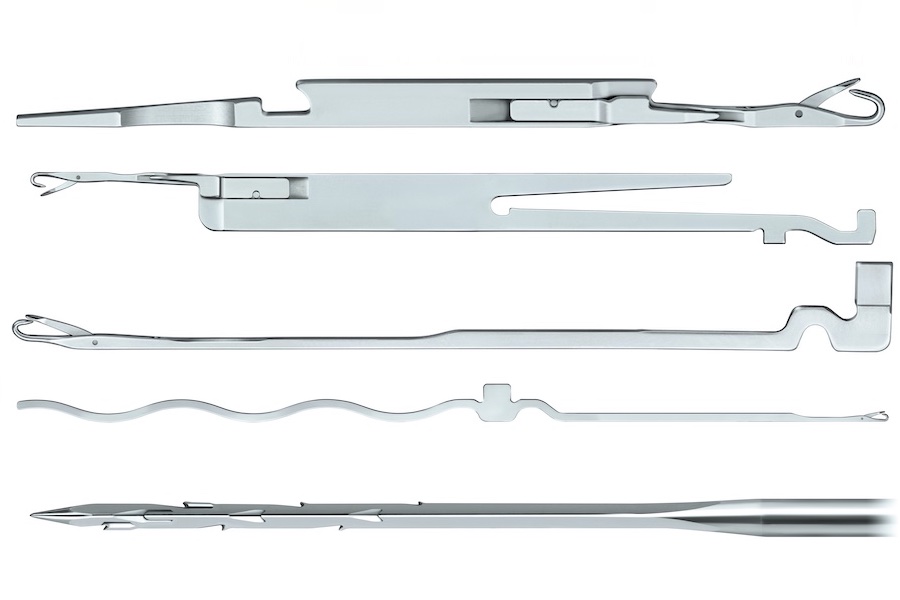
Mono wire healds from Groz-Beckert: Optimized for application and environment

© 2021 Groz-Beckert
Healds are one of the core components of the weaving process: No woven fabric can be created without them. Groz-Beckert has many different healds for a wide variety of applications in its range. Among them RONDOFIL- and Jacquard healds, which are usually made of two wires. Groz-Beckert provides them innovatively as mono wire healds made from one single wire. This offers numerous advantages for the process, end product and the environment.

From RONDOFIL to Jacquard

Both Groz-Beckert RONDOFIL healds and Groz-Beckert Jacquard healds are made from a single wire. This provides a perfect surface for even the finest warp threads. The surface quality of mono-wire healds is also advantageous for very high row densities of warp threads: High-quality fabrics produced with maximum efficiency are the result.

The mono wire healds from Groz-Beckert are also characterized by the fact that their thread eye, also known as mail eye, is not twisted-in and soldered, but glued. Compared to the use of twin wire healds, the thread surface is therefore protected even more and damages to the warp yarn due to material fatigue and corrosion are prevented. Another advantage of the glued thread eye is that no lead-containing solder must be used for fastening, which makes the healds more environmentally friendly and resource-saving.
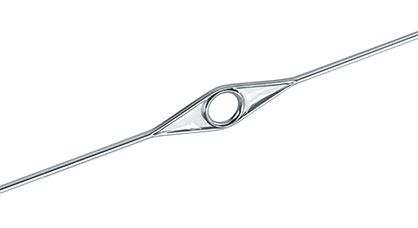
RONDOFIL mono wire healds © 2021 Groz-Beckert


The advantages of Groz-Beckert mono wire healds at a glance:

1. Surface is gentle on thread

2. Made from mono wire for high densities

3. No soldering tin used

4. Made from stainless steel

5. Suited for any yarn

6. Highest production accuracy

7. Customer-specific specifications available


REACH compliant and environmentally friendly

The avoidance of lead-containing soldering tin in the manufacture of healds offers advantages across the board. In contrast to other competitor products, the mono wire heald does not contain any lead and is therefore not harmful to health or the environment. Precautions that are required when handling SVHC lead, such as special skin protection, are therefore not necessary. This means that mono wire healds from Groz-Beckert are also REACH-compliant and thus help to meet compliance requirements with regard to the use of chemical substances.

Groz-Beckert service

Buyers of mono wire healds from Groz-Beckert who need a REACH certificate for compliance reasons can contact their Groz-Beckert representative who will be happy to prepare this for them.
More News from Groz-Beckert KG

More News on Weaving

#ITMA Asia + CITME 2026

Three stages, multiple customer benefits: KARL MAYER during ITMA ASIA 2026

At ITMA ASIA in Shanghai, KARL MAYER will once again demonstrate that it understands the challenges facing the Asian textile industry – and will present tailor-made solutions.

#Weaving

Lindauer DORNIER GmbH welcomes new apprentices and dual-study students

For 22 new “DORNIER Talents”, these days mark the beginning of a new chapter at Lindauer DORNIER. For the family-owned company, in-house training is a key pillar in developing skilled professionals and retaining them within the company for the long term.

#Weaving

"Dynamic markets do not only create uncertainty – they also create opportunities."

Volatile markets, increasingly complex materials and growing demands for flexibility are changing the weaving industry. At the same time, new opportunities are emerging in technical textiles, filtration, composites and many other specialised applications. Since taking over as Head of DORNIER's Weaving Machines Product Line at the beginning of 2026, Yvonne Schuberth has been helping to shape this development. In this interview with TexData, she explains why process stability and customer proximity remain the foundation of innovation, how digitalisation is transforming weaving mills, and why she believes the future belongs to technologically demanding applications.

#Weaving

More patterns, less effort: the MULTI-MATIC® at Rohleder

Rohleder is one of Europe’s most modern weaving mills. For over 80 years, the family-owned company has been developing and manufacturing premium fabrics for brands, retailers and private customers – 100% Made in Germany. This success is made possible by a consistent focus on design, quality, and functionality, as well as by continuous investment in state-of-the-art production facilities. Rohleder also relies on innovative technologies in warp preparation and has been collaborating with KARL MAYER for many years. As recently as 2023, a MULTI-MATIC® was delivered to the company’s headquarters in Konradsreuth.

Latest News

#Research & Development

180 years of TESTEX: From Zurich silk testing to global certification

For 180 years, TESTEX has developed alongside the textile industry while maintaining the same underlying purpose: creating trust through independent and reliable measurement. Founded in Zurich in 1846 as the Zurich Silk Conditioning Institute, TESTEX has grown from a local institution serving the silk trade into an international Swiss testing and certification institute for textiles and leather.

#Recycling / Circular Economy

Moving Advanced Recycling from Innovation to Implementation

The Advanced Recycling Conference 2026 explores technologies, markets, financing and scale-up of innovative recycling solutions for waste streams including mixed plastic waste, textiles and PVC. Europe’s chemical and materials sector faces growing pressure to close carbon loops, strengthen raw-material safety and resilience and meet increasingly ambitious EU recycling targets. Against this backdrop, the Advanced Recycling Conference (ARC) will bring together industry leaders, technology providers, researchers, innovators and policy-makers on 17–18 November 2026 in Cologne, Germany.

#Associations

German textile industry and retailers form alliance to shape textile EPR system

Germany’s textile and fashion industry and retail sector have joined forces to establish the “Alliance for Textile Circularity” (Allianz für textile Kreisläufe). Initiated by the German Textile and Fashion Industry Association (Gesamtverband textil+mode) and the German Retail Federation (HDE), the alliance aims to contribute industry expertise to the development of Germany’s future Extended Producer Responsibility (EPR) system for textiles and footwear.

#Sustainability

Cascale launches member-led process to shape 2030 strategy

Cascale has launched a member-led process to define the industry alliance’s strategic direction for the next decade. At the Cascale Annual Meeting 2026 in Athens, CEO Ying McGuire announced that members will contribute to an industry system map that will inform Cascale’s 10-year vision, its 2030 strategy and priorities for 2027. The new strategy is scheduled to be finalized in December.

TOP