[pageLogInLogOut]

#Weaving

Loepfe Brothers Ltd. launches new WeftMaster SFB
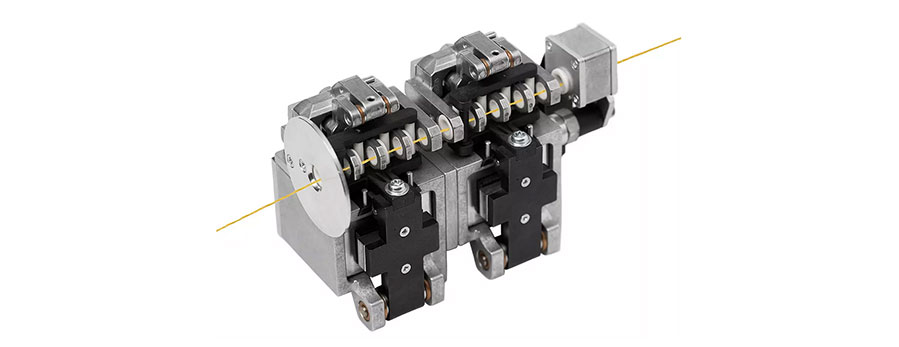
WeftMaster SFB © 2020 Leopfe
The WeftMaster® brand carries with it a long heritage of international success and reputation for Swiss engineering quality. The WeftMaster SFB weft thread brake has now been upgraded with new electronics to control up to four brakes. It is the first of several of planned launches featuring latest technology products aimed at maximizing productivity in weaving mills.

Designed for fitting to projectile and rapier looms, the WeftMaster SFB controls the tension for all yarn types, thus minimizing weft thread breaks. Braking start is optimized through precise projectile detection allowing increased loom speeds and promoting higher output. The WeftMaster SFB brakes also feature reduced yarn abrasion and higher wear resistance.

Loepfe’s Head of Products & Solutions Guido Wieland commented: “Today, it’s all about productivity and maximizing return on investment. The WeftMaster SFB helps our customers in the technical textile business to increase production while, effectively, prolonging the life of their original equipment. We know there are still many owners of mechanically-braked weaving looms out there, so would urge them to contact us – there’s never been a better time to adopt a well-proven and reliable electronically-controlled solution!”


Loepfe CEO Dr. Ralph Mennicke added: “Despite the continuing Covid-19 crisis, a few months ago we announced our intent to transform the company and bring new products to the market. While our transformation is already well-advanced, many congratulations to the whole Loepfe team for their excellent work to facilitate the launch of the new WeftMaster SFB product today. We are all very excited about this and other upcoming product launches. Our customers can soon expect more new best-in-class products to support them as economic recovery gets underway.”

More News from LOEPFE BROTHERS LTD.

More News on Weaving

Latest News

#INDEX 2026

“We clearly see that reliability, flexibility, service and total cost of ownership are becoming increasingly important again.”

The nonwovens industry continues to face a challenging market environment. Nevertheless, AUTEFA Solutions reports successful projects, new line sales and growing demand for energy-efficient and flexible solutions. In this interview, André Imhof of AUTEFA Solutions talks about competitiveness against Chinese suppliers, new service and recycling concepts, the growing importance of application development and the opportunities created by countercyclical investments.

#INDEX 2026

“Needle punching technology is more universal and sustainable than ever!”

Needle punching technology was long regarded as a rather traditional and comparatively slow technology within the nonwovens industry. In this interview, Johann Philipp Dilo explains why needle punching is more relevant than ever today – ranging from energy efficiency and resource conservation to hygiene applications, new machine concepts and design-oriented nonwoven solutions.

#Research & Development

Textile climate control system in workwear – exhibition at the 2026 SME Innovation Day!

Conventional protective workwear often reaches its limits during strenuous physical activity. In particular, the transport of sweat and excess body heat poses a problem. The German Institutes of Textile and Fiber Research (DITF) conducted research on flow-optimized, air-conducting textile structures that enable targeted climate control directly on the body. These structures can be integrated straight into protective work garments. The textile climate control system supports the body’s natural thermoregulation. This contributes to improved workplace safety and comfort.

#Nonwovens

PET spunbond from China – EDANA welcomes imposition of provisional anti-dumping measures

On 13 May 2026, after eight months of investigation, the European Commission imposed provisional anti-dumping duties of 45.6-50.0% on imports of PET spunbond from China. EDANA welcomes this expression of the Commission’s clear determination to protect EU industries from the unfair trade practices of Chinese producers.

TOP