#Textiles & Apparel / Garment
Fashionsustain: digitisation and dialogue are the key to lasting transformation in the fashion industry

The digital transformation is accelerating across the entire textile and fashion industry at an unprecedented pace. This is requiring everyone involved to adopt a more agile mindset in order to be able to adapt in disruptive environments. Holistic thinking is required – with regard to production standards, but also when it comes to the inclusion of the most diverse target groups. Fashion is a form of expression and identity. It is about political statements and a reflection of social issues.
“Even though we have certainly been noticing a sense of digital fatigue after three seasons online, there was no sign of it whatsoever during Fashionsustain,” said Thimo Schwenzfeier, Show Director of Neonyt. “Digitalisation is shaping a sustainable future and therefore also the international fashion scene; it is opening up brand-new synergies for the textile and fashion industry and extending the scope – as proven by the experts at Fashionsustain.”
State of the Industry
The framework for Fashionsustain was set on the first day of the conference: as a starting point for the discussion on the repercussions of the COVID-19 pandemic on textile and fashion production, Mariska Schennink, Sustainability Manager at Euretco Fashion, talked about the imbalance in the industry. For Andreas Bothe, Head of CSR & Sustainability from Bay City Textilhandels GmbH, it is essential to ensure transparency along the supply chain: “You have to give people, consumers, the opportunity to take a look behind the scenes – to see where and how things are produced.”
The German supply chain law, or Due Diligence Act, is one of the approaches providing transparency along the textile value chain. Standards and certifications also play a key role in that – such as the German government’s textile standard “Grüner Knopf”, or Green Button: “For the Green Button, sustainability and innovation belong together,” said Dr Gerd Müller, Germany’s Federal Minister of Economic Cooperation and Development. “Socially and ecologically manufactured products and companies that take responsibility for their own supply chain will be the norm in the future.”
In many respects, the crisis has acted as a catalyst for companies to adopt climate and sustainability measures – a bit like a dry run that has given them the chance to see how they can tackle a growing spectrum of ecological, social and governance challenges. Green financing and impact investments are effective tools in this: “There is a huge pressure to transform the entire industry, including the fashion sector, into a sustainable industry,” says Ullrich Hartmann, Partner Compliance, Risk & Regulation in Financial Services at PwC. “At the end of the day, it’s a global process and a global approach.”
One specific approach to achieve more sustainability is cradle-to-cradle. In a masterclass with representatives from the textile industry taking place at the same time as Fashionsustain, EPEA – Part of Drees & Sommer compiled a white paper outlining specific scenarios. As a best-practice example, ISKO, one of the world’s leading manufacturers of materials for the denim industry, debuted a new technology at Fashionsustain that uses a process to separate cotton and polyester blends so the recycled raw material can be used to make a variety of new products, ranging from clothing to cosmetics.
Social criteria also include company management and the inclusion of different target groups. In reference to representation in the international fashion industry, Meriem Lebdiri, Creative Director at Mizaan, said: “Diversity basically tells the story of my life.” Lydia Maurer, founder of Nana Bodywear, took this inequality as an opportunity to establish her meanwhile second label and make the world though adaptive fashion more inclusive.
Watch the recap video of the first day of the conference with statement highlights from the speakers here:
https://neonyt.messefrankfurt.com/frankfurt/en/programme-events/fashionsustain.html#recap
Innovating the Industry
There is a direct relation between digitisation and data volumes – big data that can help to understand assets like customer base or brands and optimise the customer journey. “We strive to work in an even more agile way and to standardise and automate our processes,” said Patric Spethmann, COO at Marc O’Polo. “To concentrate our energy on value-adding activities, and to develop a technology landscape that supports our strategic vision for the foreseeable future.”
A technology landscape that Sam Fields, Director of Creative Technology at RYOT International, wasn’t seeing at the beginning of the COVID-19 pandemic: “The fashion industry was in crisis and not really prepared for a fully immersive, digital age. Incorporating digital fashion in the future in a way that harnesses technologies like XR and blockchain will revolutionise the industry and ensure a greener, more sustainable future and increasing, highly profitable new sources of revenue.” Damara Inglês, Designer of Extended Reality Experiences and Virtual Fashion, and Kim Berndt, founder of 3MBASSY, both agree that the fashion industry will eventually become hybrid and that digital fashion has limitless potential. Fashion designer Esther Perbandt supported this statement with hard figures: “Digital fashion can reduce the amounts of waste compared to a physical product, can be worn a trillion times and has no expiration date. This technology can be used in almost every step of the product development, marketing and recycling.”
Technological progress is also leaving its mark on the denim industry and starts with the choice of the right fibres: “Product development has become a DNA of the denim industry,” said Michael Kininmonth, Business Development & Project Manager at Lenzing AG, in a panel by the Transformers Foundation. But there is also potential for innovations in the finishing of denim products: “There is space for improvement and adoption, especially when it comes to certain technologies like ozone and laser,” said Maurizio Morosini, Global Marketing Manager at Tonello. Ozone finishing is a bleaching process for denim that reduces environmental impact and processing costs as well as processing time.
There are many technological solutions that make transparency in textile production more efficient and visible. For Lukas Pünder, Co-Founder & CEO of Retraced, it’s all about having the right data at the right time: “The transparent communication of the value chain of a product and its impact need to become key to the consumers’ shopping experience.” And Marian von Rappard, founder of Dawn Denim, is certain that transparency alone will no longer be enough: “The next generation of consumers will be asking very different, more in-depth questions, and they will be asking for the data to back things up.”
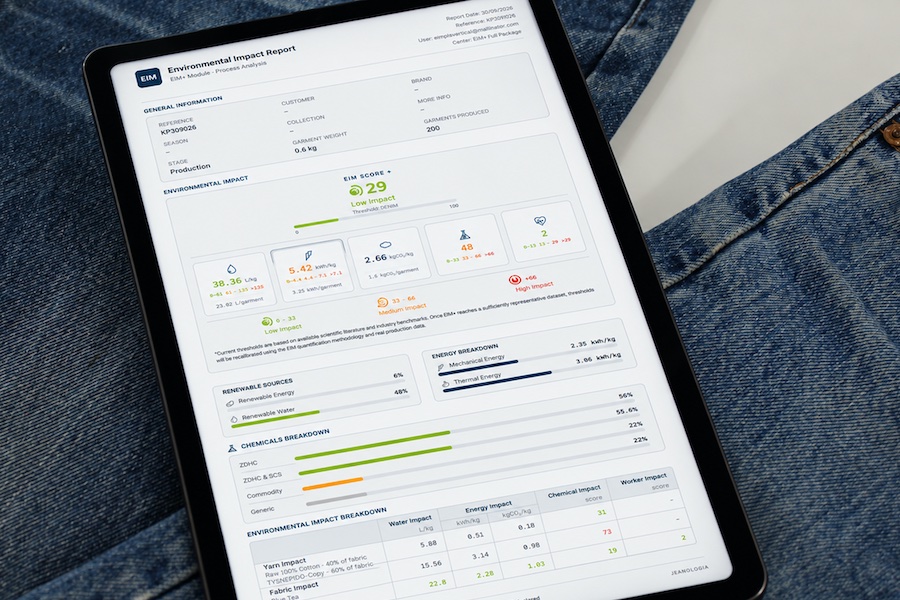
Oeko-Tex is leveraging precisely this data and, together with sustainability consultancy Quantis, has developed a tool with which companies and production facilities can digitally calculate their own water and CO2 footprints: “Companies are already collecting data for other certification purposes, so why shouldn’t they also use them to determine their water and carbon footprints?” said Angela Adams, Global Apparel Lead at Quantis. Sönke Giebeler, Head of Business Development at Oeko-Tex, added: “These days, the collection and management of data is extremely important, not only for us, but for the entire industry, for the supply chain and even for labels.”
Watch the recap video of the second day of the conference with statement highlights from the speakers here:
https://neonyt.messefrankfurt.com/frankfurt/en/programme-events/fashionsustain.html#recap
State of Retail
The retail sector has undergone a huge transformation, especially during the COVID-19 pandemic – digital offers have accelerated the change in the industry, which has had to adapt to new customer needs very quickly. It’s no longer a question of physical or digital: phygital is the solution. “More than ever, people are seeking experiences,” said Carrera Kurnik, Culture Director at Fashionsnoops. “Whether consumers or creatives, we are all looking for inspiration.”
But Oliver Feske, CEO of P4Marketing, still sees the clear advantage of stationary retail in sustainability communication: “It’s not so much about experience shopping, but more about information shopping.” And according to Axel Augustin, Spokesman & Member of the Executive Board at the German Association of the Textile Retail Trade (BTE) customers can only make a fully informed purchasing decision with the help of personal interaction and consultation in the store.
Around 300 million people worldwide work in the fashion industry and its associated industry sectors – for Tamsin Lejeune, CEO of Common Objective, this figure is both an opportunity and a challenge at the same time: “One of the biggest challenges for the fashion industry is that it’s so diverse and separated into supply, demand and sales – we need to find a way to make it easier for the community to connect on a global scale.” Bernd Hausmann, founder & CEO of Glore, sees the only possibility for sustainability and transparency in the long-term relationships with his suppliers and brands.
An alternative to the status quo of the fashion industry is circularity: pre-owned, renting, leasing, re-selling – these circular business models offer alternative options for consumers who want to mix up their existing wardrobe. They also offer additional opportunities to make fashion more sustainable. “Conventional fashion is short-lived, sustainable fashion is long-lasting,” said Jasmin Huber, the founder of WeDress Collective. Bert van Son, founder & CEO of Mud Jeans, follows the same ethos. The Dutch label offers its denim products for rent, recycling the returned jeans and turning them into new ones.
Sustainability and durability start with the design of (textile) products: “We like to talk about good design. But what is that exactly? In my point of view, good design is always sustainable and has always been sustainable,” said Lutz Diebold, CEO of the German Design Council. And for Matthias Mey, Managing Partner of Mey GmbH & Co KG, sustainability is also a matter of attitude and something that is embedded in a brand’s core values: “We don’t see sustainability as a trend, but as a tradition.”
Special cotton and denim
Transparent and differentiated information are also a central topic when it comes to cotton, the most important raw material in the denim industry. “Around 30 million people worldwide make their entire annual salary in the cotton industry,” said Dr Kreshav Kranthi, Lead Scientist of the International Cotton Advisory Committee. And there a lot of myths surrounding its cultivation: “Cotton has a bad reputation as far as its cultivation is concerned,” says Wil Jackman, Agronomy Assistant on the Sundown cotton farm in Australia. As part of a study together with cotton expert Simon Ferrigno, the Transformers Foundation is therefore currently examining statements like: “It takes 20,000 litres of water to make a T-shirt or a pair of jeans”.
You can watch the recap video of the third day of the conference with statement highlights from the speakers here:
https://neonyt.messefrankfurt.com/frankfurt/en/programme-events/fashionsustain.html#recap
From Frankfurt to the world: high international reach
Visitors from more than 60 countries around the world registered in advance for the three international conference formats taking place during Frankfurt Fashion Week. They mainly came from Germany, France, Switzerland, Russia, the USA, Spain, Belgium, Britain, the Netherlands, Italy and Brazil. But the contents of Frankfurt Fashion Week also reached visitors from Israel, South Africa, Botswana, Thailand, Tonga, Mexico, India, Oman, Finland, Lithuania, Romania, Turkey, Portugal, Australia, Greece, Malaysia, Denmark and Sweden.
As well as international fashion institutions like the British Fashion Council, Camera Nazionale della Moda Italiana, Fashion Council Germany, the Swedish Fashion Council and the Swarovski Foundation, the list of registered visitors also included numerous fashion events, including South Africa Fashion Week, Windhoek Fashion Week, Fashion Weekend Skopje and Rio Ethical Fashion. They were joined by numerous brands such as Adidas, Blutsgeschwister, Bumoka, Calzedonia, dariadéh, Drykorn, FOND of, Geox, Hugo Boss, Jil Sander, Louis Vuitton, LVMH, Marc O’Polo, Monki, Ralph Lauren, Schoeffel, Tiger of Sweden, VAUDE and Zazi Vintage. And flying the flag from the retail sector were: Avocadostore, Bikini Berlin, Delta-Sport Handelskontor, Globetrotter, Impressionen, Kauf dich Glücklich, KaDeWe, OTTO, Peter Hahn GmbH, Peek & Cloppenburg, Tchibo and Zalando.
Representing NGOs, certifications and politics, the list of visitors included EURATEX, Fashion Africa Now, Fashion for Good, Fairtrade, Femnet, Global Fashion Agenda, Good on You, Hohenstein Group, IVN e.V, OEKO-TEX, Ökotest, The Woolmark Company, US Cotton Trust Protocol, WWF and the German Foreign Office, the German Federal Ministry for Economic Cooperation and Development and the United Nations.