[pageLogInLogOut]

#Textiles & Apparel / Garment

Schoeller highlights for summer 2022: Knitted fabric collection
© 2020 Schoeller
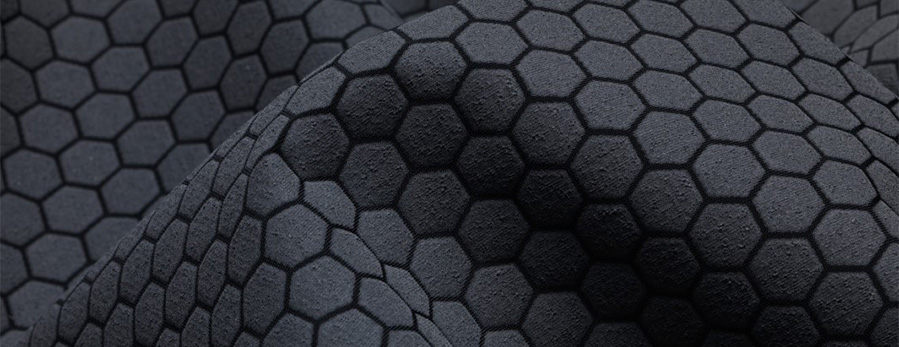
Knitted textiles from Schoeller Textil AG make a convincing impact in terms of function and unique looks. Developed in Switzerland by the leading textile company in the woven and knit fabrics categories and produced under eco-friendly conditions on high-tech machinery, the collection also features long-lasting thermal insulation and highly abrasion-resistant protection options. Additional highlights include full-surface reflective prints and new dyeable polyester knit fabrics with a distinctly positive ecobalance.

Sustainable insulation, reflective and abrasion-resistant protection and dyeable polyester

INSULATING THERMO FLASH

ThermoFlash articles from Schoeller are highly-elastic fabrics with double-face, warp-knit construction, offering optimum moisture management, as well as quick-drying properties. Nilit® Heat high-performance, environmentally-friendly yarn, utilizes a natural thermal insulation by integrating coffee charcoal (from coffee bean shells) into the nylon fiber. Sweat is distributed evenly across the interior and transported to the exterior side of the fabric. Schoeller ThermoFlash fabrics also offer protection against cold and a high level of comfort.

HIGHLY ABRASION RESISTANT PU COATING 3D

schoeller®-PUcoating 3D knitted textiles are equipped with protective foam panels, which offer a completely new technical look and a pleasant texture while also being extremely abrasion resistant. The interior guarantees reliable insulation and climate regulation. These new textiles are ideally suited as inserts in the shoulder, knee and elbow area, e.g. for mountain biking, gravel biking, commuting, as well as gloves.


FULL-SURFACE REFLECTION

The use of a special, reflective yarn in combination with a complex style of weaving or knitting ensures that schoeller®-reflex provides extensive protection in poor visibility. The same effect can also be achieved with various Schoeller knitted fabrics by using a specific reflective coating or print. When light shines on it in the dark, millions of tiny glass spheres reflect the light back toward the source (retroreflection), meaning the wearer can be seen from a distance.

DYEABLE POLYESTER KNIT FABRIC

A new dyeable warp-knitted fabric with polyester and elastane yarns is made of a modified PES which can be dyed under atmospheric conditions using conventional polyester dispersion dyes. The advantage is that no high-temperature dyeing units have to be used for dyeing. By dyeing at lower temperatures, there are significant savings in operating costs, as well as reduced CO2 emissions, resulting in a much more environmentally-friendly balance.
More News from Schoeller GmbH & CoKG

More News on Textiles & Apparel / Garment

#Recycling / Circular Economy

Arc'teryx introduces System 0™, a new framework for the future of product design and circularity

Arc'teryx Equipment, the global design company specializing in technical high-performance apparel and equipment, today introduced System 0™, a new framework that reimagines how products can be designed, manufactured, used, repaired, and ultimately regenerated. System 0 represents the next evolution for sustainability in the outdoor industry, as it embeds circular thinking across an entire product lifecycle while maintaining the uncompromising performance standards that define the Arc’teryx brand.

#Textiles & Apparel / Garment

Texworld Apparel Sourcing Paris reflects shift towards more diversified sourcing

The latest edition of Texworld Apparel Sourcing Paris confirms the global reshaping of sourcing strategies. The offer is evolving to satisfy more selective buyers, looking for responsiveness, innovation and diversification in their sourcing options.

#Textiles & Apparel / Garment

YDC 2026 names winners in Hong Kong

The Hong Kong Young Fashion Designers’ Contest 2026 (YDC) has named its winners at the conclusion of CENTRESTAGE in Hong Kong. Ten emerging local designers presented collections inspired by personal experiences and emotions, translating their ideas through distinctive tailoring, materials and craftsmanship.

#Fabrics

Texhibition Istanbul to bring together more than 500 exhibitors for 10th edition

The 10th edition of Texhibition Istanbul Fabric and Textile Accessories Fair will take place from 9 to 11 September 2026 at Istanbul Expo Center. More than 500 exhibiting companies across five halls and 42,850 square metres will present new-season collections, materials and technologies, bringing together Türkiye’s textile production strength with an increasingly international sourcing community.

Latest News

#Industry 4.0 / Digitalization

Coats Digital launches AI-powered GSD RealMotion for motion analysis

Coats Digital has launched GSD RealMotion, an AI-powered solution designed to provide apparel manufacturers with greater visibility into factory-floor operations. By analysing shop-floor video and applying Coats Digital’s GSD methodology, the solution turns video recordings into structured, motion-by-motion method studies.

#Textile chemistry

Archroma and Lameirinho partner in pioneering deployment of InOneGO single-step dyeing

Archroma, a global leader in specialty chemicals, and Lameirinho, a leading home textiles manufacturer based in Portugal, are collaborating to bring InOneGO by Archroma, a new single-step dyeing process, into commercial production. Lameirinho’s first InOneGo bedlinens collection is now available worldwide.

#Knitting & Hosiery

KARL MAYER launches extra-wide HKS 3-M EL for increased productivity

KARL MAYER has launched a new extra-wide version of its HKS 3-M EL tricot machine, designed to increase productivity particularly in the manufacture of textiles for sports, activewear and athleisure applications.

#Research & Development

Reducing development times for technical textiles by accelerated thermo-oxidative aging in a high-pressure autoclave

Synthetic polymers used in technical textiles can be effectively protected against degradation caused by heat, oxygen, and water through the use of stabilizer systems. This enables service lives of several decades, extending to more than 50 years. As the use of durable technical textiles continues to grow, so does the demand for reliable methods to predict their service life within economically feasible testing periods. For the first time the German Institutes of Textile and Fiber Research Denkendorf (DITF) developed methods for robust service life prediction for textiles in an IGF research project.

TOP