[pageLogInLogOut]

#Textile chemistry

Innovation for more sustainable textile coatings
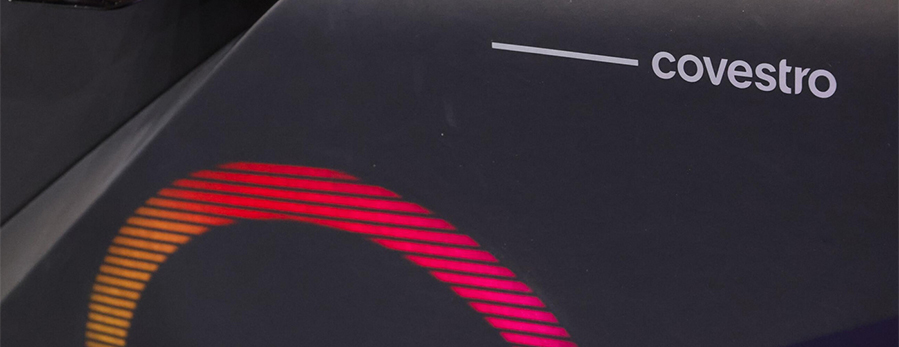
Covestro offers a new aqueous and partially bio-based PU dispersion under the name Impranil® CQ DLU, which can be used to produce, among other things, trims for car interiors. © Covestro
Climate protection requires the industry to gradually move away from petroleum and other fossil raw materials and instead use raw materials from renewable sources. That’s why Covestro is increasingly relying on alternative raw materials, including those from biomass. For example, the company offers a new aliphatic polyester carbonate polyether polyurethane (PU) dispersion for textile coating under the name Impranil® CQ DLU, in which around 34 percent of the carbon contained is of plant origin. Impranil® CQ DLU expands the existing range of partially bio-based dispersions for textile coating with a product whose purely petroleum-based variant Impranil® DLU is very popular with customers.

Since the new dispersion has the same outstanding properties as the established one, as well as a high solids content of 55 percent, customers can now replace Impranil® DLU one-to-one with Impranil® CQ DLU in their processing operations – and thereby easily achieve an additional increase in textile coating sustainability. Sustainability is increasingly becoming a key purchasing criterion not only for the industry, but also for brand owners and consumers. CQ stands for "Circular Intelligence". The core idea of the CQ concept is to label Covestro products if the alternative raw material base exceeds a content of 25 percent, as in this case.

As the raw material for INSQIN® technology, the established Impranil® DLU already enables aqueous textile coating without the use of solvents. The ecological footprint of such a coating is significantly lower than that of solvent-based systems. "With the innovation Impranil® CQ DLU as part of our Impranil® CQ portfolio, we are now enabling the textile coatings industry to take the next step towards more sustainability through the increased use of renewable resources," says Dr. Torsten Pohl, Head of Global Textile Coatings at Covestro.


Impranil® CQ DLU is suitable, among other things, for producing synthetic materials for sports articles, technical textiles, car interiors, and bags. Properties of coatings based on the new high-performance dispersion include excellent hydrolysis resistance, very good lightfastness, as well as high tensile strength and scratch resistance. In addition, the coatings have a pleasant feel and good alkali resistance. Impranil® CQ DLU can be used for both the intermediate coat and the top coat. The dispersion can be applied in various ways: The spectrum ranges from direct or transfer coating to printing processes and microfiber dipping.

Visit us at the Automotive Interiors Expo

From December 5 to 7, 2023, visitors to the Automotive Interiors Expo in Stuttgart can explore the new PU dispersion for themselves: A car interior door panel coated with Impranil® CQ DLU will be demonstrated at the Covestro exhibition stand no. 3424 in Hall 3. 


More News from Covestro AG

#Smart Textiles

Covestro, FILK Freiberg, and OUT e.V. develop flexible, conductive polymer smart textile system

As the smart textiles market continues to grow across healthcare, personal protection, sportswear, and automotive applications, developers are seeking new ways to integrate electronic functionality directly into textiles, without the rigidity and complexity of conventional wiring. To address this challenge, FILK Freiberg Institute, an independent research institution with expertise in polymer coatings for textile applications, collaborated with Optotransmitter-Umweltschutz-Technologie (OUT) e.V. The joint project, funded under the German Industrielle Gemeinschaftsforschung (IGF) program of the Bundesministerium für Wirtschaft und Energie (BMWE), focused on developing flexible, conductive polymer surfaces for next-generation smart textiles.

#Techtextil 2026

Covestro to exhibit solutions for a more sustainable and productive textile industry at Techtextil 2026

Covestro will present a broad portfolio of material innovations for textile coatings, adhesive films and thermoplastic polyurethanes (TPUs) at Techtextil 2026 (Hall 11.0, Booth C79). The exhibits will demonstrate how advanced solutions can enhance durability, recyclability and manufacturing efficiency across applications such as automotive, infrastructure, protective apparel and sportswear. A particular focus will be on more sustainable coating technologies, including antimicrobial systems based on INSQIN® in combination with AGXX from Heraeus Precious Metals, as well as the integration of Pontacol® thermoplastic adhesive films into Covestro’s offering.

#Technical Textiles

Covestro showcases monomaterial concept in autonomous SUE People Mover

UE | STUDIOS has unveiled the fully autonomous electric minibus “Self-driving Urban E-Shuttle” (SUE), placing strong emphasis on sustainable material design. Developed within a project funded by the Federal Ministry for Economic Affairs and Energy (BMWE) and the European Union, the vehicle will begin public road testing this year. At the core of the concept is the consistent use of recyclable monomaterials to improve circularity at end of life.

#Textile chemistry

Covestro and Heraeus Precious Metals collaborate to enable safer, more sustainable antimicrobial textile coatings

Laboratory tests reveal that AGXX antimicrobial surface technology from Heraeus Precious Metals is fully compatible with Impranil® PU dispersions which are part of the waterborne INSQIN® textile coating technology from Covestro, paving the way for more sustainable antimicrobial textile coatings. This discovery comes at a key moment for the textile coatings industry. As the sharing economy continues to grow, more people are coming into regular contact with high-use surfaces, creating ideal conditions for bacteria, viruses, and other microorganisms to thrive.

More News on Textile chemistry

Latest News

#Spinning

Ibrahim Fibres and Trützschler: A strong partnership enters its next phase with the TC 30Si

For more than two decades, Ibrahim Fibres and Trützschler have grown side by side, driven by a shared ambition to continuously improve spinning performance, strengthen technology leadership and set new benchmarks in the textile industry. Today, Ibrahim Fibres is a leading yarn and polyester staple fiber manufacturer in Pakistan. The company operates the largest number of Trützschler cards in the country, with more than 200 machines running across its mills in Faisalabad, and plays an important role in one of Asia’s largest textile industries.

#Digital Printing

USColorworks expands digital platform with Kornit Atlas MATRIX and Atlas MAX PLUS solutions

Kornit Digital Ltd. (NASDAQ: KRNT), a global pioneer in sustainable, on-demand digital fashion and textile production, today announced that USColorworks, a North Carolina-based apparel decoration and fulfillment company specializing in custom and on-demand printing for retail and promotional markets, has expanded its Kornit digital production platform with the addition of Atlas MATRIX and Atlas MAX PLUS systems to deliver high-quality, on-demand apparel across cotton, blended fabrics and polyester.

#Functional Fabrics

CovationBio introduces two new bio-based innovations at Functional Fabric Fair New York

Covation Biomaterials LLC (“CovationBio®”) is showcasing its two new bio-based innovations, Xatryx® and Sorona® elasterell-p fiber, at this year’s Functional Fabric Fair in New York City, July 7–9, 2026. Attendees can visit CovationBio at Booth #404 to explore this next generation of bio-based performance materials.

#Research & Development

Geotextiles made from recycled materials: GREEN leads the way into the industry

For the industry, recycled materials are creating new opportunities in geotextile production. In the GREEN project, the Fraunhofer Cluster of Excellence Circular Plastics Economy CCPE demonstrates that recycled polypro-pylene (PP), polyethylene terephthalate (PET), and high-density polyeth-ylene (HDPE) can be processed into nonwovens, fibers, and membranes that meet industrial requirements. This creates opportunities for use in existing production lines and new value chains in the geotextile market.

TOP